Amazon Store Bookkeepers: What They Do and How to Hire One

TL;DR: Amazon store bookkeepers reconcile every Amazon settlement against your bank, split it into sales, fees, refunds, ads and reserves, and value your inventory so you know what each SKU earns. Hire one who has closed Amazon books before, give them a paid test on one real settlement, and expect a monthly profit and loss within days of month end.
Table of Contents
- Why does an Amazon store need its own kind of bookkeeper?
- What Amazon store bookkeepers do in a month
- In-house, freelance or an Amazon finance team: which fits?
- How do you test an Amazon bookkeeper before hiring?
- What should you hand a new bookkeeper on day one?
- Where hiring an Amazon store bookkeeper goes wrong
- How SellerPlex handles bookkeeping for Amazon stores
- Frequently Asked Questions
- Where to start
Most sellers start looking for a bookkeeper after a bad surprise. The bank shows a healthy deposit, the tax return shows a big gross number, and nobody can say which products paid for the ads. This guide covers what the job contains each month, how to test a candidate before you hand over Seller Central access, and which hiring route fits which stage.
Why does an Amazon store need its own kind of bookkeeper?
An Amazon store needs a bookkeeper who reads settlement reports, because the money in your bank is a net figure. Amazon pays out roughly every two weeks, and each deposit has already had fees, refunds, ad spend and reserve holds taken out. As Rachel Dauchy puts it in the Woodard Report on Amazon accounting, the bank feed is not your source of truth; Amazon is.
A general bookkeeper who books each deposit as income will understate your revenue and hide your costs in the same entry. Your profit line may even look right by accident. You still lose the one thing you hired them for: knowing where the margin went.
What one deposit hides
Here is an illustrative month for a store selling $40,000 of product in a category with a 15% referral fee. Amazon publishes those referral rates on its selling fees page, and the Professional plan costs $39.99 a month on top.
| Where a $40,000 sales month goes before it reaches the bank | Amount (USD) |
|---|---|
| Gross product sales | 40000 |
| Referral fees at 15% | 6000 |
| FBA fulfillment fees | 7200 |
| Sponsored ads | 5000 |
| Refunds | 1600 |
| Reserve held back | 1400 |
| Storage fees | 600 |
| Net deposits to your bank | 18200 |
If someone books $18,200 as sales, every fee line above vanishes from your reports. The $1,400 reserve is also your money, released later, and it needs its own balance so it does not look like a loss now and a windfall next month.
What Amazon store bookkeepers do in a month
The core job is a monthly close that ties three things together: Amazon's settlement data, your bank and your inventory. Everything else sits on top of that close.
Settlement reconciliation
Each settlement gets matched to its deposit and broken into categories. Sales, referral fees, FBA fees, ads, refunds, reimbursements and reserve movement each land in their own account. A good bookkeeper books summaries per settlement and skips re-keying thousands of orders, which is the approach the Woodard piece recommends too.
Settlements rarely line up with calendar months. One that opens on the 25th and closes on the 8th has to be split, or your monthly numbers drift by whatever sold in those days.
Cost of goods and inventory
Cost of goods follows the units you sold. If you paid your supplier $10,000 in March for stock that sells through June, that cost belongs to April, May and June in proportion to sales. Your bookkeeper builds a landed cost per SKU: unit price, freight, duties and prep, divided by units received.
At month end they value what is left. That means units in Amazon's warehouses, units in transit and units at your 3PL, each at landed cost. Without it, your balance sheet has no idea you own a container of product.
Payments out
Supplier deposits, balance payments and forwarder invoices need a paper trail that matches the purchase order. This is where an Amazon store bookkeeper often overlaps with your supply chain management work, because payment timing and payment terms drive cash flow as much as sales do.
The monthly report you should receive
You should get a profit and loss by SKU or product family, a cash position and a short note on anything unusual. The note matters more than people expect. "Storage fees doubled because 400 units of the blue variant sat for 6 months" is something you can act on this week.
For a deeper look at reading those numbers, our guide to measuring true SKU-level profit walks through the report line by line.
In-house, freelance or an Amazon finance team: which fits?
The right route depends on revenue, how many SKUs you run and whether you need forecasting or only clean books. Here is how the three common routes compare on the points sellers ask about.
| Route | Who does the work | What you get | Where it breaks |
|---|---|---|---|
| In-house bookkeeper | One employee you manage | Daily availability, deep knowledge of your store | Holidays, turnover and a single point of failure |
| Freelance bookkeeper | One contractor, several clients | Lower monthly commitment | Amazon experience varies; month end competes with other clients |
| Amazon-focused finance team | A team with settlement and inventory routines | Monthly close, COGS per SKU, payments, forecasting | You share a process rather than owning a person |
Most stores under a few hundred orders a month do fine with a capable freelancer who has done Amazon books before. Once you run dozens of SKUs, pay suppliers in deposits and balances, or ship to several warehouses, a team with a fixed close routine usually costs less than the mistakes.
Our earlier piece on what good ecommerce bookkeeping services actually do covers the scope questions to ask any provider. Below is the part that article skips: how to test the person who will do the work.
Know What Every SKU Really Earns
Book a free 30-minute Blueprint Session and see how we would close your Amazon books each month.
Talk to a StrategistHow do you test an Amazon bookkeeper before hiring?
Give every finalist the same paid task on one real settlement, and judge the result against numbers you already know. An interview shows who talks well about Amazon fees; only a test shows who can tie out a deposit.
The one-settlement test
Pick a settlement from a month you understand. Export the settlement report from Seller Central and the matching bank statement line, then share both with read-only access. Ask for three things:
- The deposit split into sales, each fee type, ads, refunds, reimbursements and reserve movement.
- A tie-out showing the categories add up to the exact deposit.
- A list of anything they could not classify, with a question for each.
A strong candidate comes back with a tie-out to the cent and two or three sharp questions. A weak one returns the deposit as one income line, or a perfect-looking split that does not add up.
Questions that separate them
Ask how they treat a settlement that crosses month end. Ask where the reserve sits on the balance sheet. Ask how they would value 200 units sitting in an inbound shipment on the last day of the month. Each has a clear right answer, and vague replies tell you what you need to know.
Also ask which tools they use to pull Amazon data into your accounting software. Bookkeeper360 notes in its guide for Amazon sellers hiring a bookkeeper that manual data entry should be avoided, especially when you pay by the hour. A bookkeeper who still types settlements in by hand will bill you for it every month.
What should you hand a new bookkeeper on day one?
Hand over access and history before you expect a single report. Most delays in the first month come from missing documents.
| Records to keep for the IRS | Years |
|---|---|
| Standard income tax records | 3 |
| Income underreported by more than 25% | 6 |
| Bad debt or worthless securities claims | 7 |
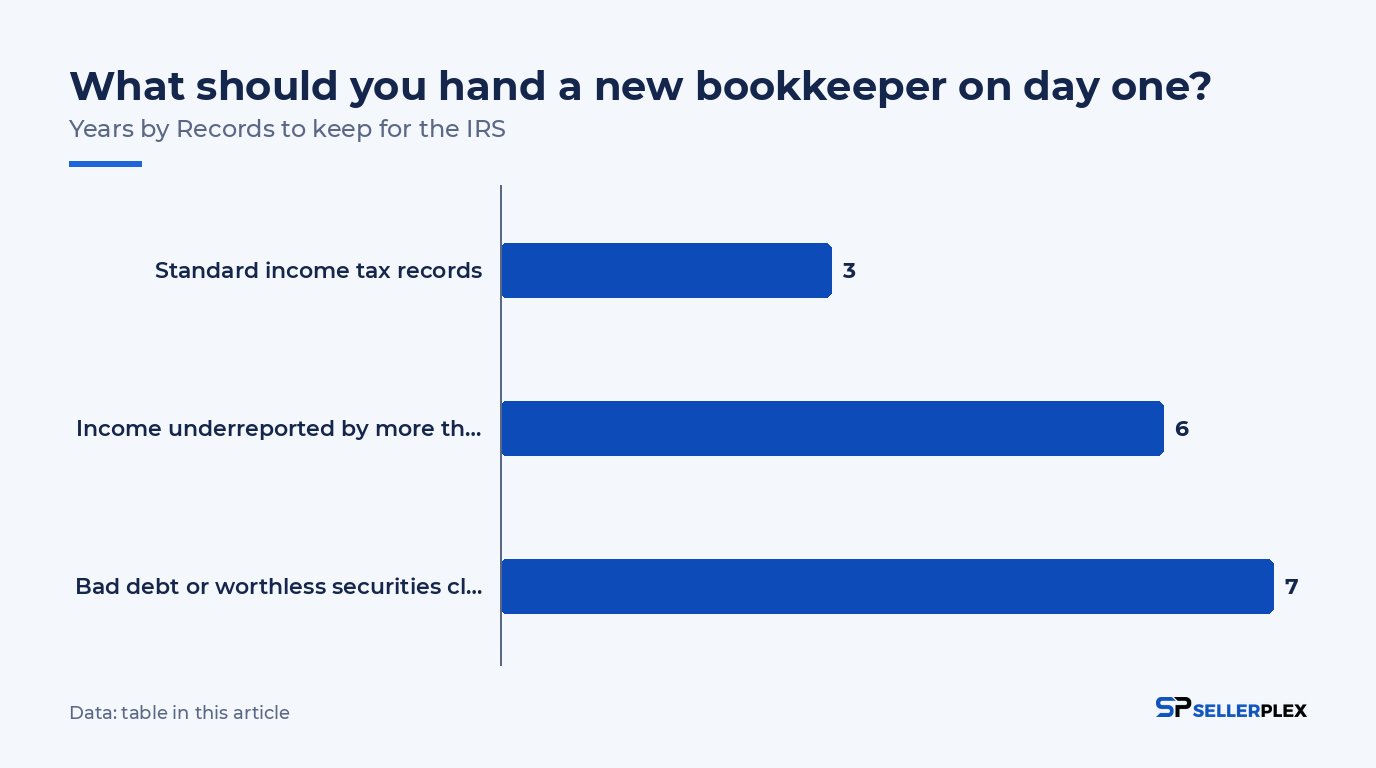
Those periods come from the IRS page on how long to keep records. For an Amazon store, keep supplier invoices, freight bills and settlement exports for at least the 3-year window, and longer if any of the other situations apply.
On day one, share these:
- A Seller Central user with reports and payments permissions only. Never share your owner login.
- Read access to the bank and card accounts that pay suppliers and receive Amazon deposits.
- Your last 12 months of supplier invoices, freight bills and purchase orders.
- Any existing COGS spreadsheet, even a rough one.
- Your CPA's name and filing deadlines.
That last point matters. Your bookkeeper produces the books; your CPA files the return from them. Our guide on what your Amazon FBA CPA needs from you explains the handover between the two.
Where hiring an Amazon store bookkeeper goes wrong
The most common failure is a hire who keeps the books tidy but never ties them to inventory. Sales and fees look right, and margin still swings 10 points month to month because cost of goods is booked when you pay the supplier.
The second is starting in March with a goal of fixing last year before the tax deadline. Catch-up work and a live monthly close compete for the same hours. Agree in writing which months get rebuilt first, and keep the current month closing on time while the old ones get fixed.
A third is giving the bookkeeper no one to ask. Settlement lines like reimbursements, coupon fees and inbound placement charges need someone who knows why they happened. Book a 30-minute call each month to go through the questions list, and the next close gets faster.
How SellerPlex handles bookkeeping for Amazon stores
SellerPlex runs bookkeeping and accounting for Amazon FBA sellers as part of its operations work. The team handles end-to-end bookkeeping, monthly profit and loss statements, cost of goods per SKU, inventory valuation at the end of each period, and supplier and forwarder payments.
Because the same company runs supply chain and account management, payment terms and inventory timing are part of the finance picture from the start. Published plans start at $500 a month for 1 sales channel and up to 3 bank or card accounts. Sellers who want their own team later can start with ours and move the work in-house when they are ready. SellerPlex holds a 5.0 rating from 25 reviews on Clutch.
Frequently Asked Questions
How much does an Amazon store bookkeeper cost?
Pricing depends on order volume, SKU count, marketplaces and whether inventory accounting is included. Freelancers often bill hourly. SellerPlex publishes its plans: $500 a month for 1 sales channel and up to 3 bank or card accounts, $700 for 2 to 3 channels and 3 to 5 accounts, and a per-SKU profit and loss from $200 more.
Can I do my own Amazon bookkeeping with software?
Yes, at low volume. Tools that sync Amazon settlements into your accounting software handle the sales and fee split well. They do not value inventory, track landed cost per SKU or chase supplier paperwork. Most sellers outgrow doing it themselves once they run more than a handful of SKUs or pay deposits to suppliers.
How often should an Amazon store close its books?
Monthly, within about ten working days of month end. Amazon settles roughly every two weeks, so each month has two or three settlements to reconcile. A monthly close lets you see storage fee spikes, refund patterns and ad costs per SKU while you can still act on them.
Does my bookkeeper need access to Seller Central?
Yes, with a limited user account. Create a separate user with permission to view reports and payments, and never share your own owner login. That access lets your bookkeeper download settlement reports directly, which is faster and more accurate than you exporting files for them each month.
Where to start
Pull your last full settlement and try to split it into sales, fees, ads, refunds and reserves yourself. If it takes more than an hour or does not tie out, that is the work to hand over. Talk to a SellerPlex strategist about closing your Amazon books each month.
Next step: Talk to a Strategist. Book a free strategy session with our Amazon and e-commerce specialists. No obligations, just actionable insights.