DSP Meaning Amazon Sellers Need: Ads or Delivery?
TL;DR: DSP meaning Amazon sellers usually need is Demand-Side Platform: Amazon’s tool for buying display, video and audio ads on Amazon, Prime Video, Twitch and thousands of outside sites. The same three letters also stand for Delivery Service Partner, the local companies that deliver Amazon parcels. If you sell on Amazon and someone pitches you DSP, they mean advertising. Amazon’s managed service typically starts at $50,000 in spend.
Table of Contents
- What is the DSP meaning Amazon sellers should care about?
- The other DSP: Amazon’s Delivery Service Partners
- How does Amazon DSP work for a brand?
- How much does Amazon DSP cost?
- What ROAS does Amazon DSP deliver?
- When is a brand ready for Amazon DSP?
- Where DSP budgets go wrong
- Where to start
- Frequently Asked Questions
Search “DSP” next to Amazon and the results mix two worlds. Half the pages talk about vans, routes and driver jobs. The other half talk about programmatic ads and audience targeting. Both are real Amazon programs, and they have nothing to do with each other.
This page sorts out which one you are looking at, then goes deep on the one that matters to a brand: what Amazon DSP does, what it costs, what return published campaigns report, and when it is worth your budget.
What is the DSP meaning Amazon sellers should care about?
For a seller or brand owner, DSP means Demand-Side Platform. Amazon Ads defines a demand-side platform as technology that lets advertisers buy digital ad placements automatically, across websites, apps and streaming services, in real time. You pick the audience, the platform bids for the ad slot in milliseconds.
Amazon’s own DSP guide explains the buying side clearly. When a shopper loads a page, the publisher’s ad server announces an open slot. The DSP checks whether that shopper fits your audience and bids before the page finishes loading.
What makes Amazon’s version different from other DSPs is the data behind the targeting. You can reach people based on what they browsed, bought and streamed on Amazon. A shopper who viewed your detail page last week and left without buying can see your ad on a news site today.
Which DSP is someone talking about?
The context usually tells you within one sentence. Use this as a quick check:
| Question | Demand-Side Platform | Delivery Service Partner |
|---|---|---|
| Who uses it | Brands and advertisers | Independent delivery companies |
| What it does | Buys display, video and audio ads | Delivers Amazon parcels on local routes |
| Where you meet it | Amazon Ads console, agency pitches | Job ads, logistics.amazon.com |
| Relevant to your Amazon sales | Yes | No |
If the conversation involves ROAS, audiences or creative, it is the ad platform. If it involves vans, routes or drivers, it is delivery.
The other DSP: Amazon’s Delivery Service Partners
A Delivery Service Partner is a small independent company that delivers Amazon packages under contract. Amazon launched the program in 2018. The owners hire their own drivers and run their own routes with Amazon’s routing technology.
The program is large. In its Delivery Service Partner program update, Amazon reports 4,400 entrepreneurs, 390,000 driving jobs and more than 20 million packages delivered every day across 19 countries.
For a seller, this DSP only shows up as the company that carries your FBA orders on the last mile. You do not choose your delivery partner and you cannot advertise through one. The rest of this page is about the ad platform.
How does Amazon DSP work for a brand?
Amazon DSP buys ad impressions for you, aimed at audiences built from Amazon’s shopping, browsing and streaming signals. You pay for impressions served, and you judge results on detail page views, new-to-brand customers and sales.
Where the ads appear
According to the Amazon DSP product page, the inventory covers Amazon.com, Prime Video, Twitch, Fire TV and Thursday Night Football. It also reaches thousands of third-party sites and apps. Formats include display, video, audio and streaming TV.
Who you can target
The useful audiences for a seller fall into a few groups. Shoppers who viewed your product and did not buy. Shoppers browsing your category or a competitor’s listing. Past customers who are due to reorder. Lookalikes of your best buyers.
Sponsored Products waits for someone to type a search. DSP reaches the shopper before that search, or after they leave your listing.
The new name: Amazon Ads Agent
Amazon has folded DSP into a single platform. Its product page now says Amazon DSP has become part of Amazon Ads Agent, where programmatic campaigns run as Display, Video and Audio campaigns (DVA+) with advanced settings. Existing campaigns, audiences and certifications carry over unchanged.
For you, the meaning of DSP stays the same. Agencies and Amazon reps will keep saying “DSP” for a long time, so expect both names in the same meeting.
How much does Amazon DSP cost?
Amazon DSP runs on two models, and the gap between them is large. Amazon’s guide says the self-service route carries no management fees because you run the campaigns yourself. Its managed service, where Amazon’s team runs them, typically requires a minimum spend of $50,000, which may vary by country.
Sponsored ads work differently. Amazon states they stay cost-per-click with no minimum spend. That is why almost every brand starts with Sponsored Products and adds DSP later.
Self-service access sounds cheaper, but someone still has to build audiences, produce creative and read attribution. That work is the real cost. Brands without an in-house media buyer usually hand it to an agency that runs DSP for them.
Our breakdown of Amazon DSP vs Sponsored Ads walks through how the two budgets fit together.
What ROAS does Amazon DSP deliver?
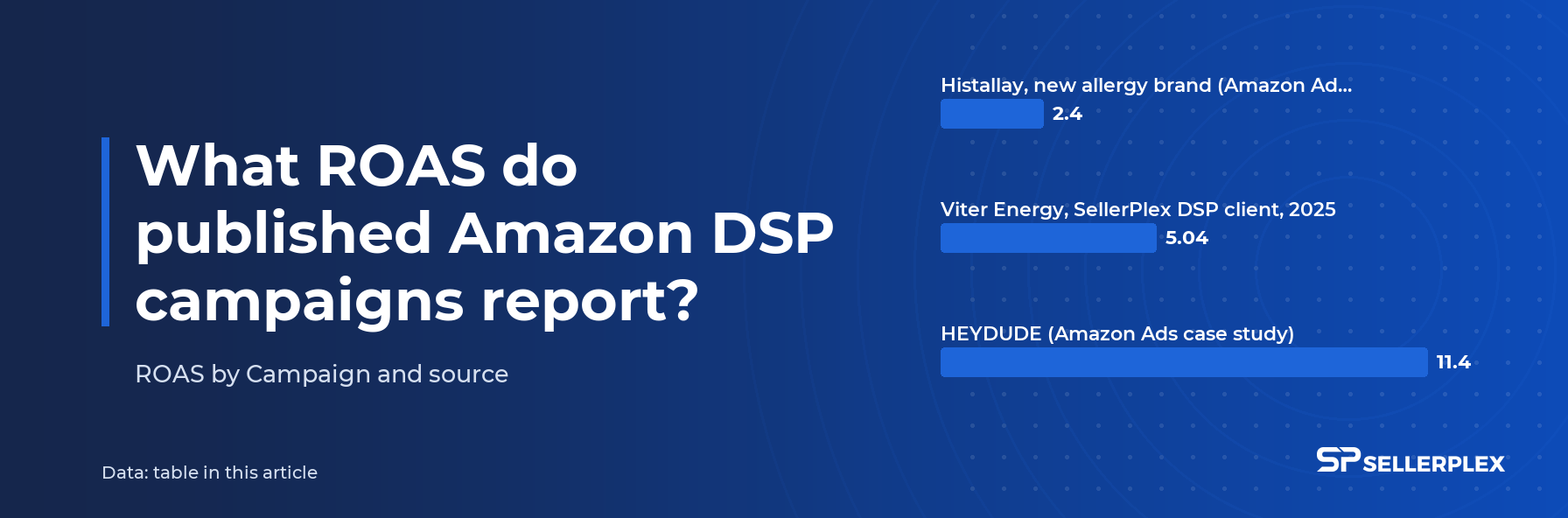
Published Amazon DSP campaigns report return on ad spend anywhere from about 2x to above 11x. The spread depends on the goal: retargeting and owned-site traffic score high, while a new brand buying awareness scores lower.
What ROAS do published Amazon DSP campaigns report?
| Campaign and source | What the campaign did | ROAS |
|---|---|---|
| Histallay, new allergy brand (Amazon Ads case study) | Launched into a crowded category, reached 500,000 unique users | 2.4 |
| Viter Energy, SellerPlex DSP client, 2025 | Full-funnel DSP with 43M impressions | 5.04 |
| HEYDUDE (Amazon Ads case study) | Sent Amazon shoppers to its own site, 47% of conversions new-to-brand | 11.4 |
Read these numbers with care. DSP attribution counts a sale when a shopper saw or clicked the ad within a lookback window, according to Amazon’s guide. Sponsored Products ROAS is mostly click-based, so the two figures are not directly comparable.
For context, our search campaigns average 6.25x ROAS across managed accounts. Those come from shoppers who already typed a search. DSP pays off differently: it fills the top of the funnel that search later converts. Our Amazon PPC benchmarks show what healthy search numbers look like before you add that layer.
Find Out Whether Your Account Is Ready for DSP
A SellerPlex strategist reviews your search performance and tells you if DSP will add sales or just add spend.
When is a brand ready for Amazon DSP?
A brand is ready for DSP once its search campaigns already run at a profit and its listings convert. DSP sends more people to the detail page. If that page loses them today, DSP loses them at a higher price.
Four checks tell you whether DSP will add sales:
- Search is profitable. Sponsored Products and Sponsored Brands hit their target ACOS on the hero ASINs for at least a few months.
- The listing converts. Images, A+ Content and reviews hold up against the top three competitors in the category.
- Stock can absorb more demand. A retargeting campaign that drives sales into a stockout wastes the budget and hurts rank.
- There is a clear job for DSP. Retargeting detail page visitors, defending branded search, or launching a new product. One objective per campaign.
This is why our Amazon DSP management runs alongside Amazon PPC management from the same playbook. We will not push DSP before your account is ready for it.
Where DSP budgets go wrong
The most common mistake is running DSP as a second search campaign. Brands point it at broad in-market audiences, judge it on last-click ROAS after two weeks, and cut it. Prospecting needs weeks of reach and frequency data before the sales show up.
The second mistake is the opposite: celebrating a high ROAS that is mostly retargeting people who would have bought anyway. Watch the new-to-brand share in your reports. Amazon’s DSP reporting includes new-to-brand metrics, reach and frequency, so you can see whether you are finding new customers or paying again for old ones.
Creative is the third gap. A static product image on a white background is fine for retargeting. It does little on Prime Video or a recipe site where nobody knows your brand yet. Budget for video and lifestyle creative before you buy upper-funnel audiences.
For a fuller walkthrough of audience setup and campaign structure, read our Amazon DSP advertising guide.
Where to start
Pull your last 90 days of Sponsored Products data for your top three ASINs. If ACOS sits at target and conversion rate holds steady, retargeting detail page visitors is the cheapest first DSP campaign. If ACOS is above target, fix search first.
If you want a second opinion on which step comes first for your brand, talk to a SellerPlex strategist about your account.
Frequently Asked Questions
What does DSP stand for at Amazon?
DSP stands for two things at Amazon. In advertising it means Demand-Side Platform, the tool brands use to buy display, video and audio ads with Amazon’s audience data. In logistics it means Delivery Service Partner, the independent companies that deliver Amazon parcels. For sellers and brands, DSP almost always means the ad platform.
Is Amazon DSP the same as Sponsored Products?
No. Sponsored Products are cost-per-click ads shown in Amazon search results and on product pages, with no minimum spend. Amazon DSP buys impressions across Amazon, Prime Video, Twitch and outside sites, targeting audiences instead of keywords. Most brands run Sponsored Products first and add DSP once search campaigns are profitable and listings convert well.
Do I need to sell on Amazon to use Amazon DSP?
No. Amazon states that DSP is available to advertisers whether or not they sell products on Amazon. Brands can send DSP traffic to their own website, as HEYDUDE did in an Amazon Ads case study. Sellers get extra value because they can retarget shoppers who viewed their listings and measure the sales on Amazon.
What is the minimum budget for Amazon DSP?
Amazon’s managed service typically requires a minimum spend of $50,000, according to its DSP guide, and the figure may vary by country. Self-service access has no management fee, but you need someone who can build audiences and creative. Without that skill in-house, an agency can run the campaigns for you.
Next step: Talk to a Strategist. Book a free strategy session with our Amazon and e-commerce specialists. No obligations, just actionable insights.