Amazon Marketing Agency: What It Covers and What It Costs
TL;DR: Amazon agency cost usually lands between a $1,500 and $15,000 flat monthly retainer or 10% to 20% of your ad spend, depending on scope. SellerPlex starts at $2,500 a month plus 5% of sales above your baseline. That fee pays back most clearly from about $6,500 a month in ads, the median across 38 accounts we manage.
Table of Contents
- What does an Amazon marketing agency actually do?
- Why the listing comes before the ad budget
- How much does an Amazon marketing agency cost?
- Amazon agency cost compared: how much do brand management agencies charge?
- Is an Amazon brand management agency worth it at $500k in monthly sales?
- What should change in the first 90 days?
- Where a marketing agency stops
- How do you vet an Amazon marketing agency?
- Where to start
- Frequently Asked Questions
Most brands that search for a marketing agency on Amazon already sell there. Sales grew for a while, then flattened. Ads got more expensive, the listing has not changed in a year and nobody owns the gap between the two. This page explains what the work should cover, what it costs relative to your ad budget and your sales, and how to tell in the first quarter whether an agency is earning its fee.
What does an Amazon marketing agency actually do?
An Amazon marketing agency manages the paid and organic work that drives traffic and conversion on Amazon. In practice that means sponsored ads, keyword research for your listings, the copy and images on your detail page, A+ Content and the Brand Store.
The label is loose. Perpetua's guide to Amazon marketing agencies splits the market into four types, from general ecommerce agencies down to ad-only specialists. It places marketing agencies in the middle: PPC management, detail page content and Amazon SEO, without the inventory and operations work a full-service agency takes on.
That middle position is where most confusion starts. Here is how the four types compare on what they actually run:
| Agency type | Runs your ads | Builds listing content | Handles inventory and account health |
|---|---|---|---|
| Ecommerce agency (several marketplaces) | Often, spread across channels | Sometimes | Rarely |
| Amazon ad agency | Yes, its core work | No | No |
| Amazon marketing agency | Yes | Yes | No |
| Full-service Amazon agency | Yes | Yes | Yes |
If your problem is purely ad efficiency, an ad specialist may be enough. We cover that case in our piece on what an Amazon ad agency runs. When conversion is weak or the catalogue keeps changing, you need someone who owns the listing as well. Our overview of Amazon marketing agencies compares named firms on exactly that split.
Why the listing comes before the ad budget
A detail page that converts poorly makes every click more expensive. Ads buy the visit, and the listing decides whether that visit turns into an order.
Across the 38 US accounts in our Amazon PPC benchmarks from managed accounts, the median ad conversion rate was 8.3%, with the middle half between 5.4% and 11.1%. A brand at 5.4% pays for roughly half again as many clicks per order as one at 8.3%. No bid strategy closes that gap. Better images, clearer bullets and A+ Content can.
This is why a marketing agency worth hiring starts with the page. Our Amazon listing and A+ Content team is a 10-person group of copywriters and designers, and a full listing rebuild takes two to three weeks with up to three review rounds. Ads can be restructured in parallel, but spend should rise only once the new page is live.
Amazon makes the order easy to follow. Its own guide to Amazon Ads recommends starting with sponsored ads when you are new to advertising, and lists Brand Stores as free, multi-page brand destinations. A Store costs nothing to build but needs content to fill it, which is listing work again.
What a listing fix looks like in practice
A typical first pass covers the main image, the title and the first two bullets, since those carry the click and the first impression. Keyword gaps come from the search term report: queries that already convert in ads but never appear in the copy. A+ Content and the Store follow once the core page is solid.
How much does an Amazon marketing agency cost?
An Amazon marketing agency costs a flat retainer, a share of ad spend, a share of revenue or a mix of a base fee and a smaller share. SellerPlex publishes its own model on its homepage: full-service management from $2,500 a month plus 5% of the sales above your baseline, scoped on a free strategy call first.
Amazon itself sets a low floor. Its guide says sponsored ads have no minimum spend and campaigns can start from $10, charged per click. The base fee is the cost that does not scale down with your budget, so it matters most for smaller accounts.
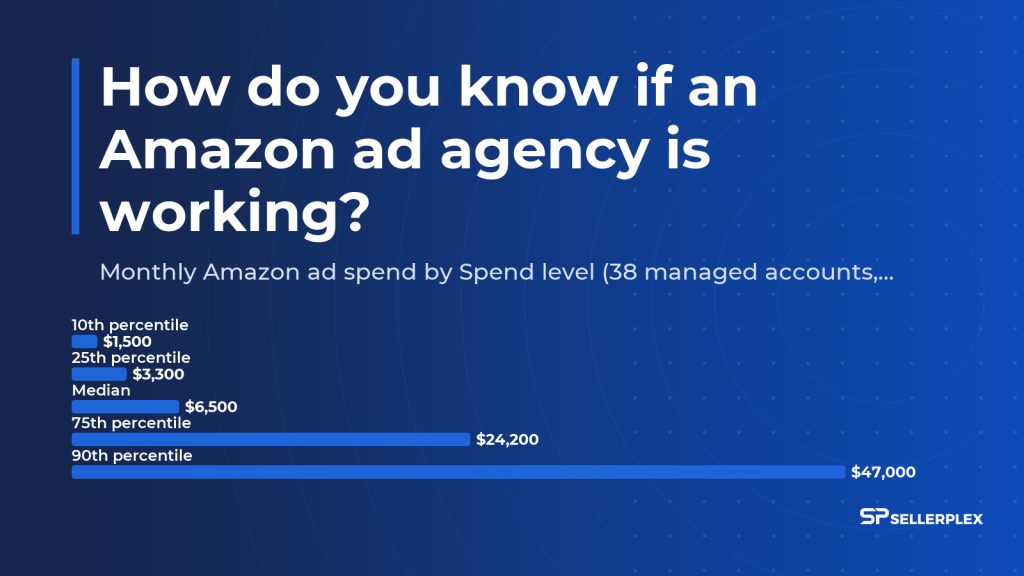
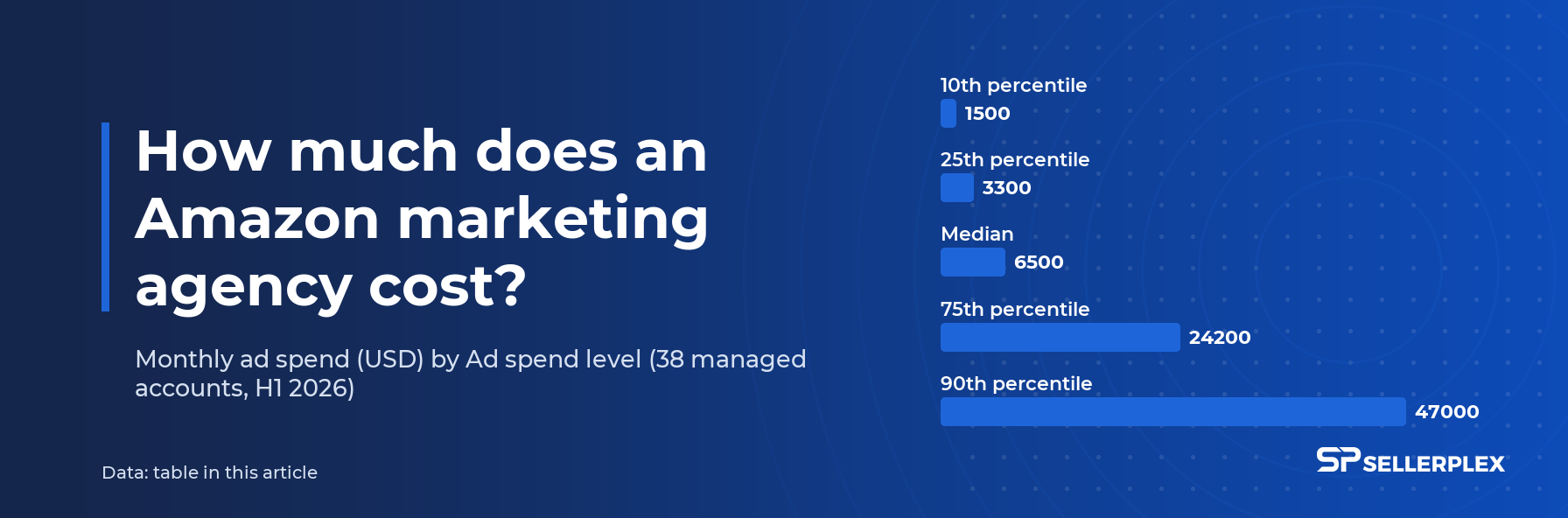
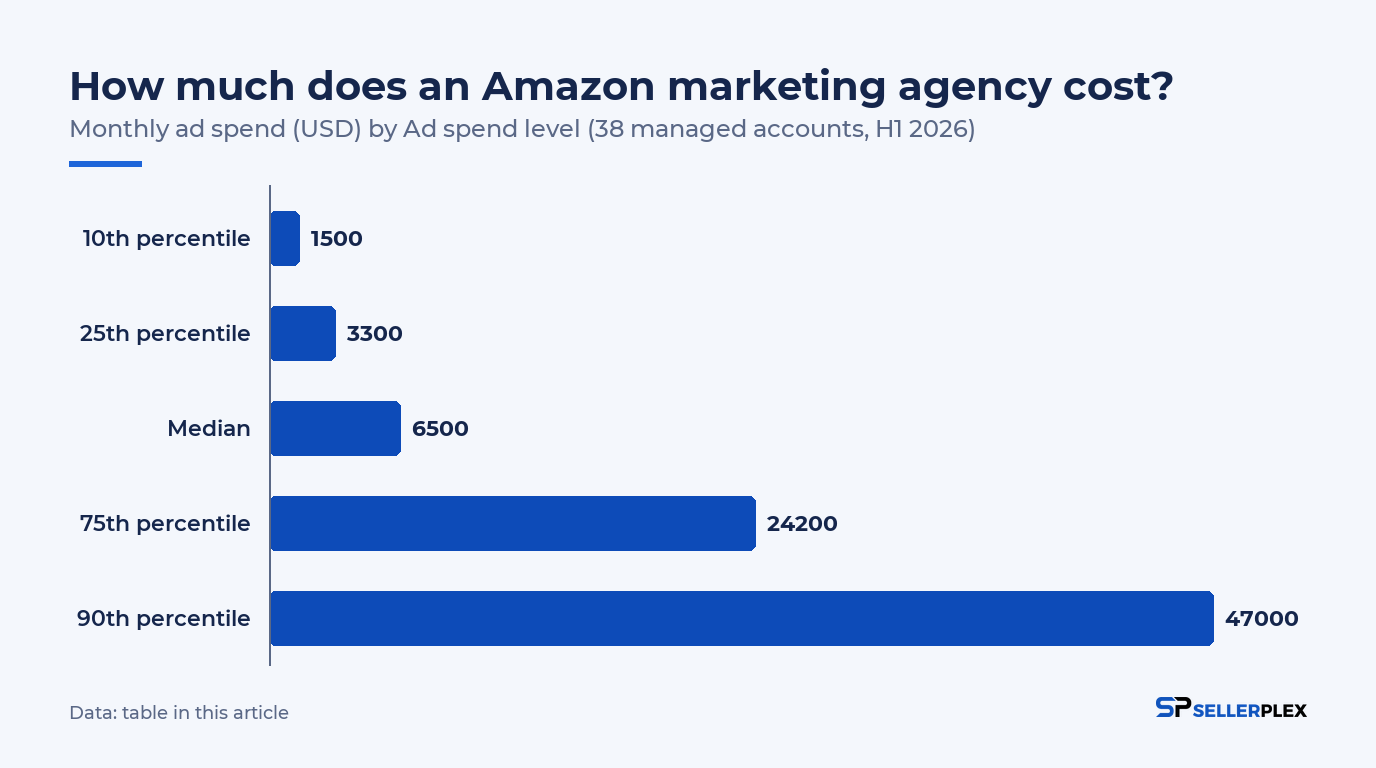
To make that concrete, here is a $2,500 monthly base fee set against the real monthly ad spend of the 38 accounts in our benchmark set:
| Ad spend level (38 managed accounts, H1 2026) | Monthly ad spend (USD) | $2,500 fee as % of ad spend |
|---|---|---|
| 10th percentile | 1500 | 167 |
| 25th percentile | 3300 | 76 |
| Median | 6500 | 38 |
| 75th percentile | 24200 | 10 |
| 90th percentile | 47000 | 5 |
At $1,500 a month in ads, the fee is larger than the budget it manages. At the median of $6,500, it equals 38% of spend, which is workable when the agency also owns your listings and content. Above $24,000, the fee becomes a small line next to the money it steers.
These are our own accounts, so treat them as one reference point. Ask every agency you speak to for the fee at your current spend and at double it, and whether listing content is included or billed per project.
Amazon agency cost compared: how much do brand management agencies charge?
Amazon brand management agencies charge in one of four ways, and the model changes your bill more than the headline number. SupplyKick's Amazon agency pricing breakdown puts flat retainers between $1,500 and $25,000+ a month, ad spend fees at 10% to 20%, and revenue fees at 3% to 10%.
| Pricing model | Typical range (USD) | What drives your bill |
|---|---|---|
| Flat monthly retainer | $1,500 to $25,000+ a month | Scope and catalogue size |
| Percentage of ad spend | 10% to 20% of ad spend | How much you spend on ads |
| Percentage of revenue | 3% to 10% of Amazon sales | Total sales, ads and organic |
| Hybrid (base fee plus share) | Lower base plus a share of growth | Sales above an agreed baseline |
Each model rewards a different behaviour. FiveX's analysis of marketplace advertising fee structures points out that a 12% ad spend fee turns every 1,000 in media into 1,120 of real cost, so a campaign at 25% ACOS behaves like 28% once the fee is loaded in. An agency paid on spend earns more when you spend more, whether or not that spend is profitable.
A full-service Amazon agency cost sits at the upper end of these ranges because it covers more work. SupplyKick's tiers put full-service management, including supply chain support, at $7,500 to $15,000 a month for brands doing $2 million to $10 million a year. Ad-only management sits lower because nobody owns listings, inventory or account health.
That is the trade we built our own pricing around. A $2,500 base plus 5% of growth means the fee rises only when sales rise above the level you already had. If you are comparing quotes from a full-service amazon agency against an ad specialist, put both on the same page: monthly fee at today's sales, fee at 20% more sales, and which work is excluded.
Is an Amazon brand management agency worth it at $500k in monthly sales?
At $500k in monthly sales, an Amazon brand management agency is usually worth it if the fee stays near 1% to 3% of revenue and it owns more than ads. At that size the question is which pricing model you pay under, since the gap between models runs into tens of thousands a month.
Here is a worked example for a brand doing $500,000 a month, using the 15% median TACOS from our benchmark set. That puts ad spend at about $75,000 a month. The ranges come from the SupplyKick figures above; the SellerPlex line assumes sales grow 10% above a $500,000 baseline.
| Model at $500k monthly sales | Monthly fee (USD) | Fee as % of sales |
|---|---|---|
| 10% of $75,000 ad spend | 7500 | 1.5 |
| 20% of $75,000 ad spend | 15000 | 3 |
| 3% of revenue | 15000 | 3 |
| 10% of revenue | 50000 | 10 |
| SellerPlex: $2,500 plus 5% of $50,000 growth | 5000 | 0.9 |
The revenue models get expensive fastest at this size, because the agency is paid on sales it did not create. A flat retainer or a base plus a growth share keeps the fee tied to the work. Whatever model you choose, the agency at this size should be running listings, inventory and account health as well as ads. A stockout on a hero product costs more in a week than most monthly fees.
What should change in the first 90 days?
The first 90 days should produce a rebuilt detail page, a restructured ad account and a falling share of sales that depends on ads. Revenue jumps in week two are rarely real; they usually come from spending more.
Month one is audit and rebuild. You should receive a written plan covering the listing, the ad structure and any account health issues before anything changes. Month two is when the new content goes live and ad bids start to follow product margin. Month three is the first fair read on results.
The number to watch is TACOS, ad spend divided by total sales. The median in our benchmark set was 15%, with the middle half between 10% and 21%. Ads drove a median 41% of total sales in those accounts. If that share stays flat while spend rises, the agency is buying sales instead of building organic rank.
Amazon's guide quotes a similar figure from its own side: 36% of sales for US small businesses are driven by Amazon Ads. A brand far above that range usually leans on ads to cover a listing that does not convert on its own.
Find Out What Is Holding Your Listings Back
A senior strategist reviews your ads, listings and account on a free 30 minute call and gives you a prioritized fix list.
Talk to a StrategistWhere a marketing agency stops
A marketing agency works on demand. It does not order stock, file reimbursement claims or fix a suspended listing, and those gaps can undo good marketing within days.
Running out of stock on a hero product is the clearest case. Ads pause, organic rank slips and the agency's report shows a drop it could not prevent. If inventory and account health keep interrupting your growth, a full-service Amazon agency that runs supply chain alongside ads and content will get further than a marketing team working around the problem.
SellerPlex is built that way: 80+ specialists across ads, content, supply chain and account management, working with 100+ brands since 2018. For brands that only need the page fixed, our guide on how DTC brands should choose a listing optimization agency covers that narrower hire.
How do you vet an Amazon marketing agency?
Ask for evidence from live work before you look at a pitch deck. Three requests separate operators from resellers.
Request a before and after of a detail page they rebuilt, with the conversion rate change over the following 60 days. Ask to see a recent search term report with the negative keywords they added. Finally, ask which person on their team writes your listing copy and which person changes your bids.
Amazon also gives you an outside check. Its partner status program awards Ads Partner Network members a verified or advanced tier based on data Amazon holds, and you can look agencies up in its partner directory. A badge proves activity with Amazon Ads. It says nothing about listing content, so you still need the page samples.
Third-party reviews help too. If you are checking SellerPlex itself, our homepage links to a 5.0 rating from 25 reviews on Clutch, where clients describe the work in their own words.
You should keep ownership of every account. A trustworthy agency works inside your Seller Central and advertising accounts through user permissions you grant and can remove.
Where to start
Pull three numbers from the last six months before you call anyone: monthly ad spend, total sales and the ad conversion rate on your top product. Compare them with the 15% median TACOS and 8.3% conversion rate above.
High TACOS with a low conversion rate points to the listing. High TACOS with normal conversion points to the ad structure. If you want a strategist to run that comparison with you and tell you which one to fix first, book a free Amazon business audit with SellerPlex.
Frequently Asked Questions
How much does an Amazon agency cost per month?
Most Amazon agencies charge between $1,500 and $15,000 a month, or 10% to 20% of ad spend, according to SupplyKick's 2026 pricing breakdown. Ad-only management sits at the low end and full-service work at the high end. SellerPlex starts at $2,500 a month plus 5% of sales above your baseline.
What is the difference between an Amazon marketing agency and an ad agency?
An ad agency manages your sponsored ads and reports on spend. A marketing agency also owns the detail page: keyword research, copy, images, A+ Content and the Brand Store. If your conversion rate is below the 5.4% to 11.1% range we see in managed accounts, you need the broader scope.
Is an Amazon marketing agency worth it for a small brand?
It depends on ad spend more than revenue. At $1,500 a month in ads, a $2,500 fee costs more than the budget it manages, so learning the console yourself is often smarter. Around $6,500 a month, the median in our accounts, a fee that also covers listing work starts to pay back.
How long before an Amazon marketing agency shows results?
Expect the first month to be audit and rebuild, with new listings live in weeks two to four. A listing rebuild at SellerPlex takes two to three weeks. Judge results on TACOS and total sales after a full quarter, because single months move with seasonality, promotions and restructuring work.
Will I keep control of my Amazon accounts?
Yes, and you should insist on it. A good agency works inside your own Seller Central and advertising accounts through user permissions you grant and can remove at any time. Your listings, campaign history and audiences stay with your brand if you change partners later, so nothing needs rebuilding.
Next step: Talk to a Strategist. Book a free strategy session with our Amazon and e-commerce specialists. No obligations, just actionable insights.