Amazon FBA CPA: What Your Seller Accountant Needs From You
TL;DR: Amazon FBA CPA work covers your tax return, entity setup and tax planning, but a CPA can only work with the books you hand over. Amazon reports your gross sales on a 1099-K, before fees, refunds, ads and inventory. Get clean monthly books with cost of goods per SKU and a year-end inventory count first. Then hire a CPA who already files for marketplace sellers.
Table of Contents
- What does an Amazon FBA CPA actually do?
- Why does your 1099-K look so much bigger than your profit?
- What your CPA needs from your books each month
- Bookkeeper or CPA: who does which job?
- What should you ask before hiring an Amazon seller CPA?
- Where an FBA tax year usually goes wrong
- Where to start
- Frequently Asked Questions
Most sellers start looking for an Amazon FBA CPA in February, when the 1099-K arrives and the number on it looks nothing like the money in the bank. That gap is the whole story of FBA accounting. The CPA's job is to turn gross marketplace payouts into taxable profit you can defend. Whether that takes two hours or two weeks depends almost entirely on what you give them.
SellerPlex runs bookkeeping for Amazon FBA brands, so our work ends where the CPA's begins. This page covers what that handover should contain, where it usually breaks, and what to ask before you hire someone to sign your return.
What does an Amazon FBA CPA actually do?
An Amazon FBA CPA prepares and signs your business tax return, advises on entity and tax elections, and plans for sales tax and income tax exposure across the states you sell into. A good one also tells you what to change during the year so the next return costs less.
What a CPA usually does not do is your monthly bookkeeping. Categorizing settlement reports, matching payouts to your bank, and tracking landed cost per unit is bookkeeping work. Some CPA firms offer both, and some bill it at their advisory rate. Others expect you to arrive with a closed general ledger and will bill extra hours when you do not.
That split matters for budgeting. With clean books, your CPA bill pays for judgment. Messy books turn the same bill into data entry at CPA rates.
Why does your 1099-K look so much bigger than your profit?
Your 1099-K shows gross payments Amazon processed for you, so it starts from total sales and ignores every fee and cost. According to the IRS guide to Form 1099-K, marketplaces must issue the form once your payments for goods exceed $20,000 across more than 200 transactions, and they may send one below that.
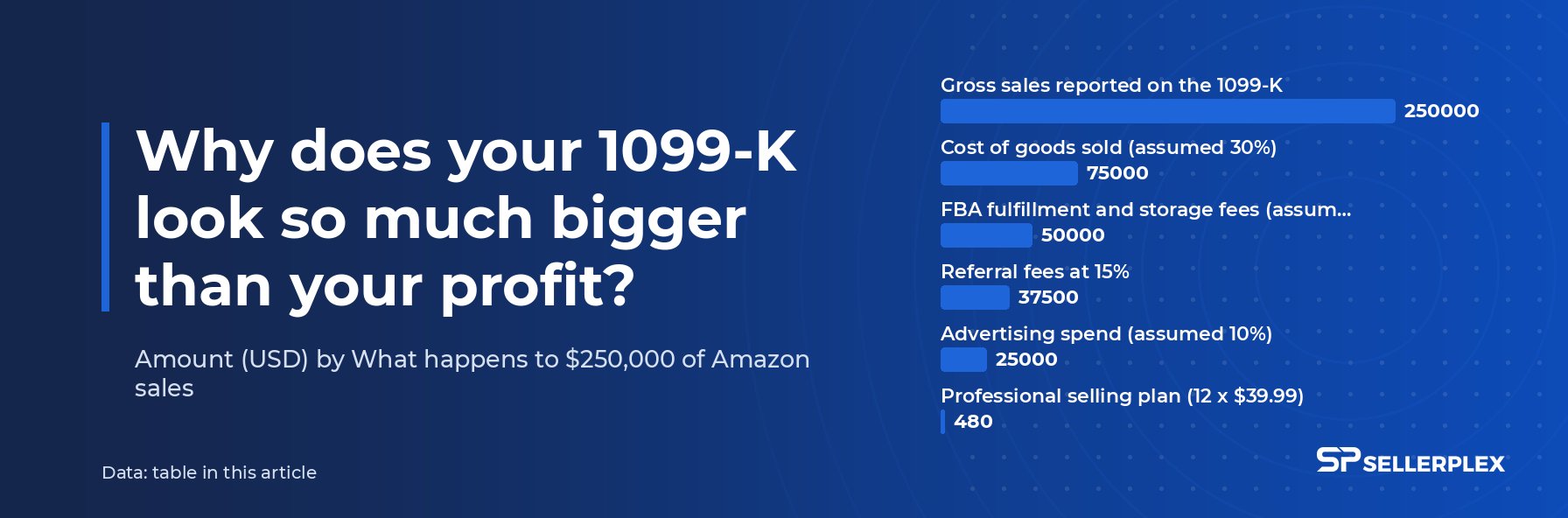
Here is an illustrative seller with $250,000 in gross sales. The referral fee and selling plan come from Amazon's published selling fees: 15% in many categories and $39.99 a month for the Professional plan. The other percentages are assumptions to show the shape of the math.
| What happens to $250,000 of Amazon sales | Amount (USD) |
|---|---|
| Gross sales reported on the 1099-K | 250000 |
| Cost of goods sold (assumed 30%) | 75000 |
| FBA fulfillment and storage fees (assumed 20%) | 50000 |
| Referral fees at 15% | 37500 |
| Advertising spend (assumed 10%) | 25000 |
| Professional selling plan (12 x $39.99) | 480 |
| Left before software, staff and overhead | 62020 |
Your CPA needs every line between the top and the bottom, backed by records. Without them, the IRS sees $250,000 of reported payments and a return that claims far less. Fees are easy to pull from settlement reports. Cost of goods sold is the line that sellers most often cannot prove.
Cost of goods follows the units you sold
COGS is what you paid for the units you actually sold this year. The total you wired to suppliers this year is a different number. A seller who paid $90,000 for a December container that lands in January has spent the cash, but most of that inventory is still sitting on the balance sheet at year end. Expensing the whole wire inflates this year's deduction and shrinks next year's.
The IRS accounting methods guide (Publication 538) explains when a business may use the cash method and simplified inventory rules. The test is average annual gross receipts of $26 million or less over the three prior years, indexed for inflation. Your CPA decides which method fits. The decision only works if someone has tracked units, landed cost and ending inventory along the way.
What your CPA needs from your books each month
Your CPA needs a closed month: every Amazon payout matched to the bank, every fee in its own account, and inventory valued per SKU. Monthly beats annual because the errors stay small enough to fix.
Settlement reports split into real categories
An Amazon payout is a net number. Behind each deposit sit sales, refunds, referral fees, FBA fees, storage fees, ad charges, promotions and reimbursements. Booking the deposit as one line called "Amazon income" is a common shortcut. It forces the CPA to rebuild the year from raw reports.
Reimbursements deserve their own line. When Amazon pays you for lost or damaged inventory, that money is income tied to stock you already counted. Our revenue recovery work won back $408,529 for one large seller in under a year, and money like that has to be booked against the right stock. If you use an outside service for this, the GETIDA alternatives comparison shows how those providers differ.
Landed cost per SKU
Landed cost is the unit price plus freight, duties, inspection and the forwarder's fees, divided across the units in the shipment. It moves every time a container lands. Building cost of goods per SKU and valuing inventory at the end of each period is the core of our Amazon bookkeeping for FBA sellers, because both your tax return and your margin decisions depend on it.
The same number feeds your SKU decisions. Our guide to measuring true SKU-level profit walks through how to use it before you reorder or scale ads.
Supplier and forwarder payments with a paper trail
Wires to overseas suppliers need an invoice, a purchase order and a payment date attached. Deposits paid months before a shipment ships are prepayments, and the CPA needs to see them that way. When we manage supplier payments as part of supply chain work, the invoice and the wire are filed together the day the money leaves.
Bookkeeper or CPA: who does which job?
A bookkeeper keeps the monthly records accurate, and a CPA uses those records to file, plan and advise. Plenty of sellers use both, or one firm that clearly separates the two roles.
| Task | Bookkeeper | Amazon FBA CPA |
|---|---|---|
| Reconcile Amazon payouts to the bank | Monthly | Reviews at year end |
| Split settlement fees into accounts | Monthly | Checks the categories |
| Cost of goods per SKU and inventory value | Every period | Chooses the inventory method |
| Monthly profit and loss statement | Prepares it | Uses it for planning |
| Supplier and forwarder payments | Schedules and records them | Not involved |
| Federal and state income tax returns | Not involved | Prepares and signs them |
| Entity choice and tax elections | Not involved | Advises |
| Sales tax registrations and nexus questions | Gathers the data | Advises |
If one person does both, ask how they bill each part. Bookkeeping hours at a CPA's advisory rate add up quickly on a seller with thousands of monthly transactions.
Hand Your CPA Books That Close Cleanly
We build per-SKU cost of goods, monthly P&L and exit-ready financials for FBA brands, so your CPA starts from closed books.
Talk to a StrategistWhat should you ask before hiring an Amazon seller CPA?
Ask how many marketplace sellers they file for today and how they handle inventory, since that answer separates specialists from generalists. A CPA who mostly serves service businesses may never have dealt with inbound shipments, FBA reimbursements or stock spread across fulfillment centers.
A short list that tends to sort people quickly:
- How do you treat inventory that is in transit or sitting at Amazon on December 31?
- Which accounting method do you recommend for a seller our size, and why?
- What do you need from us each month, and in what format?
- Do you advise on sales tax nexus, or do you refer that out?
- What does a year cost for a seller with our order volume, and what pushes it higher?
The last question matters more than it looks. Many firms price by complexity, and an FBA seller with 300 SKUs and four sales channels is complex. A clean closed ledger is usually the cheapest way to lower that quote.
Where an FBA tax year usually goes wrong
Most FBA tax problems trace back to missing records, and they show up in a small number of places. Four of them come up again and again.
Inventory counted once a year, if at all. Without an ending inventory value, the CPA has to estimate cost of goods. Estimates invite questions and usually leave money on the table. If stock levels are a mess, start with our inventory management tips for Amazon sellers, since good counts make good books.
Personal and business money mixed. A personal card used for one container payment turns into a reconciliation project. Keep one business bank account and one business card per entity.
Ad spend booked on the wrong date. Amazon often deducts ad charges from payouts, while other ad bills hit a card. Both need to land in the same advertising account in the right month.
Books closed in March. A ledger rebuilt in tax season has no time for questions. A ledger closed every month gives your CPA time to plan, which is where the savings are.
Where to start
Start with the last three months. Pull your Amazon settlement reports, match each payout to the bank, and check whether you can state the landed cost of your top five SKUs. If you can, you are ready to interview CPAs. If you cannot, fix the books first, because a CPA will charge you to do it later.
SellerPlex has run Amazon operations since 2018 and keeps books for FBA brands as part of a full team covering supply chain, PPC and account health. If you want your books CPA-ready before next tax season, book a free Blueprint Session with a senior strategist.
Frequently Asked Questions
Do I need a CPA who specializes in Amazon FBA?
You need someone who understands inventory accounting and marketplace payouts. A generalist CPA can file your return, but FBA brings in-transit stock, reimbursements, multi-state sales and net settlements. A specialist already knows what questions to ask, which usually means fewer billable hours and fewer estimated numbers on your return.
Is my 1099-K amount the income I pay tax on?
No. The 1099-K reports gross payments processed through Amazon, before referral fees, FBA fees, refunds, advertising and cost of goods. You pay income tax on profit after those deductions. Your CPA reconciles the 1099-K total to your books, which is why every fee needs to be recorded and backed by settlement reports.
Can my bookkeeper file my taxes?
Usually not. A bookkeeper keeps monthly records accurate and prepares your profit and loss statement. Filing and signing a business tax return, and advising on elections and entity structure, is CPA or enrolled agent work. Many sellers use a dedicated Amazon bookkeeper monthly and hand the closed books to a CPA once a year.
When should I hire an Amazon FBA CPA?
Hire one before your first full year of sales closes, or as soon as you form an entity. Tax elections, inventory methods and state registrations are cheaper to set up correctly than to fix later. Bring three months of reconciled books to the first meeting so the CPA can give specific advice.
Next step: Talk to a Strategist. Book a free strategy session with our Amazon and e-commerce specialists. No obligations, just actionable insights.