How Does Amazon FBA Work? Steps, Fees and Where It Breaks
TL;DR: How does Amazon FBA work? You send inventory to Amazon's fulfillment centers, Amazon stores it, and when a customer orders, Amazon picks, packs, ships and handles returns and customer service. You pay a referral fee on each sale, a fulfillment fee per unit and monthly storage. The model is simple. The hard part is keeping the right stock in the network without paying aged inventory charges.
Table of Contents
Most explanations of FBA stop at the warehouse door. The steps are easy to describe and Amazon documents them well. What decides whether FBA makes you money is everything around those steps: the referral fee in your category, the size tier of your product, and how many days of stock you keep in Amazon's network.
This page walks through the flow the way it runs in a real account, with Amazon's published fees and the inventory traps we see most often in the supply chains we manage.
How does Amazon FBA work, from your factory to the customer?
Amazon FBA works as a five step loop: you list the product, prepare and ship it to Amazon, Amazon receives and stores it, Amazon fulfills each order, and you replenish before stock runs out. Amazon's own Fulfillment by Amazon overview describes the same core flow.
1. Set up the account and the listing
You need a seller account first. According to Amazon's selling plan pricing, the Professional plan costs $39.99 a month and the Individual plan charges $0.99 per item sold. Brands that plan to scale almost always run Professional, and our guide to the 2 types of Amazon seller accounts covers that choice in more detail.
You then enable FBA in Seller Central and set each listing's fulfillment channel to Amazon. You can do this on a new listing or convert an existing merchant-fulfilled one.
2. Prep, label and ship inventory to Amazon
Your units must arrive in a state Amazon can scan and store. That means FNSKU barcodes, packaging that meets Amazon's prep rules and cartons labeled through the Send to Amazon workflow in Seller Central.
This is the step where most inbound problems start. A wrong carton label or a mixed SKU box slows check-in, and stock that sits in receiving cannot sell.
3. Amazon receives and stores the units
Once the shipment is checked in, the units show as available and your listing becomes Prime eligible. Amazon decides which fulfillment centers hold your stock. You pay monthly storage based on the average daily volume your units take up, measured in cubic feet.
4. A customer orders and Amazon ships
When an order comes in, Amazon picks the unit, packs it and ships it. Amazon also answers delivery questions and processes returns. Returned units that can be resold go back into your available stock; unsellable ones can be removed or disposed of with a removal order.
5. You replenish before you run out
FBA does not reorder for you. Amazon's FBA guide for beginners suggests keeping about 2 months of inventory at fulfillment centers and using the Restock tool for recommendations. In practice, your factory lead time, freight time and Amazon's check-in time all have to fit inside that window.
What does Amazon charge for FBA?
FBA costs come in three layers: a referral fee on every sale, a fulfillment fee per unit shipped, and storage for the space your stock uses. The referral fee applies whether or not you use FBA, but it is the first number to check because it varies widely by category.
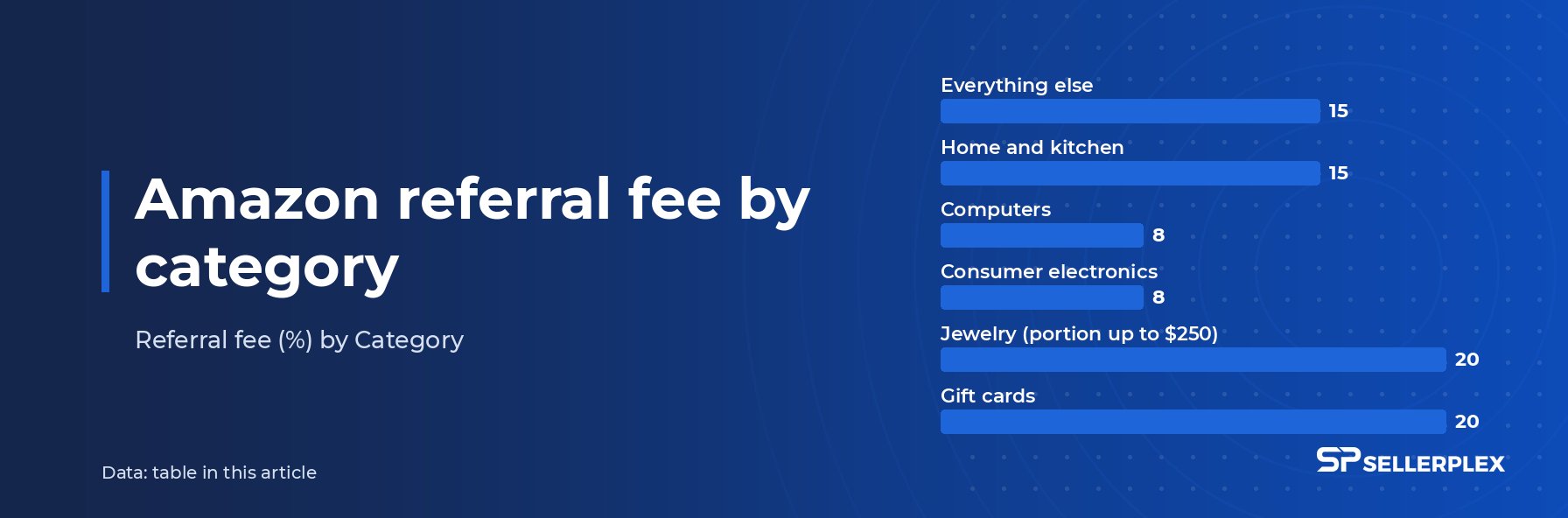
Amazon referral fee by category
These rates come from Amazon's selling plan and referral fee page, opened on 3 November 2026.
| Category | Referral fee (%) | Minimum per item |
|---|---|---|
| Everything else | 15 | $0.30 |
| Home and kitchen | 15 | $0.30 |
| Computers | 8 | $0.30 |
| Consumer electronics | 8 | $0.30 |
| Jewelry (portion up to $250) | 20 | none listed |
| Gift cards | 20 | none listed |
Media categories add a $1.80 closing fee per item on top of a 15% referral fee. On a $30 home and kitchen product, the referral fee alone is $4.50. Before you count the fulfillment fee, storage or advertising, 15% of the price is gone.
Fulfillment and storage fees
Fulfillment fees depend on the product's price, weight and dimensions, so a slim 8 ounce item and a bulky 15 pound one land in very different tiers. Storage is charged every month and costs more in the October to December peak. Items held in a fulfillment center for 181 days or longer also pick up a monthly aged inventory charge, according to Amazon's FBA overview.
Because Amazon revises these rates, the reliable way to price a SKU is the Revenue Calculator in Seller Central, run with the product's real measured dimensions. A product that measures half an inch over a size tier boundary pays the higher tier on every unit it ever ships.
Is FBA cheaper than shipping yourself?
For most small and standard items it is. Amazon says shipping with FBA costs 70% less per unit than comparable premium shipping options from other major US carriers, citing its 2024 Small Business Empowerment Report. That comparison is against premium carrier options, so it holds best for fast delivery promises. A heavy or slow moving product can still come out cheaper merchant fulfilled.
Who does what under FBA
FBA splits the work cleanly, but it does not take everything off your plate. This is how the jobs divide in a typical account.
| Job | FBA | Merchant fulfilled |
|---|---|---|
| Sourcing and quality control | You | You |
| Prep, labeling and inbound freight | You | You |
| Storage | Amazon | You or your 3PL |
| Picking, packing and shipping | Amazon | You or your 3PL |
| Customer service on delivery | Amazon | You |
| Returns processing | Amazon | You |
| Forecasting and reorders | You | You |
| Advertising and listing content | You | You |
The rows you keep are the ones that decide profit. Amazon handles the physical work after check-in. Everything that happens before your units reach the dock, and every decision about how many to send, stays with you.
Where FBA breaks for growing brands
FBA usually breaks at the inventory clock. Amazon's warehouses run reliably, so the money is lost in when and how much you send.
Running out costs more than the lost sales
A stockout on Amazon does more than pause revenue. Your listing loses sales history while it is unavailable, and ad campaigns either stop or spend on a product nobody can buy. Getting a product back to its old rank after a long gap usually means paying for that visibility again through ads, which is why our Amazon PPC team plans campaigns around inbound dates.
Overstock turns into storage and aged inventory fees
Sending too much is the opposite trap. Stock that sits past 181 days starts paying an aged inventory charge each month, and Q4 storage rates make overstock worse in exactly the months you want space for fast sellers. Our guide to Amazon inventory management tips covers reorder points and safety stock in detail.
The fix is a pipeline plan
The brands that run FBA smoothly plan backwards from Amazon's shelf. They know the factory lead time, the ocean or air transit time and the check-in delay, and they place orders so stock lands before the 2 month buffer runs down.
Two SellerPlex supply chain clients show what that planning changes. Gold Coastal cut its air shipments by 80% after moving to a 200 day pipeline plan. Vidal Crafts stayed 95% in stock for the year after a supply chain audit. Both results are published on our supply chain management page.
Keep Your FBA Stock Moving Without Overpaying
Talk to a SellerPlex strategist about your lead times, inbound plan and storage costs.
Talk to a StrategistHow much inventory should you keep in FBA?
Keep enough to cover sales until the next shipment is checked in, plus a buffer for delays. Amazon's starting point of about 2 months of cover works for many standard items. Seasonal products, long ocean lead times and new launches need their own numbers.
A practical way to set it:
- Take your average daily units sold over the last 30 days.
- Multiply by the full replenishment time: production, freight and check-in, in days.
- Add a buffer of 2 to 3 weeks of sales for delays at sea or at the dock.
- Compare the result with what you hold in FBA plus what is already in transit.
If the gap is positive, you are short and should order now. If you hold far more than 181 days of cover on any SKU, slow the next order and check whether a promotion or a removal makes sense before the aged inventory charge starts.
Many brands keep part of their stock in a 3PL or their own warehouse and send it to Amazon in smaller, more frequent shipments. That costs a second handling step but keeps FBA storage lean. Our article on the Amazon FBA supply chain explains how that split usually works.
Is FBA the right model for your catalog?
FBA fits most products that are small to mid sized, sell steadily and benefit from Prime delivery. It fits less well for heavy, oversized or very slow moving items, where fulfillment and storage fees eat the margin.
Run three checks on each SKU before you commit:
- The Revenue Calculator margin after referral and fulfillment fees, with real measured dimensions.
- Monthly sales velocity against your replenishment time, to see how many days of stock you would carry.
- Whether a few SKUs would do better merchant fulfilled while the rest stay in FBA.
Plenty of brands run a hybrid. Fast movers sit in FBA for the Prime badge and the Buy Box, and bulky or seasonal items ship from a 3PL. Amazon reports that over 11,000 US independent sellers grew their sales more than 10 times in 2025. Growth at that pace only holds when the inventory plan keeps up with it.
Frequently Asked Questions
How long does it take for FBA inventory to go live?
Units go live once Amazon checks them in at the fulfillment center. Transit time depends on your carrier and origin, and check-in at the fulfillment center adds its own delay. Plan for the whole chain from your factory or 3PL to available stock, and send replenishment well before your current units run out.
Do I need a Professional seller account to use FBA?
FBA is available on both selling plans, but the Professional plan at $39.99 a month is the practical choice for any brand selling more than about 40 units a month. Below that, the Individual plan's $0.99 per item fee costs less. Professional also unlocks bulk listing tools, advertising and brand features most growing sellers need.
What happens to returns under FBA?
Amazon handles the return for you. The customer sends the item back to a fulfillment center, Amazon inspects it, and sellable units go back into your available stock. Units Amazon marks unsellable stay in your inventory until you create a removal order to have them shipped back to you or disposed of.
Can I use FBA inventory for orders from my own website?
Yes. Amazon lets FBA fulfill orders from other sales channels, including your own store, through Multi-Channel Fulfillment. It keeps one pool of stock for every channel, which simplifies forecasting. Check the fees per order against your current 3PL, since the right choice depends on order size and how many units ship outside Amazon.
Where to start
Pick your top five SKUs and run each through the Revenue Calculator with measured dimensions. Then work out the days of stock you hold in FBA and in transit for each one. If any SKU sits under 30 days or over 181 days, that is where your FBA setup is costing you money. Book a strategy call with SellerPlex and we will walk through your inbound plan with you.
Next step: Talk to a Strategist. Book a free strategy session with our Amazon and e-commerce specialists. No obligations, just actionable insights.