Amazon Seller Solutions: Which Kind of Help Fits Your Store
TL;DR: Amazon seller solutions come in four kinds: programs Amazon runs itself, software you operate, vetted service providers hired per task, and agencies that run whole parts of the account. Amazon's own tools cost $39.99 a month on the Professional plan plus a referral fee per sale. Add software when the work is repetitive, a provider for a one-off job, and an agency when nobody owns the results.
Table of Contents
- What counts as an Amazon seller solution?
- Amazon's own programs: what you get before paying anyone else
- Software: when the work repeats
- Service providers: one job done well
- Agencies: when nobody owns the result
- How do you choose the right Amazon seller solutions for your stage?
- Where sellers waste money on solutions
- How SellerPlex fits in
- Frequently Asked Questions
- Where to start
Search for this phrase and Google mostly shows you Amazon. Seller Central, the Sell on Amazon homepage and the Service Provider Network fill the top results, with a few consultants below. That mix is the honest answer to the search. "Solutions" means different things at different stages, and buying the wrong kind is how sellers end up paying for three tools and still doing the work at midnight.
This guide sorts the options by the problem they solve. It draws on what we see running PPC, supply chain, account health and content for more than 100 brands since 2018.
What counts as an Amazon seller solution?
An Amazon seller solution is any product or service that takes a piece of selling work off your plate or makes it measurably better. In practice that falls into four groups, and each one is paid for and managed differently.
| Kind of solution | Who does the work | How you pay | Typical job |
|---|---|---|---|
| Amazon's own programs | Amazon, inside your account | Plan fee, referral fees, program fees | Storage, delivery, ads platform, brand protection |
| Software and apps | You or your team | Monthly subscription | Repricing, research, reporting, automation |
| Service providers | A vetted outside specialist | Per project or per month | Photos, translation, compliance, FBA prep |
| Agencies | An outside team with targets | Monthly retainer, sometimes plus a share of sales | Running PPC, supply chain or the whole account |
The groups overlap. An agency uses software, and most software plugs into Amazon's programs. The useful question is who is accountable when the number moves the wrong way.
Amazon's own programs: what you get before paying anyone else
Amazon's built-in programs are the base layer, and several of them are easy to overlook. You already pay for them through your selling plan and fees.
According to Amazon's selling fees page, the Individual plan costs $0.99 per item sold and the Professional plan costs $39.99 a month. Professional unlocks bulk listing tools, Amazon Ads, Automate Pricing, B2B selling through Amazon Business and access to apps and APIs. Brand tools such as A+ Content and a Brand Store also require Amazon Brand Registry, which Amazon describes as a free program.
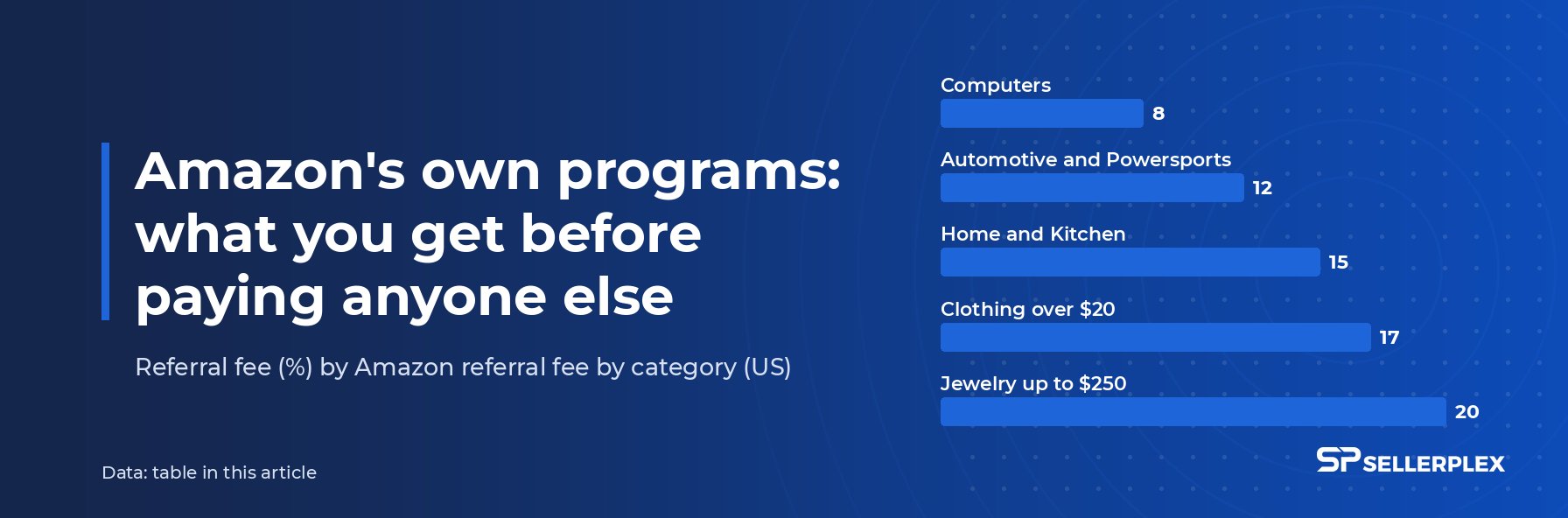
On top of the plan, every sale carries a referral fee that depends on the category. These rates shape which outside help is worth paying for, because they set how much margin is left to spend.
| Amazon referral fee by category (US) | Referral fee (%) |
|---|---|
| Computers | 8 |
| Automotive and Powersports | 12 |
| Home and Kitchen | 15 |
| Clothing over $20 | 17 |
| Jewelry up to $250 | 20 |
All five rates come from the same Amazon fee table, with a $0.30 minimum per item in each of these categories. A jewelry seller hands Amazon 20 cents of every dollar before fulfillment or ads. A computer accessories seller at 8% has room for tools that a jewelry seller may need to think twice about.
When the Professional plan pays for itself
The arithmetic is simple, and it is the first decision most new sellers get wrong in one direction or the other.
| Items sold per month | Individual plan cost (USD) | Professional plan cost (USD) |
|---|---|---|
| 10 | 9.90 | 39.99 |
| 40 | 39.60 | 39.99 |
| 41 | 40.59 | 39.99 |
| 100 | 99.00 | 39.99 |
| 500 | 495.00 | 39.99 |
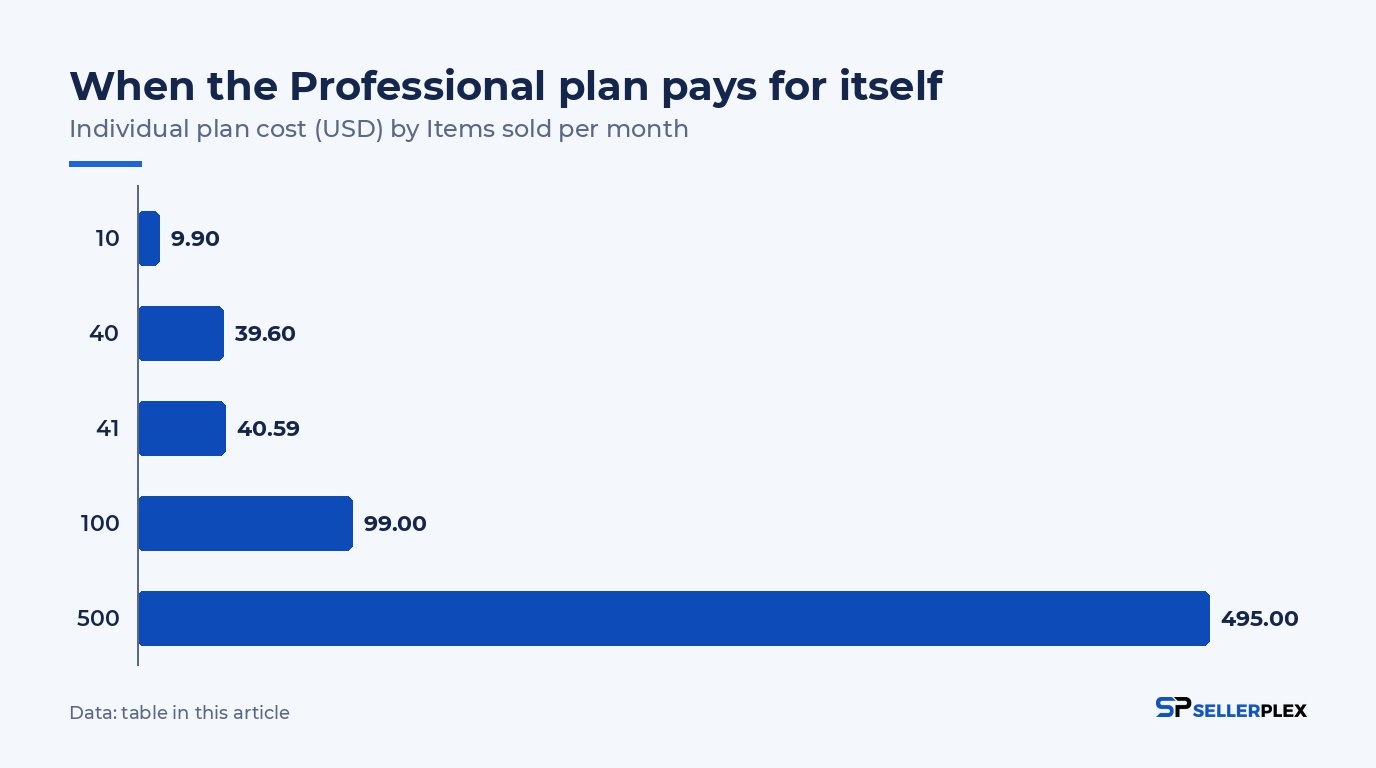
At 41 items a month the Professional plan is already cheaper. If you plan to advertise at all, you need Professional regardless of volume, since Amazon Ads is listed as a Professional feature. Our breakdown of the two types of Amazon seller accounts covers the remaining differences.
Software: when the work repeats
Software is the right Amazon seller solution when you know exactly what needs doing and it happens every day. Repricing, keyword tracking, inventory alerts and profit reporting all fit that description.
The trap is buying software to solve a judgement problem. A bid tool will raise and lower bids all night, and it will happily raise them on keywords that never convert. A forecasting tool will tell you to reorder 3,000 units without knowing your supplier just moved the factory. Someone still has to decide.
A good test before any subscription: write down who will open the tool every week and what decision they will make with it. If you cannot name the person, the tool becomes another login nobody checks. We wrote about this in more detail in what you are actually buying from an Amazon tools provider, including the point where tools stop being the answer.
Service providers: one job done well
A service provider is the right pick for a defined task with a clear finish line. Product photography, A+ Content design, a compliance document or translating listings for a new marketplace are typical examples.
Amazon runs its own directory for this. The Service Provider Network lists vetted third parties in categories such as account management, accounting, advertising optimization, imaging, compliance, FBA preparation and international shipping. Access is free with a selling account, and you find it in Seller Central under Apps and Services, then Explore Services.
Two details on that page matter before you hire through it. Amazon says it vets providers and monitors their performance, and it also says it does not endorse any of them. You contract directly with the provider, and the listed reference prices are only a guide; the final price can differ.
What to ask a provider before you start
Ask for two examples of the exact deliverable in your category. Ask what they need from you and by when. Agree in writing what "done" looks like, such as "7 images at 2,000 pixels, white background, two rounds of edits". Most disputes with providers come from a scope nobody wrote down.
Agencies: when nobody owns the result
An agency is the right Amazon seller solution when the problem is ongoing and tied to a number: ad spend per sale, stock cover in weeks, account health, or margin per SKU. You hire a team to run part of the account against a target, and they answer for it every month.
Growing brands often reach this point once the account needs daily attention in several areas at once. The work becomes too much for a founder, and too varied for one hire. A single ad manager rarely also knows how to plan a container shipment or fight a listing suppression.
Find Out Which Kind of Help Your Store Needs
A senior strategist reviews your PPC, supply chain and account health on a free 30-minute call, with recommendations you keep either way.
Talk to a StrategistSpecialist agency or full-service agency?
A specialist agency runs one channel, usually advertising. A full-service Amazon agency runs several connected parts of the account with one team. The choice depends on where your problems sit.
If ads are the only weak spot and inventory runs smoothly, a specialist is a fine choice. Problems often cross over, though. Ads push a product into a stockout, the stockout kills ranking, and the next shipment arrives to a listing that has lost its position. When one team runs ads and reorders, it can slow spend on a SKU three weeks before it runs out, rather than after.
Our guide to choosing an Amazon FBA agency lists the questions to ask on a sales call, including who will actually work on your account.
How do you choose the right Amazon seller solutions for your stage?
Match the solution to the problem you have this quarter, and to who has time to manage it. Here is how it tends to look by stage.
| Stage | Usual bottleneck | What tends to fit |
|---|---|---|
| Launching, first products | Listing quality, first reviews | Amazon's programs, a provider for images and A+ Content |
| Steady sales, one person running it | Founder time, ad waste | A few tools with a named owner, PPC help |
| Growing, several SKUs and suppliers | Stockouts, cash tied in inventory, account fires | An agency across ads, supply chain and account health |
| Large catalog, several marketplaces | Coordination across teams | An in-house lead plus an agency or providers for each area |
None of these stages is fixed. A brand at $30,000 a month with a suspended listing needs account help today, whatever the table says.
Signs you have outgrown your current setup
Your current mix has stopped working when the same problem returns every month. Typical signs: ads stay paused because nobody had time to check them, a hero SKU runs out twice in a year, or a case with Seller Support stays open for weeks. Our piece on when to outsource Amazon management goes through what to hand off first.
Where sellers waste money on solutions
The most expensive mistake is stacking tools with no owner. A store can easily pay for overlapping research, repricing and reporting subscriptions that each get opened a few times a month. Cancel anything nobody opened in the last 30 days and see if you miss it.
The second is hiring an agency for one channel while the real leak sits elsewhere. Lower ad costs do not help if a third of sessions land on an out-of-stock listing. Before you sign with anyone, look at the full account once: ads, stock cover, account health and fees.
The third is skipping Amazon's free programs. Brand Registry is free, Brand Analytics comes with it, and the Service Provider Network is free with any selling account. Plenty of sellers pay for outside data that Amazon already shows them.
How SellerPlex fits in
SellerPlex is a full-service Amazon agency. Since 2018 a team of more than 80 specialists has run PPC, supply chain, account health, content, DSP, bookkeeping and revenue recovery for over 100 Amazon brands. One of those clients, an FBA supplement brand, grew from $10,000 to $1.5 million a month in sales. SellerPlex holds a 5.0 rating from 25 reviews on Clutch, and AdLabs named it its highest ROAS agency of 2025.
Our Amazon account management service is often the starting point. A dedicated team watches the account every day, handles suppressions and Seller Support cases, and keeps listings compliant while the ads and stock plans run alongside.
Frequently Asked Questions
Are Amazon seller solutions from Amazon free?
Some are included and some cost extra. Brand Registry is free, and the Service Provider Network is free with a selling account. FBA, Amazon Ads and storage are paid per use. You pay $39.99 a month for the Professional plan plus referral fees per sale.
What is the difference between the Service Provider Network and the Appstore?
The Service Provider Network lists agencies and individuals who do work for you, such as imaging, accounting or advertising. The Selling Partner Appstore lists applications from software partners that automate tasks in your account. Amazon vets providers in the network but does not endorse them, and you contract with each provider directly.
How much does an Amazon agency cost?
Most agencies charge a monthly retainer, and some add a percentage of sales or ad spend. Costs depend on how many channels and SKUs they run. Ask for the fee in writing and what it includes. A free audit call is a sensible first step, since it shows how the agency thinks before you commit.
Can I mix software, providers and an agency?
Yes, and most growing brands do. The rule that keeps it working is one owner per number. If an agency runs your ads, it should also control the bid tool, and the provider who shoots images should hand files to whoever owns the listings. Overlap without an owner is where money disappears.
Where to start
Write down the one number that worries you most this quarter, then the person who owns it today. If that person is you and you have no time for it, that is the gap to fill first. Talk to a SellerPlex strategist and get a free 30-minute review of your account.
Next step: Talk to a Strategist. Book a free strategy session with our Amazon and e-commerce specialists. No obligations, just actionable insights.