Amazon Advertising Managed Service: Who Runs It and When
TL;DR: An Amazon advertising managed service means someone else runs your Amazon ads for a fee. Amazon's own DSP account team typically starts around $50,000 a month in media and covers display only. An agency runs Sponsored Ads and DSP inside your own account, with no Amazon minimum. For most brands spending under $25,000 a month, the agency route fits better than managed DSP or running ads in-house.
Table of Contents
- What does an Amazon advertising managed service include?
- The three routes, side by side
- How much do brands actually spend on managed Amazon ads?
- What results should a managed service deliver?
- How to vet a provider before you sign
- When is managed DSP the better pick?
- When does doing it in-house still make sense?
- Frequently Asked Questions
- Where to start
Sellers who search for this usually have the same problem. Ads take hours every week, ACOS keeps drifting, and nobody internally has time to fix the structure. The question is which kind of help to buy, because the phrase covers services with very different entry points and fee models.
This page uses our own numbers where we have them. SellerPlex manages Amazon ads for 38 US accounts in our H1 2026 benchmark set, and their spend profile says a lot about which route makes sense for which brand.
What does an Amazon advertising managed service include?
It includes the daily work of running campaigns: structure, bids, budgets, targeting, search-term cleanup and reporting. The provider does that work while you approve strategy and pay the media bill.
In practice the scope splits into two layers. The first is Sponsored Ads, meaning Sponsored Products, Sponsored Brands and Sponsored Display. These are cost-per-click ads, and Amazon states on its Sponsored Products page that campaigns have no monthly or upfront fees. You only pay for clicks, within a daily budget you set.
The second layer is Amazon DSP, the programmatic side that buys display and video audiences on and off Amazon. Here the "managed" label has a specific meaning, because Amazon itself sells a managed-service version.
The work you are actually handing off
A useful scope covers these jobs:
- Campaign structure built around product margin, with proven search terms isolated in exact match
- Daily bid and placement changes
- Weekly search-term reviews, negating waste and promoting converting terms into their own campaigns
- Keyword, product and category targeting
- Budget allocation by SKU economics
- A weekly report that shows spend, sales, ACOS and what changed
If a proposal leaves out search-term work or change logs, you are buying monitoring. Ask what gets touched each week.
The three routes, side by side
Each route answers the same need with a different operator and a different minimum.
| Route | Who runs the ads | Typical entry point | Covers Sponsored Ads | Who keeps the account |
|---|---|---|---|---|
| Amazon DSP managed service | Amazon Ads account team | Around $50,000 a month in media | No, DSP only | Amazon operates the campaigns |
| DSP self-serve or in-house | Your team or a partner with API access | No Amazon minimum; $10,000 to $15,000 a month suggested for signal | Separate effort | You |
| Agency managed service | A dedicated agency team | Set by the agency; no Amazon minimum on Sponsored Ads | Yes, plus DSP when ready | You, with full visibility |
The DSP figures come from the Marketplace Ad Pros guide to self-serve versus managed DSP, which lists managed DSP as typically starting around $50,000 a month (varying by country) and self-serve as having no Amazon-imposed minimum since 2025. Amazon's own Amazon DSP page confirms that DSP has offered both self-service and managed-service options.
Amazon's own managed DSP
Amazon's managed DSP means an Amazon Ads account team plans and runs your programmatic campaigns. It suits large brands that already spend heavily and want audience reach beyond search.
Two limits matter. The entry point sits well above what most third-party sellers spend on ads in total. The team also runs DSP only, so your Sponsored Products account, where most sellers' ad sales come from, still needs its own operator.
Running it yourself
Self-serve keeps every decision in-house and avoids a service fee. It works when you have a person with real hours for it and the account is small enough that a weekly review catches problems.
The cost is time and attention. Search-term waste, broad-match bleed and budgets capping out by noon are all quiet failures. They rarely show up until someone pulls a month of data.
An agency managed service
An agency runs Sponsored Ads day to day and adds DSP when the account is ready for it. You keep ownership of the ad account and the data, and you see every change.
This is the route most brands under the managed DSP threshold end up on. It is also the one where quality varies most between providers, which is why the questions further down matter.
How much do brands actually spend on managed Amazon ads?
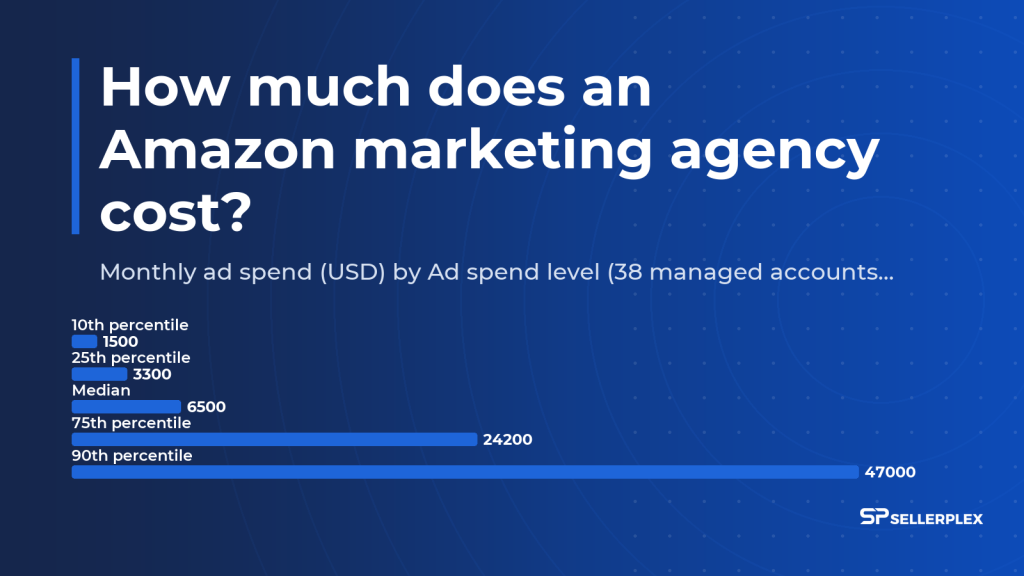
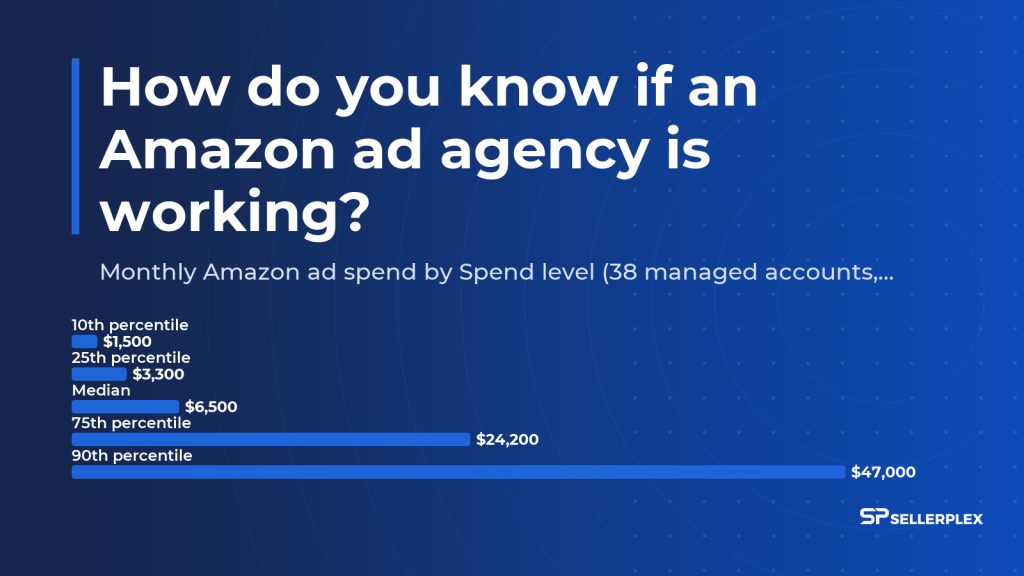
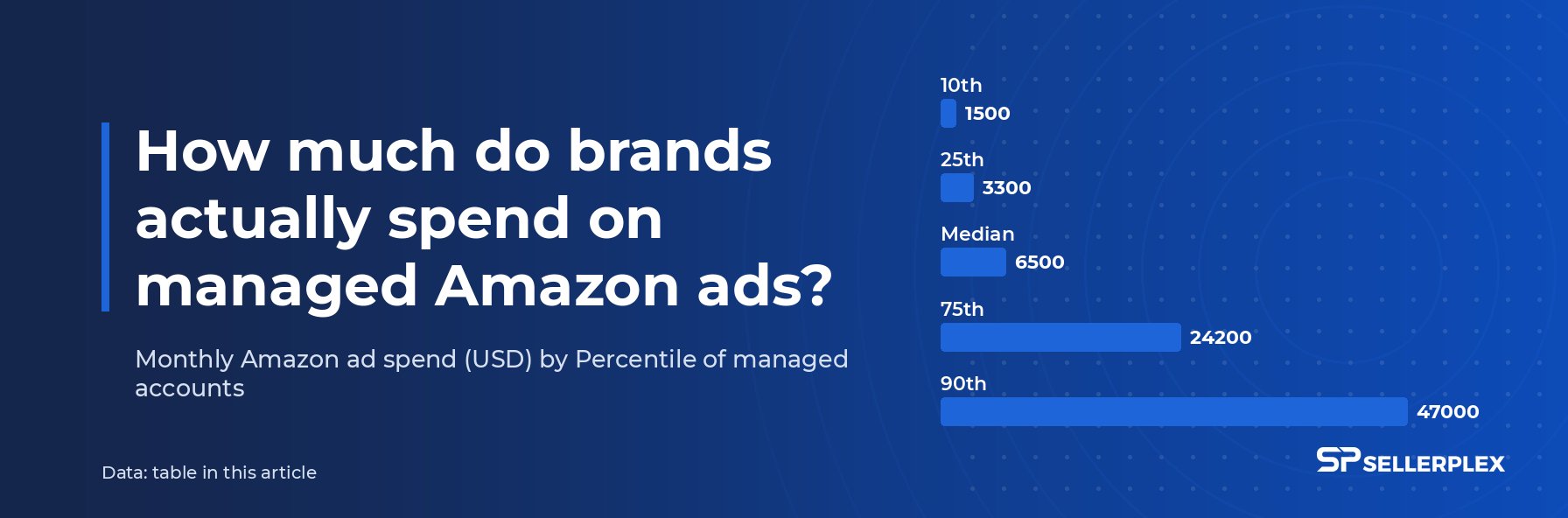
Most brands spend far less than Amazon's managed DSP entry point. In our H1 2026 data, the median SellerPlex-managed account spent $6,500 a month on Amazon ads, and even the 90th percentile account spent $47,000.
These figures come from our Amazon PPC benchmarks from managed accounts, covering 38 US accounts from January to June 2026.
| Percentile of managed accounts | Monthly Amazon ad spend (USD) |
|---|---|
| 10th | 1500 |
| 25th | 3300 |
| Median | 6500 |
| 75th | 24200 |
| 90th | 47000 |
Read that table against the entry points above. Nine out of ten accounts in our set spend less per month than the roughly $50,000 where managed DSP typically starts. A quarter of them spend under $3,300. For those brands the realistic question is who runs Sponsored Ads well, and DSP comes later, if at all.
The table also shows why a flat percentage-of-spend fee can feel cheap at the low end and expensive at the top. A 10% fee is $650 on a median account and $4,700 at the 90th percentile, for work that does not scale tenfold.
What results should a managed service deliver?
It should bring your account toward the efficiency range of comparable brands and show its working each week. Promised ACOS targets before anyone has seen your data are a warning sign.
For reference, these are the per-account medians across the same 38 accounts in H1 2026:
| Metric | Median | Middle 50% of accounts |
|---|---|---|
| ACOS | 38% | 25% to 53% |
| TACOS | 15% | 10% to 21% |
| ROAS | 2.6 | 1.9 to 4.0 |
| Blended CPC | $1.07 | $0.75 to $1.85 |
| Conversion rate | 8.3% | 5.4% to 11.1% |
A wide range is normal. A launch-stage supplement brand and a mature home goods brand should not share an ACOS target. TACOS matters more for most owners, since it shows ad spend against total sales, organic included.
Costs also moved fast this year. Median CPC across these accounts rose 37% from January to June 2026. A provider who is not adjusting bids and placements daily is losing ground in that kind of market.
See What Managed Amazon Ads Would Change
Get a senior strategist's read on your account structure, spend and the route that fits your budget.
Talk to a StrategistHow to vet a provider before you sign
Start with access and pricing, because those two terms decide whether you can leave cleanly. Then look at the work itself.
Account ownership
Your ad account should stay in your name, with the provider added as a user. The campaign history and the data stay with you. If a provider wants campaigns moved into an account they control, walk away.
How the fee is set
Ask how the fee moves when spend grows. Percentage-of-spend pricing rewards the provider for spending more of your money, whether or not it earns a return. SellerPlex does not price that way; fees are set by account size and scope on the first call.
The first 30 days
A serious provider can tell you what happens week by week. Ours looks like this: an audit and restructure plan in week one, campaigns rebuilt and negatives added in week two, daily optimisation in weeks three and four, and the first weekly report by week four. Structure fixes usually show within a few weeks. ROAS trends take longer.
Who touches the account
Ask whether a senior strategist is on the account or only on the sales call. At SellerPlex every account has a senior strategist plus one account manager as the single point of contact. For a wider checklist, see how to vet PPC management agencies for Amazon.
When is managed DSP the better pick?
Managed DSP is worth it when you already spend well above $50,000 a month across Amazon, your Sponsored Ads are efficient, and growth depends on reaching shoppers who are not searching yet.
At that stage the questions change. You care about audience reach, frequency and new-to-brand customers more than keyword bids. Our comparison of Amazon DSP vs Sponsored Ads walks through how to tell whether your account is there.
Before that point, the money usually does more inside Sponsored Products. An agency can add self-serve DSP for retargeting at a much smaller budget, which keeps search and display under one plan.
When does doing it in-house still make sense?
In-house works when someone on your team owns ads as their main job and spend is modest. At our 25th percentile of $3,300 a month, a capable operator with a few focused hours a week can run a clean account.
It breaks when ads become a side task. The usual pattern is a founder who checks the console every few weeks, after the waste has already run. If that sounds familiar, the full-service Amazon agency model exists so ads, listings and inventory are planned together. Our Amazon PPC management service is the ads part of that.
Frequently Asked Questions
Is Amazon's managed DSP service the same as an agency managing my ads?
No. Amazon's managed DSP is run by an Amazon Ads account team and covers programmatic display and video only. An agency usually manages Sponsored Products, Sponsored Brands and Sponsored Display inside your own account, and may add DSP later. Entry points differ widely, with managed DSP typically starting around $50,000 a month.
Is there a minimum ad spend to use a managed service?
Amazon sets no minimum for Sponsored Products and charges no monthly or upfront fees, only clicks. Managed DSP typically starts around $50,000 a month according to third-party guides. Agencies set their own fit criteria, so ask directly. Our managed accounts ranged from about $1,500 to $47,000 a month between the 10th and 90th percentile.
Do I lose control of my ad account with a managed service?
You should not. A good provider works as a user inside your account, so you keep ownership of the campaigns, data and spend relationship with Amazon. You should be able to see every change. If a provider asks to move your campaigns into an account they own, treat that as a reason to decline.
How long before a managed service shows results?
Structural fixes such as negating waste and isolating winning terms tend to show within the first few weeks. Reliable ROAS and TACOS trends take longer, usually a few months, because seasonality and rising CPCs move the baseline. Median CPC in our managed accounts rose 37% between January and June 2026.
Where to start
Pull your last 60 days of ad spend, ad sales and total sales, and work out your TACOS. Compare it with the 10% to 21% middle range above. If you sit well outside it, or nobody owns the account day to day, book a strategy call with SellerPlex and we will tell you which of the three routes fits your spend.
Next step: Talk to a Strategist. Book a free strategy session with our Amazon and e-commerce specialists. No obligations, just actionable insights.