Amazon A9 Search Engine: How Shoppers Find Your Products
TL;DR: The Amazon A9 search engine is the product search Amazon built through its A9.com subsidiary, now run by the team called Amazon Search. It works in two passes: it finds every listing that could match the query, then orders them by how likely the shopper is to buy. Your text gets you into the first pass. Clicks, sales, price and stock decide the second.
Table of Contents
Sellers still say "A9" when they mean the system that decides where a listing shows up. The name is old, but the question behind it is current. Why does one listing sit on page one for a search while a near copy never appears at all? The answer sits in how the engine is built, and most of that is public if you know where to look.
Where did the A9 name come from?
A9 was an Amazon subsidiary in Palo Alto, set up in 2003 to build search and search advertising technology. According to the Wikipedia entry on A9.com, the name is a numeronym for "algorithms": an A followed by nine more letters.
Its product search ran on all of Amazon's retail sites and on retailers that licensed Amazon's platform. The same group built "search inside the book" and the sponsored links that appeared on Amazon.com from 2003. That last point matters more than it looks. Organic search and ads came from the same building, and they still share one results page.
The A9.com website itself is gone. In 2019 Amazon pointed the domain at its own home page, and the team later became Amazon Search. Nothing in public suggests a clean switch to a new engine with a new name. "A10" is a label from seller forums and agencies, and Amazon has never announced it. We cover that debate in our explainer on the Amazon A9 algorithm and its ranking factors, so this page sticks to how the search engine handles a query.
How does the Amazon A9 search engine pick results?
The engine first retrieves a set of products that match the query, then ranks that set. Those two steps run on different evidence, and sellers who mix them up waste effort in the wrong place.
Step one: matching the query to the catalog
Retrieval decides whether you are in the race at all. Traditionally this was lexical matching: the words in the search had to appear in your title, bullets, description or back-end search terms.
Amazon's own scientists explained why words alone fall short. In Semantic product search, a 2019 paper presented at KDD, they list three gaps in pure keyword matching. It misses synonyms and broader terms, it trips on variants like "woman" and "women", and it breaks on spelling errors. Their fix was a deep learning model trained on customer behavior data.
So the engine can now match a listing to a query that does not contain the exact words. That helps, but it does not let you skip the words. A model trained on what shoppers bought still starts from the text you supplied.
Step two: ranking the matches
Ranking decides your position among the listings that matched. Amazon's seller guide names the inputs it wants you to work on here: listing quality, competitive price and account health. Behavior already shapes even the matching step. The 2019 paper trains its model to separate three kinds of products: random ones, ones that were shown but not bought, and ones that were purchased.
That detail tells you what the system values. A listing that gets seen and skipped teaches the model something different from one that gets seen and bought. What counts is a purchase after the search.
The paper reports at least a 4.7% gain in Recall@100 and 14.5% in mean average precision over the earlier best semantic methods. Those are offline research results. They show the direction Amazon took, without telling you how much weight any single factor carries today.
What the engine reads, and what you can change
Amazon's seller guide to Amazon SEO lists the inputs it wants sellers to work on. Read alongside the retrieval and ranking split, they fall into clear groups.
| Input | Which step it feeds | What you control |
|---|---|---|
| Title, bullets, description | Matching | Words that describe the product the way shoppers search |
| Back-end search terms | Matching | Synonyms, abbreviations and alternate names that do not fit on the page |
| Main image and price | Ranking, through clicks | Whether a shopper picks you from the grid |
| Conversion after the click | Ranking | Detail page, reviews, price and delivery promise |
| Stock and account health | Ranking | Staying in stock and keeping the account clean |
A few specifics from Amazon's guide are worth taking literally. The title limit is 200 characters, and Amazon recommends no more than 60. Keyword stuffing "can create a poor customer experience and hurt your rankings," in Amazon's words. Product images should fill 85% or more of the frame on a plain white background.
None of this is secret. Most sellers already know it. The gap is usually in execution across dozens of ASINs, kept current as the catalog and the competition change.
Why ads and organic rank move together
On Amazon, ads feed the same sales history the ranking step reads. A sale that starts with a sponsored click is still a sale of that product after that search.
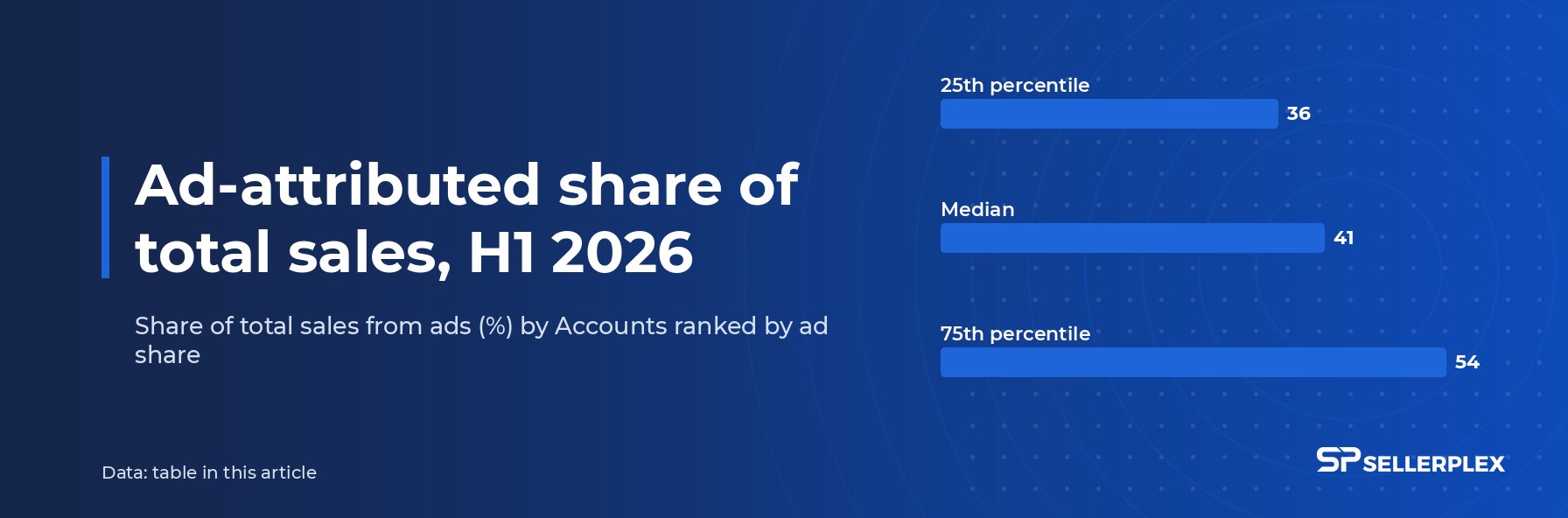
Our own numbers show how large the paid side has become. In the first half of 2026 we tracked 38 US Amazon.com accounts under SellerPlex management for our Amazon PPC benchmarks. Ads drove a median 41% of total sales, and the organic side relied on rank that paid traffic helped hold.
Ad-attributed share of total sales, H1 2026
| Accounts ranked by ad share | Share of total sales from ads (%) |
|---|---|
| 25th percentile | 36 |
| Median | 41 |
| 75th percentile | 54 |
This is why "we will just turn ads off and live on organic" plans usually disappoint. The purchases that kept a listing near the top often started with a paid click. Cut them and the ranking step sees fewer sales for that search, which lowers your position, which cuts organic sales too.
Find out why your listings are not ranking
A senior strategist reviews your top ASINs against the searches that should find them, in a free 30-minute session.
Talk to a StrategistWhich signals can a seller actually move?
You can move relevance and conversion directly. Everything else follows from those two. Below are the levers we check first when a listing should rank for a search and does not.
Fix the words before you buy traffic
If a listing does not match the search, no bid fixes that for long. Check whether the core phrase a shopper types appears in the title or bullets in their language. Supplier names and internal product codes rarely match what people search.
Back-end search terms are the place for misspellings, other languages your buyers use and synonyms that would read badly on the page. Amazon's guide says to skip repeats and irrelevant terms there. Repeating a word you already used on the page adds nothing.
Our guide to Amazon product listing optimization goes through titles, bullets and A+ Content one field at a time.
Win the click on the results grid
The ranking step rewards listings that shoppers choose. On the results page they see one image, a title fragment, a price, a star rating and a delivery date. That small set decides your click-through rate.
In our managed accounts the median ad click-through rate was 0.59%. Below 0.4% we usually find broad targeting or ads showing on searches where the product does not belong. That number comes from sponsored placements, but a weak main image hurts organic clicks in the same way.
Convert the shoppers you get
Conversion is where most ranking problems actually live. The median managed account converted 8.3% of ad clicks into orders, and it barely moved month to month while click prices rose 37%. When conversion drops, the fix is usually on the detail page or in the price.
Look at reviews against the top three competitors for your main search. Compare the delivery promise. Check whether the images answer the questions buyers ask in reviews. Our Amazon content creation services team works on exactly this layer: images, copy and A+ Content built around what the search brings in.
Stay in stock
A product that is out of stock cannot be bought, so it stops collecting the sales the ranking step reads for every search it used to win. Amazon's guide also names listing quality and account health among the things that can contribute to rank. Plan reorders around your best-ranking ASINs first.
What the engine does not reward
Some old tactics still circulate and cost money. Stuffing every variant of a keyword into the title is the clearest. Amazon's guide warns against it, and the semantic model already links "women" and "woman" without your help.
Paying for traffic that will not convert is the second. A sponsored click on an irrelevant search adds a view that did not lead to a sale. The model in the 2019 paper learns from exactly that gap between shown and bought.
Chasing a secret factor list is the third. Amazon has published the principles: match the query, then rank by what shoppers buy. The work is applying that to every important search for every product you sell, and checking it again when the market moves. If your ad side needs that discipline too, our Amazon PPC management team runs search-term reviews weekly on every account.
Where to start
Pick your five best-selling ASINs. For each one, write down the three searches that should find it. Search them yourself in a private window and note where you appear, organic and sponsored.
Then sort the gaps. Where you do not appear at all, the problem is matching, so fix the words. Where you appear low, the problem is ranking, so look at click-through, conversion, price and stock. If you want a second pair of eyes, book a free strategy call with SellerPlex and we will go through those searches with you.
Frequently Asked Questions
Is the Amazon A9 search engine still used?
The A9 name belongs to the Amazon subsidiary that built product search from 2003. The A9.com site was retired in 2019 and the team became Amazon Search. The engine has changed a lot since then, adding machine learning trained on shopper behavior, but it is the same product search lineage sellers still call A9.
Is A10 a new Amazon algorithm?
Amazon has never announced an algorithm called A10. Sellers and agencies use the label to describe changes they believe gave more weight to external traffic and to organic sales. Treat it as shorthand. The public evidence points to steady changes inside one search system rather than a named replacement.
Do back-end search terms still matter?
Yes. Amazon's own seller guide tells you to add back-end terms for synonyms, abbreviations and alternate names, and to avoid repeats and irrelevant words. They help the matching step place your product in front of searches whose words do not fit naturally on the page. They do not help a listing that fails to convert.
Do Amazon ads improve organic ranking?
Ads do not buy organic rank directly. They bring shoppers who may purchase after a search, and those purchases become part of the sales history the ranking step reads. Across 38 accounts SellerPlex managed in early 2026, ads drove a median 41% of total sales, so cutting them usually lowers organic sales too.
Next step: Talk to a Strategist. Book a free strategy session with our Amazon and e-commerce specialists. No obligations, just actionable insights.