


Advertising effectiveness in marketing management is not just a reporting question. For Amazon brands, it is the operating discipline that decides which campaigns deserve more budget, which products can scale, and which sales are quietly destroying margin.
Table of Contents
- What effectiveness really means when you sell on Amazon
- The problem with judging ads inside the ad console
- Build a measurement model before you touch bids
- Role 1: defend profitable branded demand
- Role 2: harvest proven non-brand demand
- Role 3: discover new profitable search terms
- Role 4: launch and rank strategic SKUs
- Role 5: expand reach beyond search capture
- The weekly management scorecard
- How to diagnose whether spend is working
Most sellers measure ads too narrowly. They check ACoS, ROAS, impressions, and click-through rate, then call the campaign good or bad. Those metrics matter, but they are only the visible layer. A campaign can look efficient inside Amazon Ads while overall profit falls because organic rank did not move, inventory got strained, or discounting carried the conversion rate.
The better question is simple: did the advertising create profitable demand the business can actually fulfill and repeat?
That answer sits at the intersection of marketing management, finance, inventory planning, listing quality, and account operations. If those functions are managed separately, ad performance gets judged in isolation. If they are managed together, advertising becomes a controlled growth lever instead of a spend line that everyone argues about after month end.
What effectiveness really means when you sell on Amazon
Effective advertising does 3 jobs at once. It reaches the right shopper, converts that shopper at an acceptable cost, and improves the commercial position of the SKU after the ad click.
That last point is where many Amazon brands lose the thread. A Sponsored Products campaign that drives $80,000 in attributed sales might still be ineffective if it pushes a low-margin SKU into stockout, trains the algorithm on the wrong search terms, or takes budget away from a product with better contribution margin.
For a 7 or 8 figure seller, effectiveness should be measured at 4 levels:
- Campaign performance: spend, sales, ACoS, ROAS, CPC, CTR, CVR, and search term quality.
- Account performance: TACoS, organic sales, total revenue, contribution margin, and rank movement.
- Operational impact: inventory coverage, stockout risk, fulfillment costs, promotions, and buy box stability.
- Strategic value: market share, launch traction, category defense, branded demand, and customer acquisition beyond one order.
Amazon’s own advertising products report campaign metrics clearly, and the Amazon Ads measurement overview is useful for understanding the platform’s attribution tools. The management work starts when you connect those reports to the rest of the account.
The problem with judging ads inside the ad console
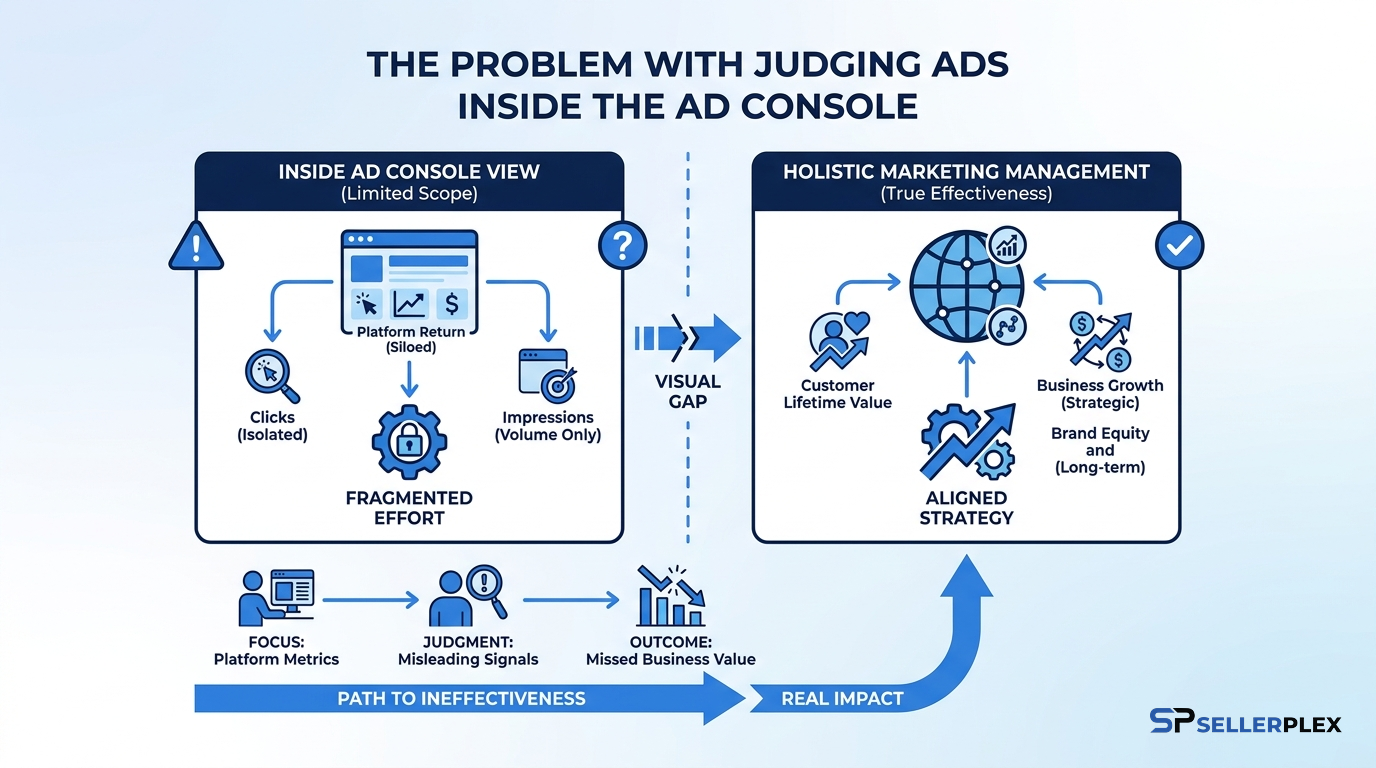
Amazon Ads Manager can tell you what happened after a shopper clicked or viewed an ad. It cannot tell you whether that spend made the brand healthier.
That gap creates bad decisions. A campaign with a 12 percent ACoS might be protected because it looks efficient, even though it only captures existing branded demand. Another campaign with a 38 percent ACoS might be cut too early, even though it is helping a newer SKU earn rank on a search term that will produce organic sales later.
Advertising effectiveness in marketing management requires context. The ad console is one input, not the judge.
ACoS is useful, but incomplete
ACoS tells you how much ad spend was required to generate attributed ad sales. It is helpful when you are comparing similar campaigns for similar products with similar margins.
It breaks down when margins differ by SKU, when campaigns serve different jobs, or when the business goal is not immediate attributed sales. A branded defense campaign, a launch campaign, and a category expansion campaign should not be held to the same ACoS target.
For example, a mature supplement SKU with a 68 percent gross margin might support more aggressive acquisition than a bulky home goods product with high FBA fees and fragile inbound supply. Same ACoS, different business outcome.
TACoS gives the broader read
TACoS connects ad spend to total sales. If ACoS improves but TACoS rises, the account may be becoming more dependent on paid traffic. If ACoS worsens while TACoS falls, the ads may be helping organic sales grow.
That is why TACoS belongs in weekly management reviews, not just monthly reporting. It helps separate efficient capture from actual growth.
SellerPlex uses this kind of connected view inside Amazon PPC campaign management because ad decisions rarely live inside one metric. Bid changes, budget allocation, keyword expansion, listing readiness, and inventory position all affect whether the next dollar of spend creates profit.
Build a measurement model before you touch bids
The fastest way to waste money is to optimize campaigns before agreeing on what each campaign is supposed to do.
A simple measurement model gives each campaign a job, a success metric, and a decision rule. Without that, every weekly review turns into opinion: finance wants ACoS down, marketing wants scale, operations wants fewer stockouts, and nobody knows which tradeoff is acceptable.
Use 5 campaign roles.
Role 1: defend profitable branded demand
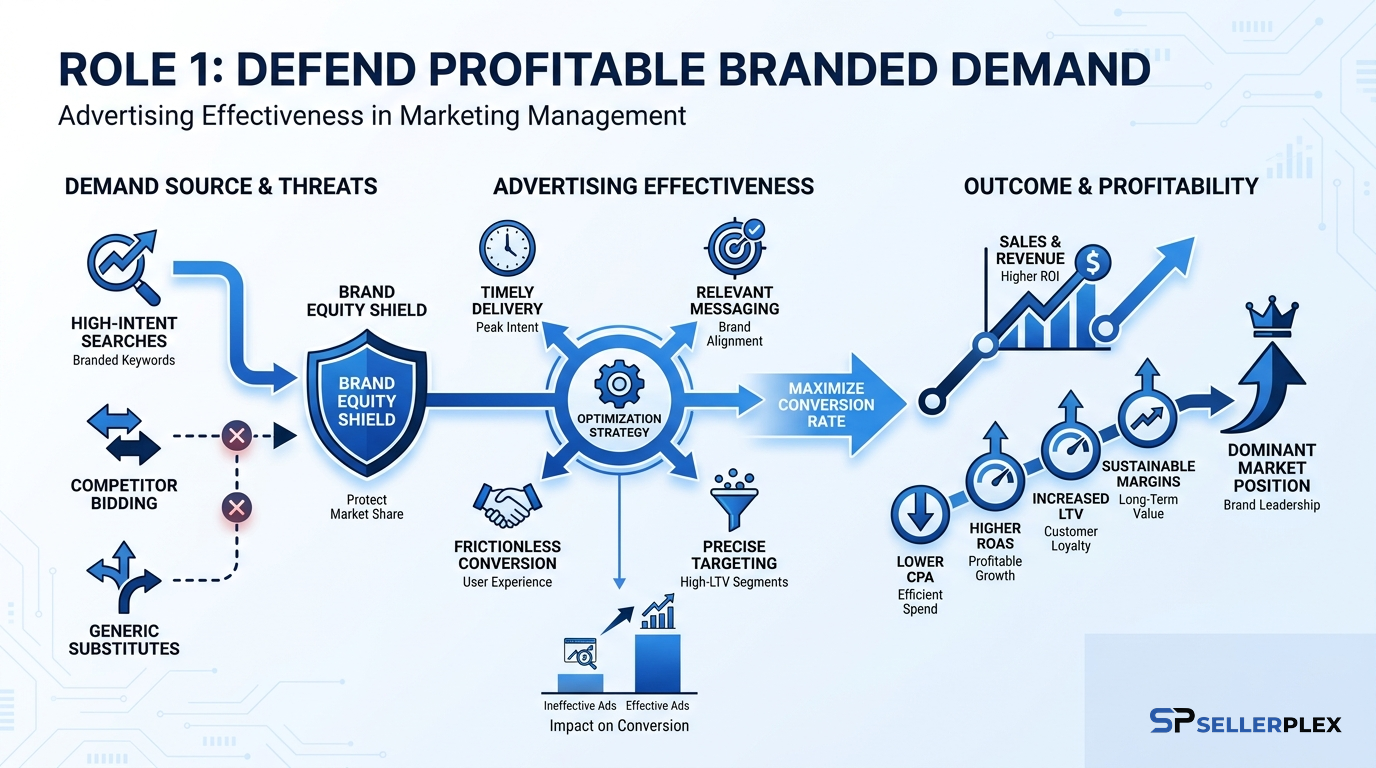
Branded campaigns protect shoppers who already know your brand. They should usually run at a lower ACoS because intent is high. The risk is over-crediting them. If branded campaigns consume too much budget, you can end up paying for sales you would have won anyway.
Measure branded defense by ACoS, impression share on key branded terms, new-to-brand data where available, and total branded search trend. Keep budgets disciplined, especially during periods when organic rank already protects the sale.
Role 2: harvest proven non-brand demand
These campaigns target search terms that already convert. They are your controlled scaling layer. Measure them by contribution margin, conversion rate, placement performance, and search term waste.
The management question is not “can we spend more?” It is “can we spend more without pulling in weaker traffic or harming total margin?”
Role 3: discover new profitable search terms
Discovery campaigns are supposed to be less efficient in the short term. Their job is to identify search terms, product targets, and audience pockets that can be moved into more controlled campaigns.
Judge them by signal quality. How many converting search terms did they produce? Which terms deserve exact match campaigns? Which irrelevant terms need negatives? The Amazon Ads guide to Sponsored Products is a good baseline for understanding how keyword and product targeting feed that learning loop.
Role 4: launch and rank strategic SKUs
Launch campaigns often tolerate higher ACoS because early velocity, review acquisition, and ranking signals matter. That does not mean launch spend gets a blank check.
Tie launch advertising to inventory coverage, target rank bands, conversion rate milestones, and review count. If a product cannot convert after enough traffic, the problem may be the offer, content, price, or review profile rather than the bid.
This is where listing work and ad work overlap. Stronger images, sharper benefit hierarchy, and better keyword coverage can lower the paid traffic burden. SellerPlex’s Amazon content optimization support connects that listing side to the ad plan so campaigns are not forced to compensate for weak product pages.
Role 5: expand reach beyond search capture
Sponsored Brands, Sponsored Display, and Amazon DSP can support upper-funnel and mid-funnel goals. For these campaigns, look beyond last-click sales. Branded search lift, detail page views, new-to-brand sales, repeat purchase behavior, and assisted impact all matter. Amazon’s Marketing Cloud can also help larger advertisers analyze paths to purchase across signals. For brands ready to move past pure search capture, Amazon DSP advertising gives useful context on managing reach and profitability together.
The weekly management scorecard
A useful advertising scorecard should fit on one page. Build the weekly view around these categories.
Spend control
Track spend by campaign role, not only by campaign name. This reveals whether the account is overinvesting in branded capture, starving discovery, or pushing launch budgets without enough evidence. Watch pacing too. A campaign can perform well early in the month and still create problems if it exhausts budget before peak conversion windows.
Profit quality
Connect ACoS and ROAS to gross margin, FBA fees, referral fees, discounts, returns, and contribution margin. A 25 percent ACoS is not automatically good. Blended account performance can also hide the fact that one hero product funds inefficient spend across weaker products.
Search term efficiency
Review converting terms, wasted spend terms, and terms with clicks but too little conversion data. Negative keyword work should be weekly, not occasional cleanup. Search term quality is also a content signal. If shoppers click but do not buy, the issue may be price, imagery, reviews, title alignment, or page content.
Organic movement
Advertising should improve more than attributed revenue. Track organic rank for priority terms, organic sales share, total unit velocity, and branded search trends. The Amazon FBA optimization guide is relevant because paid growth only compounds when inventory, fulfillment, account health, and SKU economics can support it.
Operational constraints
A campaign can be effective today and harmful next week if inventory coverage is thin. Every review should include stock position, inbound timing, buy box status, suppression risk, and pricing changes. When supply constraints are active, you may need to reduce ads on a strong SKU and redirect budget to a product with better coverage.
Turn Ad Spend Into Managed Profit
Get a PPC audit that connects campaign structure, TACoS, SKU margin, and inventory realities before you scale spend.
How to diagnose whether spend is working
A clean diagnosis starts with segmentation. Do not review the whole account as one blob.
Separate branded and non-branded campaigns. Split defensive spend from acquisition spend. Pull launch campaigns away from mature SKU campaigns. Group products by margin profile and inventory health. Once the segments are clean, the signal gets much easier to read.
Step 1: define the profit floor by SKU
Before changing bids, calculate the maximum sustainable ACoS for each SKU or product group. Use real contribution margin, not gross margin alone. Include referral fees, FBA fees, average promo cost, returns, storage pressure, and landed cost changes. If the SKU can only tolerate 18 percent ACoS after costs, a 30 percent ACoS campaign needs a strategic reason to exist.
Step 2: compare ACoS against TACoS
Look at both metrics across the same time window. A campaign set with rising ACoS and falling TACoS may be expanding demand efficiently. Falling ACoS and rising TACoS can mean you are trimming discovery and becoming dependent on paid capture.
This is especially important after bid reductions. Lower spend can make the ad dashboard look better while total sales soften.
Step 3: audit the search term mix
Pull search terms by spend, sales, orders, and conversion rate. Mark terms as harvest, test, negative, or content issue. Harvest terms deserve tighter bid control. Test terms need more data. Negative terms are irrelevant or consistently wasteful. Content issue terms have shopper intent that should fit the product, but the page is failing to convert.
Step 4: check the retail readiness of the product page
Advertising cannot fix a weak offer forever. If a priority SKU has poor image clarity, thin A+ content, weak review count, uncompetitive price, or vague positioning, ad spend will expose the weakness faster.
For DTC brands expanding onto Amazon, this is common. Creative that works on a Shopify store may not answer Amazon shopper objections. The product page needs to convert search intent quickly.
Step 5: tie campaign decisions to inventory
Before scaling a profitable campaign, check days of cover and inbound timing. If a SKU has 18 days of sellable inventory and the next replenishment lands in 35 days, scaling ads can create a stockout that damages rank and future sales.
Inventory risk should change bid strategy. It may justify lowering budgets, shifting spend to substitute SKUs, or pausing expansion campaigns until supply stabilizes. SellerPlex’s helps brands connect these calls before ad growth creates avoidable operational drag.
Where advertising effectiveness breaks down
Most ineffective ad programs do not fail because one bid was wrong. They fail because the management system rewards the wrong behavior.
If the PPC owner is judged only on ACoS, they will protect campaigns that make ACoS look good. That can reduce discovery, underfund new product growth, and overvalue branded demand. Set goals by campaign role instead.
Finance also needs to see spend before it happens, not only after month end. Bring margin targets into campaign planning before budgets are allocated. This prevents the cycle where marketing scales revenue, finance sees weak contribution, and the team cuts spend without knowing which part failed.
Inventory is the third failure point. Amazon sellers cannot separate traffic from availability. Stockouts can weaken organic position, interrupt sales velocity, and waste the learning that ad spend created. Prime Day, seasonal peaks, deal periods, and launch pushes need operations input before the budget goes live.
The last issue is testing discipline. If every dollar must hit target ACoS immediately, the brand stops learning. Discovery needs spend limits, minimum data thresholds, promotion rules, and negative keyword rules before the test starts.
For larger accounts, connect PPC reviews to broader account management. Advertising effectiveness depends on catalog decisions, promotions, account health, content, and supply chain. That is why should sit close to PPC strategy, not downstream from it.
Frequently Asked Questions
What is advertising effectiveness in marketing management?
Advertising effectiveness in marketing management measures whether ad spend supports the business goal behind the campaign. For Amazon brands, that means connecting campaign metrics to total sales, TACoS, contribution margin, organic rank, inventory, and SKU strategy.
Which metric is best for measuring Amazon advertising effectiveness?
No single metric is enough. ACoS shows campaign efficiency, TACoS shows paid traffic dependence, and contribution margin shows whether growth is profitable. The best view combines all 3 with inventory and organic performance.
Can high ACoS still be effective?
Yes, if the campaign has a clear strategic role. A launch campaign, ranking push, or discovery campaign may run above target ACoS for a defined period. It becomes a problem when high ACoS has no learning value, no rank impact, and no path to profit.
Why does TACoS matter more than ACoS for management?
TACoS shows ad spend as a percentage of total revenue, so it helps management see whether ads are supporting overall growth or creating paid sales dependency. ACoS can improve while the account becomes weaker if organic sales decline.
Where to start
Start by assigning every campaign a role. Then review spend by SKU margin, TACoS, search term quality, and inventory coverage. That one change will expose more waste than another round of blind bid tweaks.
If you want advertising effectiveness to become a management system instead of a reporting debate, SellerPlex can help. Our Amazon PPC management team connects campaign structure, bid optimization, budget allocation, TACoS analysis, DSP, and weekly performance reporting so ad spend is judged by profit, not dashboard comfort.
Ready to Grow Your Amazon Business?
Book a free strategy session with our Amazon and e-commerce specialists. No obligations, just actionable insights.
Campaign structure, bids and search-term hygiene, run by operators who have spent millions on Amazon ads.