


Introduction
If you sell on Amazon at any meaningful scale, your margins usually do not disappear because of one catastrophic mistake. Instead, they erode through dozens of small misses across inventory, listings, ad spend, and account operations. That is exactly why amazon fba seller tools matter. The right amazon fba seller tools help you spot demand earlier, price more accurately, prevent stockouts, and catch performance issues before they become expensive.
Table of Contents
- Introduction
- What Are Amazon FBA Seller Tools?
- How Amazon FBA Seller Tools Work
- Key Benefits of Amazon FBA Seller Tools
- Step-by-Step Guide to Choosing Amazon FBA Seller Tools
- Best Tools and Resources for Amazon Sellers
- Common Mistakes to Avoid
- Advanced Tips and Strategies
- Frequently Asked Questions
- Next Steps
At the same time, most brands buy too many tools and still run the account poorly. In practice, software does not fix weak workflows. This guide shows you which amazon fba seller tools actually matter, how they work, where sellers misuse them, and how to build a tool stack that supports profitable scale.
What Are Amazon FBA Seller Tools?
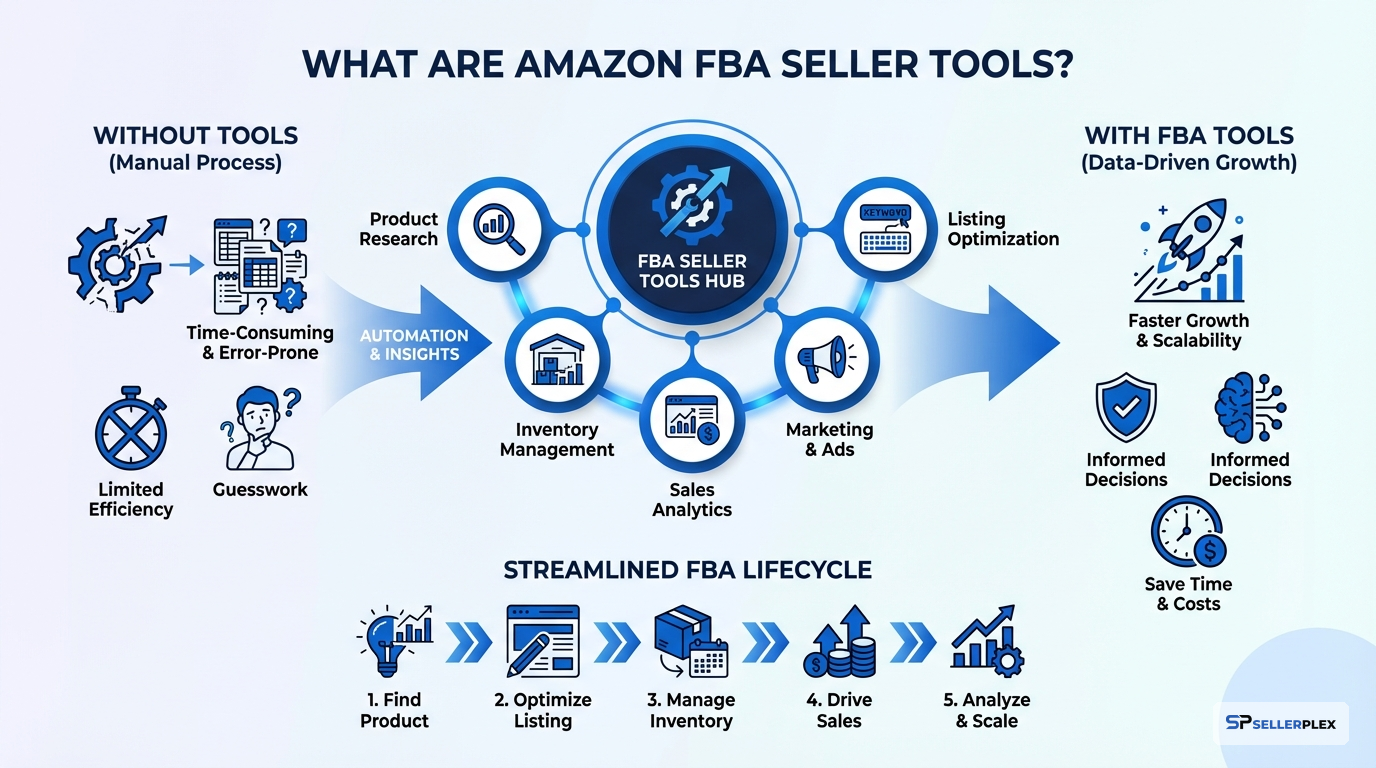
Amazon FBA seller tools are software platforms, reporting systems, and operational resources that help you run an Amazon business more efficiently. Usually, these tools support product research, keyword tracking, listing optimization, inventory planning, repricing, analytics, and advertising performance.
More importantly, amazon fba seller tools turn raw marketplace data into decisions you can act on. For example, Amazon’s own Product Opportunity Explorer helps you evaluate demand patterns, while Seller Central reporting helps you monitor sales, traffic, and fulfillment trends. Additionally, third-party platforms often add deeper keyword intelligence, profitability views, and workflow automation.
For 7- and 8-figure brands, this matters because account complexity compounds fast. Once you manage multiple SKUs, global marketplaces, and rising ad spend, manual tracking breaks down. Therefore, amazon fba seller tools become less about convenience and more about control.
How Amazon FBA Seller Tools Work
Different amazon fba seller tools solve different operational problems, but most follow the same basic process. They collect data, organize it, surface patterns, and help you act faster.
1. They pull marketplace and catalog data
First, tools gather information from Amazon, your catalog, ad accounts, or connected systems. That can include sessions, conversion rates, keyword rankings, inventory levels, and reimbursement gaps.
2. They turn data into dashboards or alerts
Next, the tool translates that information into reports, trend lines, or notifications. As a result, you can quickly see whether a SKU is losing rank, an ASIN is understocked, or PPC spend is rising faster than revenue.
3. They support decisions or automation
Some amazon fba seller tools only report issues. Others also automate actions such as repricing, keyword tracking, or inventory forecasting. However, automation still needs oversight because bad inputs can create expensive downstream mistakes.
4. They help teams standardize workflows
Finally, tools create a shared operating system. That means your account manager, PPC lead, and supply chain owner can work from the same set of numbers. If you already invest in Amazon account management services, this alignment becomes even more valuable because execution gets faster and cleaner.
In other words, the best amazon fba seller tools do not just show you data. They reduce response time across the account.
Key Benefits of Amazon FBA Seller Tools
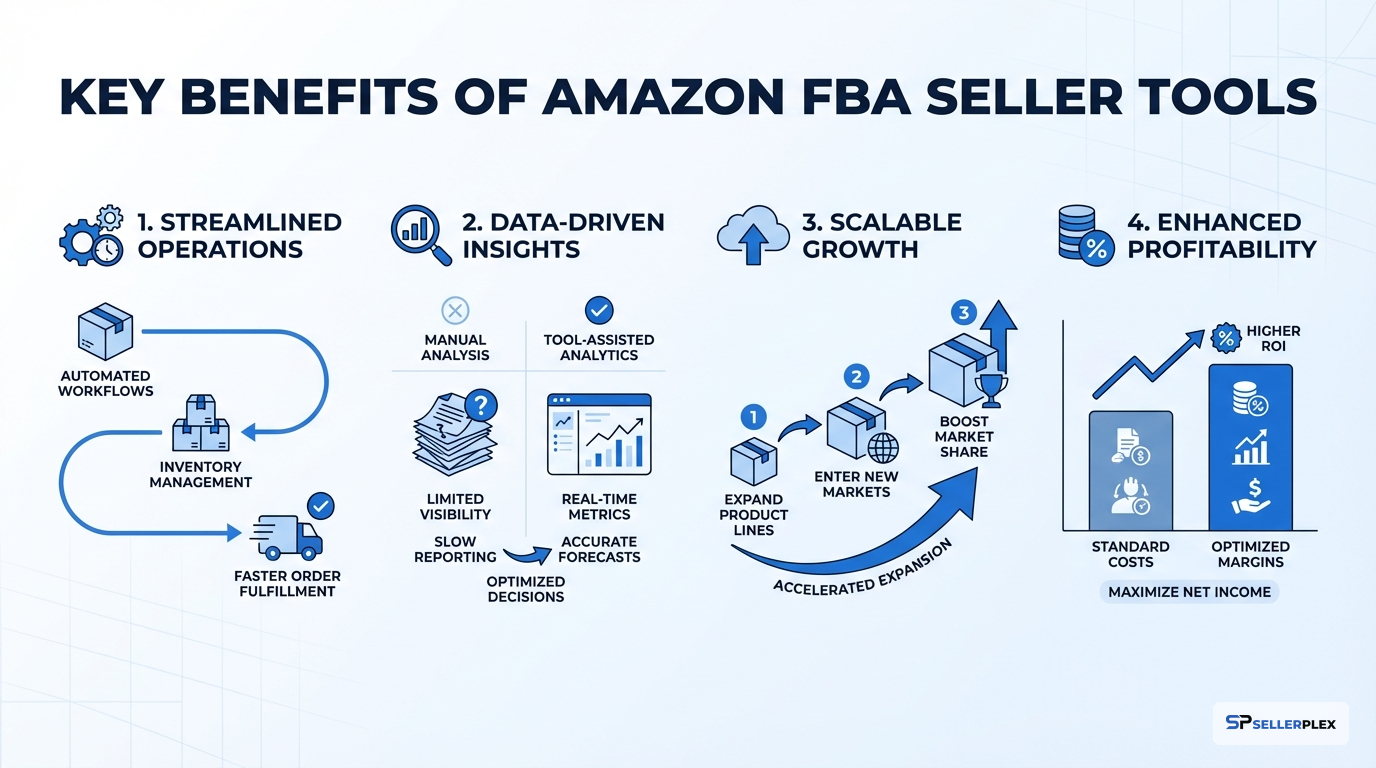
When used correctly, amazon fba seller tools can improve both efficiency and profit quality. The biggest benefits usually show up in these areas:
Better product and keyword research
- You can validate demand before launching or expanding a SKU.
- Additionally, you can identify search volume shifts earlier and adjust your content or PPC plan before competitors react.
Stronger inventory planning
- Tools help you model lead times, sell-through, and reorder windows.
- As a result, you reduce the risk of stockouts, which can damage rank and organic momentum.
Faster listing optimization
- You can spot weak titles, image gaps, and conversion problems sooner.
- For example, a structured process paired with Amazon content creation support often improves click-through rate and conversion without increasing traffic costs.
Tighter advertising control
- Amazon PPC performance deteriorates fast when keyword waste goes unchecked.
- Therefore, reporting tools help you isolate wasted spend, evaluate TACoS trends, and connect ads to real profit. SellerPlex’s own paid performance data recently showed Google Ads CPA improving to $65.52 while tighter optimization reduced leakage.
Clearer profitability reporting
- Revenue growth alone can hide margin loss.
- Good dashboards show landed cost, fees, ad spend, and return behavior together, so you can make smarter decisions at the SKU level.
Better team coordination
- Finally, tools reduce fragmented decision-making.
- If your operations, content, and PPC owners all use different data sources, execution slows down and mistakes multiply.
Step-by-Step Guide to Choosing Amazon FBA Seller Tools
Choosing amazon fba seller tools should be an operating decision, not a shopping spree. Use this process instead.
Step 1: Audit your current bottlenecks
Start with the problems that hurt margin the most. For one brand, that may be stockouts. For another, it may be poor listing conversion or ad waste. Because the problem determines the tool, you should never start with features.
Step 2: Separate software gaps from execution gaps
Many sellers assume they need more amazon fba seller tools when they actually need better ownership. If your catalog changes are slow, your issue may be process discipline rather than missing software.
Step 3: Prioritize four core categories
In most cases, you need tools for research, listing and keyword intelligence, inventory planning, and reporting. Additionally, you may need specialized support for advertising or forecasting if your SKU count is growing quickly.
Step 4: Evaluate integration and reporting depth
A tool is only useful if your team can trust the output. Therefore, check how often data refreshes, what metrics it surfaces, and whether it can be used across functions. A beautiful dashboard with weak operational relevance is still a weak tool.
Step 5: Test on one brand problem first
Do not roll out multiple amazon fba seller tools at once. Instead, use one tool to solve one high-value issue. For example, you might use a keyword platform to improve your listing strategy while also comparing results against Amazon product listing optimization best practices.
Step 6: Build a weekly operating cadence
Tools create value when they shape decisions every week. That means setting owners, review dates, thresholds, and action rules. If no one owns the dashboard, the dashboard does not matter.
Step 7: Measure ROI by saved margin or time
Finally, judge amazon fba seller tools by economic output. Did they reduce stockouts? Improve conversion? Lower ad waste? Save hours of manual analysis? If not, remove them.
Build a Leaner Amazon Tool Stack
Get a free account review to find the tools and workflows your brand actually needs.
Best Tools and Resources for Amazon Sellers
The best amazon fba seller tools usually combine Amazon-native data with targeted third-party analysis. Here are the most useful categories to evaluate.
Amazon Seller Central and Product Opportunity Explorer
Start with Amazon’s own ecosystem. Seller Central and Product Opportunity Explorer provide first-party demand, catalog, and operational visibility. Since the data comes directly from Amazon, it should anchor your reporting stack.
Keyword and market intelligence platforms
Next, a research platform such as Helium 10 or Jungle Scout can help you evaluate search demand, listing gaps, and launch opportunities. These tools are useful when you need deeper visibility than Seller Central alone provides.
Inventory and supply planning systems
If lead times are volatile, forecasting tools become more valuable. However, software only works when procurement, operations, and demand planning stay aligned. That is why many brands also need stronger Amazon supply chain management support.
Performance and profitability reporting
Finally, you need a clean reporting layer that connects traffic, ads, fees, and contribution margin. Otherwise, even the best amazon fba seller tools will only tell you what happened, not whether it was profitable.
Common Mistakes to Avoid
Sellers often buy amazon fba seller tools for confidence, then use them in ways that create more noise than clarity. Avoid these common mistakes.
Mistake 1: Buying overlapping tools
Many brands pay for multiple platforms that surface nearly identical keyword and sales data. Consequently, they increase cost without improving decisions.
Mistake 2: Letting dashboards replace ownership
A tool can show a problem, but it cannot own the fix. If no one is responsible for inventory, listings, or ad efficiency, the issue simply stays visible for longer.
Mistake 3: Chasing features instead of outcomes
A large feature set looks impressive. However, most brands only need a few reliable views tied to revenue, conversion, and stock health.
Mistake 4: Ignoring operational context
Some amazon fba seller tools recommend actions that make sense in isolation but fail in the real business. For example, a forecasting model can suggest aggressive replenishment while cash flow or supplier constraints say otherwise.
Mistake 5: Failing to review tool ROI quarterly
Tool stacks expand quietly. Therefore, review every subscription against measurable output at least once per quarter.
Advanced Tips and Strategies
Once you have the basics in place, amazon fba seller tools become more powerful when you use them as part of a disciplined operating model.
Build one source of truth for weekly reviews
First, consolidate the numbers that matter most: sessions, conversion rate, ad efficiency, inventory risk, and contribution margin. If your team debates which dashboard is right every Monday, decision speed collapses.
Pair tools with service-line owners
Additionally, assign one owner per function. Your PPC lead should own ad reporting. Your ops lead should own inventory health. Your account owner should connect the dots. That operating rhythm is what separates a tool stack from a real growth system, which is also why many brands outsource execution through Amazon account management outsourcing.
Use thresholds, not opinions
Define action triggers before a problem appears. For example, set thresholds for low-stock alerts, ACoS spikes, CVR drops, and suppressed listings. As a result, your team reacts faster and argues less.
Connect tool output to content and PPC actions
When search demand shifts, your listing, creative, and ad structure should move with it. Therefore, your amazon fba seller tools should inform both organic and paid decisions, not sit in separate silos. If your ads are scaling, this should also tie into a broader Amazon PPC strategy.
Keep your stack lean as complexity rises
Finally, complexity does not justify tool sprawl. In fact, more tools often create slower decisions. The best-performing brands usually run a focused stack with clear owners and strong follow-through.
Frequently Asked Questions
What are the most important amazon fba seller tools for growing brands?
The most important amazon fba seller tools usually cover research, keyword intelligence, inventory planning, and profitability reporting. Most growing brands do not need dozens of subscriptions. They need a small set of trusted tools tied to weekly decisions.
Are amazon fba seller tools enough to scale an account on their own?
No. Amazon fba seller tools improve visibility, but they do not replace execution. You still need strong account ownership, faster decision-making, and clear operating processes.
Should you use Amazon’s native tools or third-party tools?
You usually need both. Amazon’s native tools provide first-party data and should anchor your reporting. Third-party tools can add deeper keyword, research, and forecasting capabilities when you need more operational detail.
How much should you spend on amazon fba seller tools?
That depends on your SKU count, complexity, and team maturity. However, the better question is whether the tools improve profit, reduce waste, or save time. If they do not create measurable value, they are too expensive.
Which mistakes make amazon fba seller tools less effective?
The biggest mistakes are overlapping subscriptions, poor ownership, weak review cadence, and using dashboards without action thresholds. In many cases, the issue is not the software but the operating model around it.
Can amazon fba seller tools help lower advertising waste?
Yes, especially when they improve visibility into keyword performance, conversion trends, and SKU-level profitability. However, you still need disciplined campaign management and listing quality to turn those insights into lower waste.
Next Steps
Conclusion
Turn tool data into action
The right amazon fba seller tools can absolutely help you scale faster. However, tools only create value when they support better execution across inventory, content, ads, and account management. If your stack is bloated, underused, or disconnected from real decisions, you are paying for visibility without control.
Get an expert account review
If you want help evaluating your stack, cleaning up workflow gaps, and building a more profitable Amazon operating system, start with SellerPlex’s Amazon account management service. You will get a clearer view of what to keep, what to cut, and where execution is leaking margin.
Ready to Grow Your Amazon Business?
Book a free strategy session with our Amazon and e-commerce specialists. No obligations, just actionable insights.