


TL;DR: Ecommerce bookkeeping services record and reconcile every sale, fee, refund and inventory cost so you know what each product really earns. A good one closes your books every month, splits marketplace payouts into their real parts, tracks cost of goods per SKU and plans cash against your next purchase order. A general bookkeeper who books one deposit per payout cannot do that.
Table of Contents
- Why ecommerce books break when general bookkeeping is applied
- What do ecommerce bookkeeping services include?
- Ecommerce bookkeeper or general bookkeeper: how do they compare?
- Signs you need ecommerce bookkeeping help now
- How to vet an ecommerce bookkeeping provider
- Where sellers get burned with bookkeeping providers
- How SellerPlex handles ecommerce bookkeeping
- Where to start
- Frequently Asked Questions
Most online sellers start looking for help after the same moment. The bank balance says one thing, the dashboard says another, and nobody can explain the gap. Revenue went up last quarter, yet cash went down, and the tax bill arrived anyway.
That gap is almost always a bookkeeping problem. At SellerPlex we run finance for Amazon and ecommerce brands alongside their ads, accounts and supply chain, so we see the same patterns across many sets of books. This guide covers what you should get from a provider, what to check before you sign and where sellers usually get burned.
Why ecommerce books break when general bookkeeping is applied
Ecommerce books break because marketplaces pay you net, while your accounts need everything gross. A single Amazon settlement mixes sales, referral fees, FBA fees, ad charges, refunds, reimbursements and reserve holds into one deposit. If your bookkeeper records that deposit as “sales,” your revenue, your fees and your margin are all wrong at once.
The fee load is large enough that this matters. Amazon’s selling plans and fee page lists the Professional plan at $39.99 a month, plus a referral fee on every sale that is 15% in many categories. Add fulfillment fees, storage and advertising, and a big share of every dollar never reaches your bank. Booked as one net number, those costs disappear from view.
Inventory makes it harder. You pay a supplier months before a unit sells, the goods sit in a warehouse and then at Amazon, and some units get lost, damaged or returned. Cost of goods sold has to follow the units. A bookkeeper who expenses inventory when the supplier invoice is paid will show a loss in the month you restock and a fake profit in the month you sell through.
The usual symptom
You see it when the profit and loss report swings wildly from month to month while sales stay flat. That swing tells you the books follow cash timing, which hides what the business actually earns.
What do ecommerce bookkeeping services include?
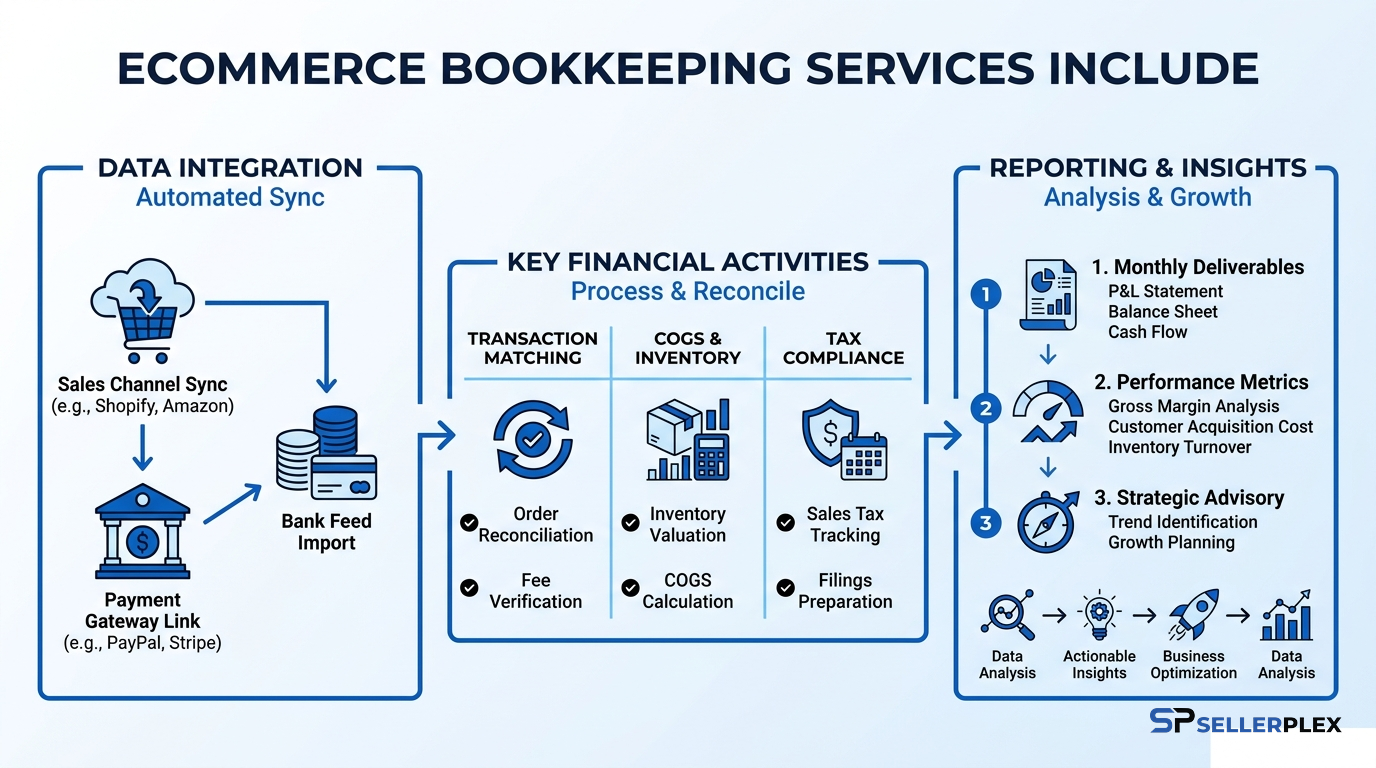
Ecommerce bookkeeping services include monthly reconciliation of every sales channel, per-SKU cost of goods, inventory valuation and a monthly close with a profit and loss statement you can act on. The better providers add cash flow planning and supplier payment handling. Here is what each piece should look like in practice.
Settlement reconciliation, line by line
Each marketplace payout gets broken into its parts: gross sales, each fee type, refunds, promotions, reimbursements and reserves. Those parts then get matched to the deposit that lands in your bank. When the numbers do not tie out, someone investigates before the month closes. This is the step most general bookkeepers skip, and it is where missing reimbursements and wrong fee charges usually show up.
Cost of goods per SKU
Landed cost per unit should include the product, freight, duties, prep and inbound shipping to the warehouse. Without it, you cannot tell which products carry the brand and which ones quietly lose money. We cover the measurement side of this in our guide to measuring true SKU-level profit.
Inventory valuation at period end
Your closing inventory has to be counted and valued at the end of every period. That number drives cost of goods sold, which drives profit, which drives tax. The IRS covers the accepted methods, including FIFO and the treatment of goods that cannot be sold, in Publication 538 on accounting periods and methods.
A monthly close you can act on
You should get a profit and loss statement, a balance sheet and a short note on what changed every month, on a fixed date. A close that arrives two months late is a history lesson. A close on the 15th of the next month still lets you change an ad budget or a reorder.
Cash flow and payments
Good ecommerce bookkeeping looks forward as well. It maps your cash on hand against your next inventory order and the payout calendar, so you can see whether you can afford the order before you place it. Some providers also run supplier and freight forwarder payments, which keeps those costs coded correctly from the start.
Ecommerce bookkeeper or general bookkeeper: how do they compare?
An ecommerce bookkeeper works from marketplace reports and SKU data, while a general bookkeeper works from bank feeds. Both can file clean returns. Only one can tell you which products are profitable. The table shows where the difference lands.
If you sell on one channel with ten products and small volume, a careful general bookkeeper may be enough for now. Once you run several channels, FBA inventory or paid ads that eat a real share of revenue, the general approach starts producing numbers you cannot trust.
Signs you need ecommerce bookkeeping help now
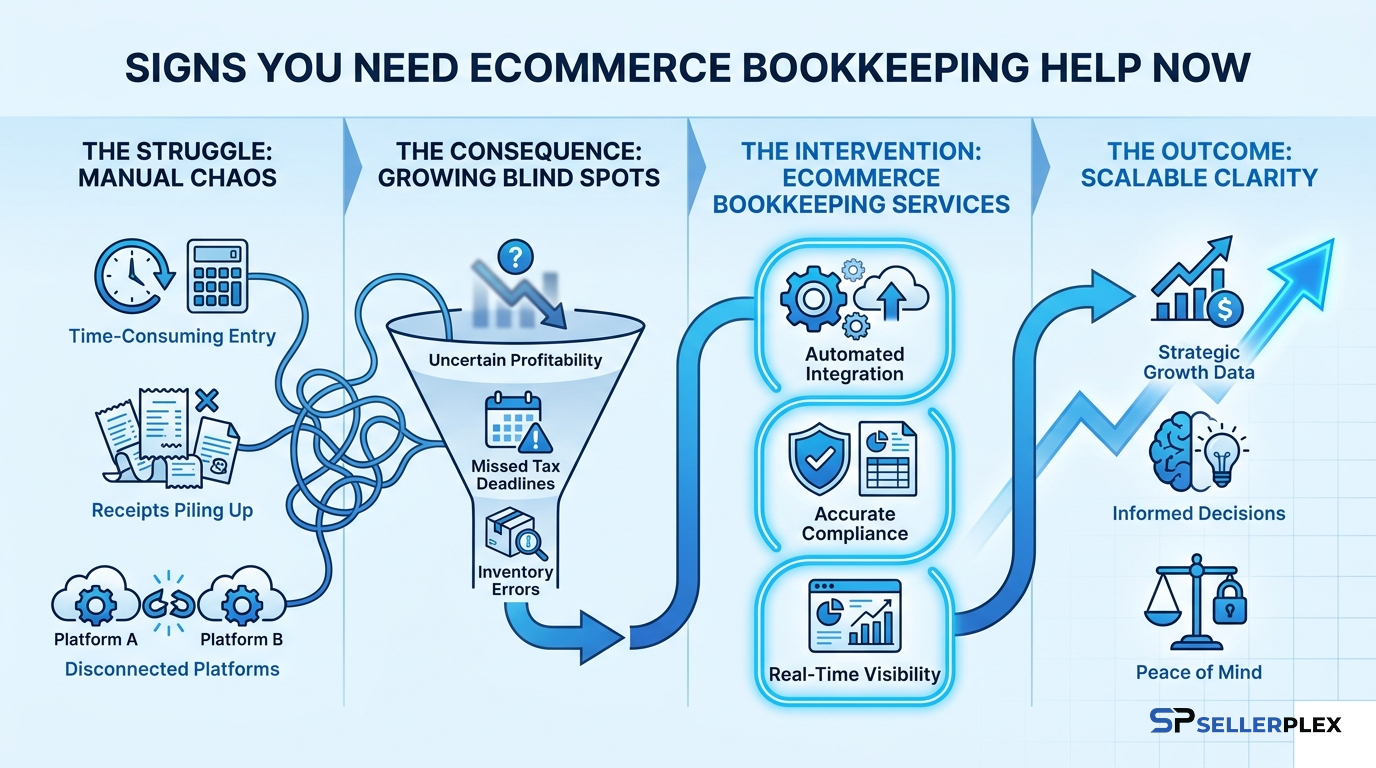
You need help when your books can no longer answer basic business questions within a day. A few situations make that obvious.
Your accountant asks for “the inventory number” at year end and nobody has one. Your ad team reports a healthy return on ad spend, yet the business has less cash than last year. You plan to raise money or sell the company, and a buyer’s due diligence list asks for monthly SKU-level margin going back two or three years.
Growth adds pressure too. A brand moving from one marketplace to three triples the reconciliation work overnight. Sellers who add Walmart or a Shopify store to Amazon often find their bookkeeper simply stops reconciling the smaller channels.
What the IRS expects from you either way
The rules do not change with the size of your bookkeeping budget. According to the IRS guidance on how long to keep records, the standard period is 3 years from filing. It stretches to 6 years if you underreport income by more than 25% of the gross income on your return. A provider who downloads and stores your marketplace reports each month makes those years easy to prove.
See What Your SKUs Really Earn
A senior strategist will walk through your books and show you which products make money and where margin leaks each month.
How to vet an ecommerce bookkeeping provider
Vet a provider by asking them to walk through one of your real settlement reports before you sign. How they handle that single file tells you more than any sales call.
Ask how they treat reserve holds, reimbursements and refund fees. Ask when they release inventory cost into cost of goods sold, and how they value goods that are lost or unsellable. Ask which day of the month your close arrives. Vague answers on any of these mean you will be paying for a bank feed tidy-up.
Questions about scope
Check which channels are covered and whether new channels cost extra. Check whether they handle supplier payments and payment terms, or only record them. A provider who can also help negotiate payment terms with suppliers changes your cash position, which a pure recorder of transactions never will.
Questions about connection to the business
The strongest sign is whether they connect the numbers to decisions. Can they show you what your ads really return after fees and cost of goods? Can they tell you whether your cash supports the next reorder? Bookkeeping that stops at a compliant tax file leaves the most valuable part on the table.
Where sellers get burned with bookkeeping providers
Sellers get burned most often by providers who promise automation and deliver a software connector with nobody checking the output. Connectors that pull marketplace data are useful. They also map fees to the wrong accounts, double count refunds and miss reimbursements when Amazon changes a report format. Someone has to review the result every month.
A second trap is the cheap catch-up. Months of unreconciled payouts get “fixed” with one large adjusting entry so the balance sheet ties out. The tax return gets filed, yet the monthly history is useless for any buyer or lender who asks for it later.
The third is splitting finance from operations completely. If your bookkeeper never talks to whoever runs your inventory, reorders get placed without a cash check. Our piece on inventory management for ecommerce shows how quickly that drains cash from both ends.
A quick sanity check on your current books
Pull last month’s profit and loss and add up the Amazon fee lines. If they come to less than the referral fee alone, often 15% of sales, the other fees are probably buried inside revenue. That is a sign the payouts were booked net and nothing below that line can be trusted.
How SellerPlex handles ecommerce bookkeeping
SellerPlex runs bookkeeping built for Amazon FBA sellers as part of a wider operations team. We have managed more than 100 Amazon brands since 2018 with over 80 in-house specialists, so the people closing your books sit next to the people running your ads and supply chain.
The monthly work covers end-to-end bookkeeping, a profit and loss statement every month and cost of goods built per SKU. It also covers inventory valuation at the end of each period, settlement reconciliation against your bank and payments to suppliers and forwarders. We also negotiate payment terms where that helps your cash flow.
Because the finance team works with our supply chain management team, your reorder plan and your cash plan come from the same numbers. Many sellers start with finance and later move other work to us, and our guide on when to outsource Amazon management covers how to decide what to hand off first.
Where to start
Start with one month. Take your most recent Amazon settlement and try to match it, line by line, to your bank deposit and your profit and loss. If you can do it in an hour, your books are in decent shape. If you cannot, that gap is costing you decisions every week.
When you want a second set of eyes, our team will review your current setup and show you what we would fix first. Learn more about our ecommerce bookkeeping services for Amazon and multichannel brands.
Frequently Asked Questions
How much do ecommerce bookkeeping services cost?
Pricing usually depends on monthly order volume, the number of sales channels and whether inventory accounting is included. Most providers charge a monthly fee rather than hourly rates. Ask for a quote based on one real month of your data, and check whether catch-up work for past months is priced separately.
Can I do ecommerce bookkeeping myself with software?
You can for a small store on one channel, if you review the output every month. Software pulls marketplace data well but often misclassifies fees, refunds and reimbursements. Once you hold inventory at Amazon or sell on several channels, the review work grows quickly and mistakes start affecting your tax return.
What is the difference between bookkeeping and accounting for an online store?
Bookkeeping records and reconciles every transaction and produces monthly statements. Accounting uses those records for tax returns, tax planning and financial advice. An ecommerce store needs both, and the accountant’s work is only as good as the books underneath it, so clean monthly bookkeeping comes first.
Do Amazon sellers need accrual accounting?
Not always. The IRS lets many smaller businesses use the cash method if average annual gross receipts for the prior 3 years fall under a set limit, listed as $26 million and indexed for inflation in Publication 538. Your accountant should confirm the method, but per-SKU profit tracking works best on accrual.
How often should an ecommerce business close its books?
Close the books every month, ideally within two to three weeks of month end. Monthly closes catch fee errors and missing reimbursements while you can still claim them. They also give you profit numbers in time to change ad budgets, prices and reorder quantities before the next month runs away from you.
Ready to Grow Your Amazon Business?
Book a free strategy session with our Amazon and e-commerce specialists. No obligations, just actionable insights.
Day-to-day Seller Central operations handled for you: catalog health, cases, compliance and buyer messages.
Want more of this in your Google results? Add SellerPlex as a preferred source.