


TL;DR: The Amazon best seller list ranks products in each category by sales, with recent sales weighted more than older ones, and it updates frequently. Reviews and page views play no part. Use it to size a category, track competitors and spot demand shifts. A spot on the list follows sales, so the way up runs through traffic, conversion and stock.
Table of Contents
- What is the Amazon best seller list?
- How is Amazon Best Sellers Rank calculated?
- The four lists sellers should watch
- What the list can and cannot tell you
- How sellers use the best seller list for product research
- How do you get a product onto the Amazon best seller list?
- Common ways sellers misread the rank
- Where to start
- Frequently Asked Questions
Most sellers open the list for one of two reasons. They want to know whether a product idea has real demand, or they want to know why a competitor suddenly sits above them. Both are good questions, and the list answers part of each. The trick is knowing which part.
We manage Amazon accounts for brands every day at SellerPlex, and the best seller rank is one of the first numbers we check in an audit. It is also one of the most misread.
What is the Amazon best seller list?
The Amazon best seller list is a set of public rankings of the best-selling products in each Amazon category, built from sales. Amazon describes the page as “our most popular products based on sales. Updated frequently.” on its Amazon Best Sellers page.
Each product that sells gets a Best Sellers Rank (BSR) in its category and in one or more subcategories. You can see it on the product detail page under “Product information.” A lower number means more sales: #1 is the top seller.
The list you see as a shopper is simply the top of that ranking, category by category. So when people say “the best seller list,” they usually mean one of three things:
- The public list for a category or subcategory.
- A single product’s BSR on its detail page.
- The orange “Best Seller” badge in search results.
The badge has its own rule
According to Amazon’s seller guide to Best Sellers Rank, the badge shows on products that rank #1 in a category with at least 100 products and meet an ordering threshold. A narrow subcategory can hand out a badge to a product that sells modestly. That is useful to know when a competitor waves the badge in your face.
How is Amazon Best Sellers Rank calculated?
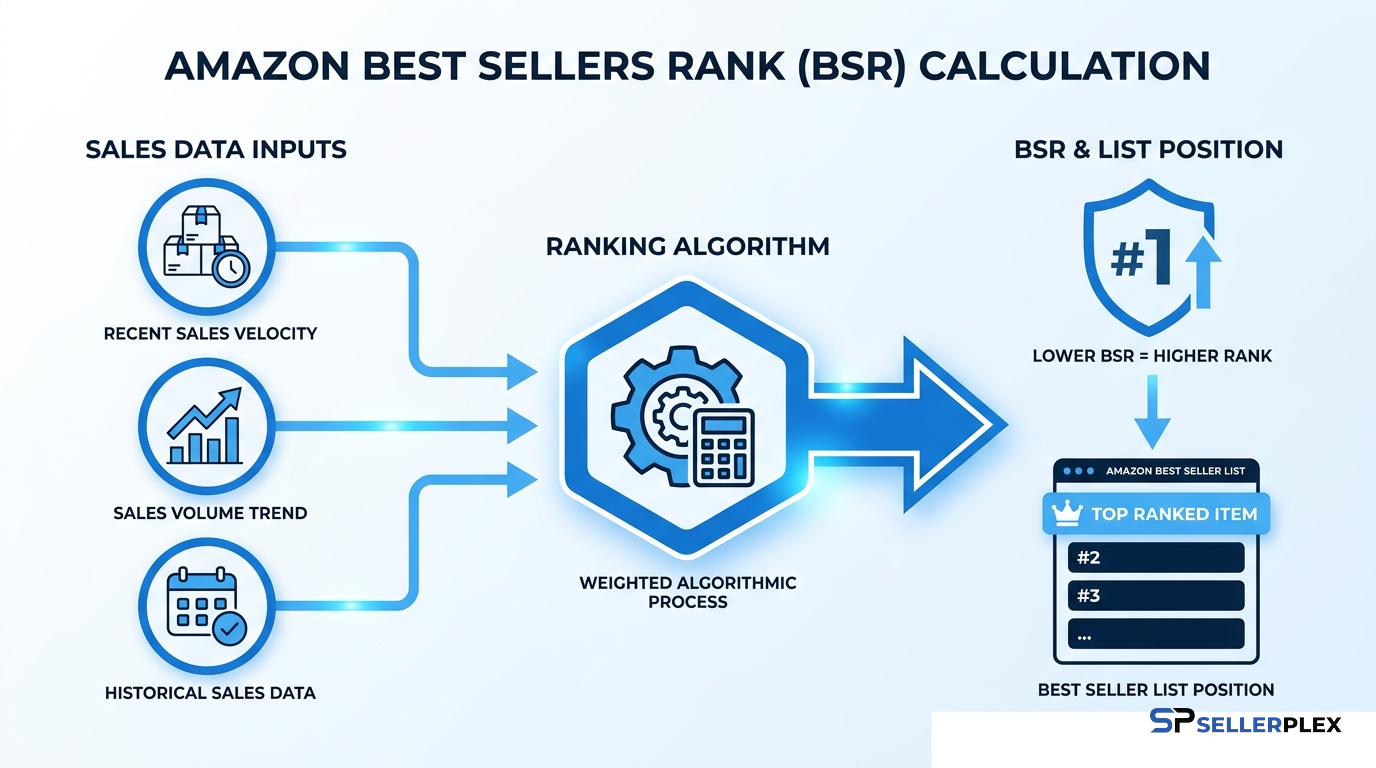
Best Sellers Rank is calculated from Amazon sales volume, with recent sales counting more than older sales. Amazon’s help page on Best Sellers Rank says the calculation “is updated frequently to reflect recent and historical sales of every item sold on Amazon.”
Three points follow from Amazon’s own wording, and each one changes how you should read the number.
Reviews and page views do not count
Amazon’s seller guide states that BSR is not influenced by page views or customer reviews. A product with 40 reviews can outrank one with 4,000 if it sold more units this week. Reviews matter a lot for conversion, which then feeds sales, but the rank itself only sees orders.
Rank is relative to the category
A rank means nothing without its category. #500 in Home & Kitchen is a strong seller. #500 in a small subcategory of garden tools may move a few units a day. Amazon’s help page is honest about this: the main list “doesn’t always indicate how well an item is selling in relation to similar items,” which is why it shows category and subcategory ranks on the product page.
One product, several ranks, several stores
A product can carry a different rank in each category it sits in. Rankings also differ by marketplace. Amazon’s own example is an item ranked #1 in the US and #23 in the UK or Japan store. If you sell in Europe and the US, check each store separately.
The four lists sellers should watch
The best seller list has siblings, and each one answers a different question. The table below is how we use them in account reviews.
Amazon’s Movers & Shakers page confirms the 24-hour window. That short window makes it noisy. One Lightning Deal can push a product up thousands of places for a day. Watch it for patterns across a few weeks, never for a single jump.
What the list can and cannot tell you
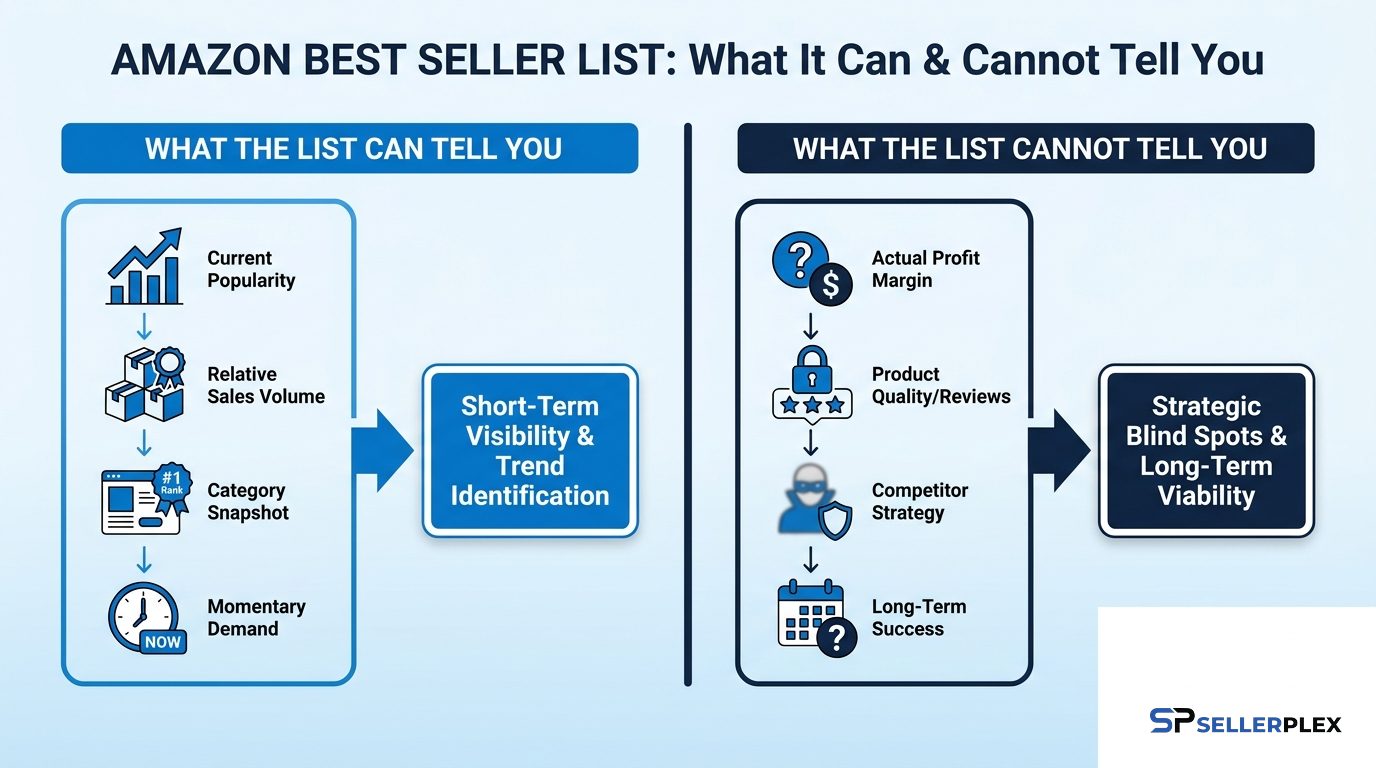
The best seller list is a good demand signal and a poor profit signal. It tells you what sells. It says nothing about who makes money doing it.
Here is what you can read from it with some confidence:
- Category depth. If the top 20 products all show strong ranks in the main category, demand is real and spread out. If only the top three do, one or two brands own the space.
- Price bands. The prices of the top sellers show where buyers are comfortable. A new product priced well above that band needs a clear reason.
- Seasonality. A product that sits at #300 in March and #30 in November is a Q4 product. Plan stock and ad budget around that curve.
And here is what it hides:
- Margin. The top seller may be buying its rank with heavy ad spend or a price cut. You cannot see its fees, landed cost or ad bill.
- Ad dependence. Sponsored sales count as sales. A rank propped up by ads can fall fast when the budget stops.
- Units. Amazon does not publish unit numbers next to the rank. Tools estimate sales from BSR, and the estimates differ between tools.
That last point is worth stressing. When you read “sells 900 a month” in a research tool, it is a model’s guess from rank history. Use it to compare products inside one tool. Do not build a purchase order on it alone. Our guide to choosing product research tools covers how to cross-check those estimates.
How sellers use the best seller list for product research
Start with the subcategory. That is where the rank means something and where a new product actually competes.
Pull the top 50 in that subcategory and note four things for each product: price, rank, review count and the brand behind it. Then look for gaps. A subcategory where the top sellers have middling reviews and similar listings often leaves room for a product with a clear improvement.
Check the rank over time before you decide. A product that holds a steady rank for 90 days is a steadier bet than one that spiked last week. Most research tools keep rank history, and Amazon’s Brand Analytics gives brand-registered sellers search and purchase data on top of that.
Finally, run the numbers yourself. Take the list price, subtract Amazon’s referral and FBA fees, your landed cost and a realistic ad budget. If the product only works at zero ad spend, the list has shown you a crowded market with no room for you.
How do you get a product onto the Amazon best seller list?
You get onto the list by selling more units than the products around you, consistently, in the right category. There is no shortcut. Anything that raises daily orders raises the rank, and anything that stops orders drops it.
In practice, four levers do most of the work.
Pick the right category
Rank is relative, so category choice matters. Amazon’s seller guide advises choosing the most specific accurate category and keeping a parent ASIN and all its child variations in the same one. A product in the wrong browse node competes against products its buyers never compare it with. Moving it to the right node is plain accuracy, and it often shows a truer rank.
Fix conversion before traffic
More traffic to a weak listing burns money. Main image, title, bullets and A+ content decide how many visitors buy. A listing that converts at 8% needs half the traffic of one at 4% to reach the same rank. Our content team rebuilds images and copy for exactly this reason, and we covered the basics in our guide to Amazon product listing optimization.
Find Out What Is Holding Your Rank Back
Talk to a strategist about your listings, ads and stock, and get a clear plan for your top products.
Use ads to start the flywheel, then taper
Sponsored Products sales count toward BSR. That makes ads the fastest way to lift the rank of a new or stalled product. It also makes them expensive when bids run unchecked.
Click prices keep climbing. In our Amazon PPC benchmarks, the median cost per click across the 34 to 37 US accounts we manage rose from $0.99 in January to $1.36 in June 2026, a 37% increase. The median account ran a 38% ACoS, and ads drove 41% of total sales. A rank that depends on ads for four in ten sales is only as strong as the ad budget behind it.
The goal is to use ads to earn organic sales, then let the organic share carry more of the rank. A well-run Amazon PPC program watches TACoS (ad spend against total sales) for that reason. If TACoS falls while the rank holds, the flywheel is working.
Never run out of stock
A stockout is the quickest way off the list. Sales stop, so the rank falls day after day, and competitors pick up your buyers. When stock returns you pay to climb back, often with higher ad spend. Keep enough inventory at FBA to cover lead time plus a buffer, and plan for Q4 weeks in advance. Our supply chain work exists largely to prevent this one expensive mistake.
Common ways sellers misread the rank
The most common mistake is treating a rank like a score for quality. Amazon’s seller guide says plainly that a sales rank does not tell you what customers think of a product. Top sellers with poor reviews show up in almost every category we audit.
The second is reacting to daily swings. Rank moves every time Amazon recalculates, and a single large order can lift a slow product for a day. Judge your own rank on a weekly average.
The third is chasing the badge. A #1 badge in a tiny subcategory looks good in a screenshot. It does little if the product still sits outside the top 1,000 in its main category, where most shoppers browse.
The last is comparing ranks across categories. #2,000 in Books and #2,000 in Industrial & Scientific are very different sales levels. Compare within a category, or not at all.
Where to start
Open the Best Sellers list for your own subcategory today and find your products and your three closest competitors. Write down each rank, price and review count, and repeat it every Monday for a month. That simple log will tell you more than any single snapshot.
If the rank is slipping and you cannot tell whether ads, listings or stock are the cause, that is the kind of problem we untangle in the first weeks of working with a brand. Our full-service Amazon agency team runs ads, content and supply chain together, so the fix does not stop at one lever.
Frequently Asked Questions
How often does the Amazon best seller list update?
Amazon says its Best Sellers lists are updated frequently, and it does not publish an exact schedule. Sellers usually see rank changes several times a day. The Movers & Shakers list uses a 24-hour window. For your own decisions, track the rank weekly, because single-day moves are often caused by one deal or one large order.
Does a good Best Sellers Rank mean a product is profitable?
No. The rank only reflects sales volume, and Amazon’s calculation ignores price, fees, ad spend and returns. A product can hold a top 100 rank while losing money on every unit because of heavy advertising or a deep discount. Always work out fees, landed cost and ad cost per unit before you judge a product by its rank.
Do reviews affect Amazon Best Sellers Rank?
Not directly. Amazon’s seller guide states that page views and customer reviews do not influence BSR, which is calculated from sales. Reviews still matter a great deal, because strong ratings raise conversion, and more conversions mean more sales. So reviews move the rank only through the orders they help win.
What does the orange Best Seller badge mean?
The badge marks the product ranked #1 in a category with at least 100 products, provided it also meets an ordering threshold. It can appear in a small subcategory, so it does not always mean high overall sales. Check the product’s rank in its main category to see how much it actually sells.
Can you see how many units a product sells from its rank?
Not from Amazon. Amazon shows the rank but not unit sales for other sellers’ products. Research tools estimate monthly units from rank history, and their estimates often differ. Use one tool consistently to compare products, and treat its numbers as a range. Your own Seller Central data is the only exact figure for your products.
Ready to Grow Your Amazon Business?
Book a free strategy session with our Amazon and e-commerce specialists. No obligations, just actionable insights.
Day-to-day Seller Central operations handled for you: catalog health, cases, compliance and buyer messages.
Want more of this in your Google results? Add SellerPlex as a preferred source.