


Sourcing issues in supply chain management rarely show up as one clean problem. For Amazon sellers, they usually appear as margin compression, stockouts, late FBA shipments, inconsistent product quality, supplier silence, and freight costs that make a winning SKU look weaker every reorder cycle.
Table of Contents
- The sourcing problems that hit Amazon sellers hardest
- Why sourcing issues become margin issues
- Build a sourcing risk map before the next reorder
- Fix the forecast before blaming the supplier
- Put supplier scorecards where decisions happen
- Negotiate around total cost, not unit price
- Qualify backup suppliers before you need them
- Keep sourcing connected to Amazon content and ads
- A 30-day sourcing control plan
- Frequently Asked Questions
The mistake is treating sourcing as a procurement task. For a scaling Amazon brand, sourcing is an operating system. It connects demand planning, supplier capacity, payment terms, landed cost, inspection standards, FBA shipment timing, and cash conversion. When one part is loose, the account feels it in Buy Box stability, ranking, ad efficiency, and contribution margin.
This is where many 7 and 8 figure sellers lose control. They have a supplier list, but not a sourcing process. They have purchase orders, but not a supplier risk model. They have freight quotes, but not a landed cost view by SKU. That works when the catalog is small. It breaks when you are managing multi-SKU complexity across seasonal demand, Amazon storage limits, production delays, and tighter cash cycles.
The sourcing problems that hit Amazon sellers hardest
Most sourcing advice is written for enterprise procurement teams. Amazon sellers need a different lens. The cost of a weak sourcing decision is not only a higher unit cost. It can also mean lost organic rank, wasted PPC spend, stranded inventory, suppressed listings, and slow capital recovery.
Here are the sourcing issues that create the most operational damage.
Supplier dependency
One factory carrying most of your volume is efficient until it is not. A supplier can raise prices, miss production windows, change materials, deprioritize your order, or face local disruptions. If you cannot shift volume quickly, you have no leverage.
Amazon sellers often build this risk accidentally. A supplier performs well on the first few orders, so the brand keeps expanding volume without qualifying alternates. By the time the SKU is doing $80,000 a month, the backup supplier is still an untested sample in a spreadsheet.
Lead time drift
Lead times rarely jump from 30 days to 75 days overnight. They drift. Production takes 4 extra days, booking freight takes 3 extra days, customs clearance slows down, and the FBA receiving window stretches. Each delay looks manageable in isolation. Together, they create a stockout.
Amazon’s own FBA documentation makes clear that sellers are responsible for planning inbound shipments correctly and preparing inventory according to FBA requirements. Miss those windows and you do not just lose sales, you lose ranking momentum. The operational detail matters: Amazon’s FBA shipment creation guidance is not optional reading for brands that depend on marketplace velocity.
Hidden landed cost increases
A supplier quote is not your cost. Your real cost includes packaging, inspection, freight, duties, warehousing, prep, FBA inbound transportation, storage, removals, defects, and cash tied up in inventory.
A $0.40 unit cost increase may look small until you apply it across 40,000 units and combine it with higher freight and slower sell-through. The sourcing team may still report the supplier as “competitive” while the finance view shows the SKU slipping below target contribution margin.
Quality inconsistency
Quality failures are sourcing failures when specifications are weak, inspections are inconsistent, or supplier accountability is unclear. On Amazon, a small defect rate can create a large review problem.
One recurring example: a brand orders a revised accessory kit from the same supplier, assumes prior QC standards still apply, and skips pre-shipment inspection because the reorder is time sensitive. The units arrive with a minor fit issue. Refund rate climbs, review sentiment shifts, and the PPC team has to spend more to maintain the same conversion volume.
Weak communication rhythm
Supplier communication often looks fine until a problem hits. If updates only happen when someone asks, the brand is already behind.
Good sourcing operations use a cadence: production start confirmation, material check, in-line inspection, packaging approval, pre-shipment inspection, freight booking, document review, and inbound tracking. Without that rhythm, the first clear signal of trouble may arrive after the recovery window has closed.
Why sourcing issues become margin issues
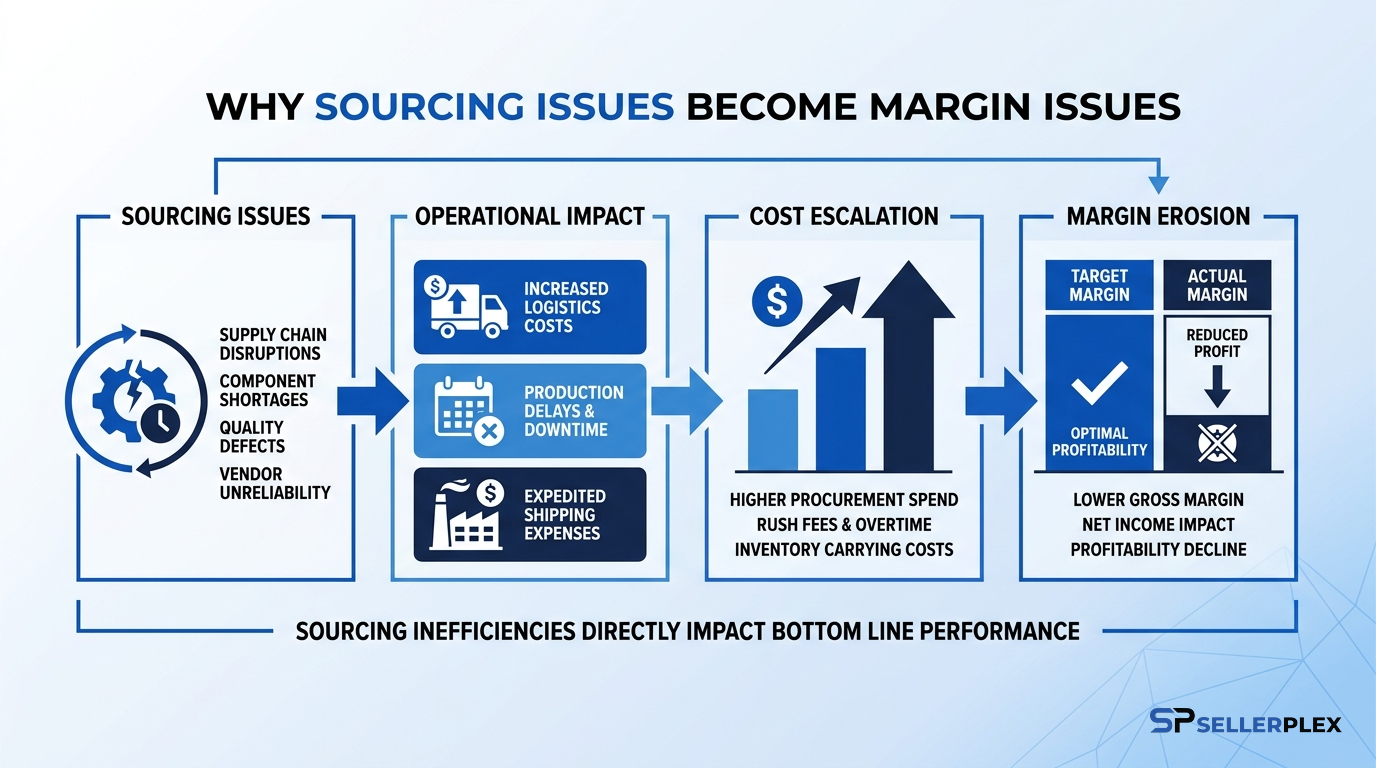
Sourcing problems are easy to underestimate because they start upstream. The P&L impact appears later.
Your PPC cost rises when conversion drops after a quality issue. Your storage fees rise when a supplier ships the wrong quantity mix. Your cash position tightens when lead time uncertainty forces you to over-order. Your organic rank falls when a late shipment creates a stockout on a hero SKU.
That is why sourcing cannot sit apart from Amazon account management. It has to connect to demand forecasts, reorder points, FBA shipment planning, and SKU-level profitability. SellerPlex treats this as part of end-to-end Amazon supply chain management, not a one-time vendor search.
A useful question for every scaling brand: can you explain why each reorder quantity, supplier allocation, freight method, and inspection decision protects margin? If the answer lives in different inboxes, you do not yet have control.
Build a sourcing risk map before the next reorder
You do not need a complicated procurement system to get better. You need a clear view of where risk sits.
Start with your top 20 revenue-driving SKUs. For each SKU, document:
The point is not documentation for its own sake. The point is decision speed. When demand changes or a supplier misses a milestone, your team can see the tradeoff instead of guessing.
Segment suppliers by revenue exposure
Not every supplier needs the same level of management. A low-volume accessory supplier does not need the same weekly operating cadence as the factory behind your top SKU.
Use a simple segmentation model:
This prevents your team from spreading attention evenly across unequal risks. It also gives suppliers a clear signal: critical volume gets tighter operating standards.
Fix the forecast before blaming the supplier
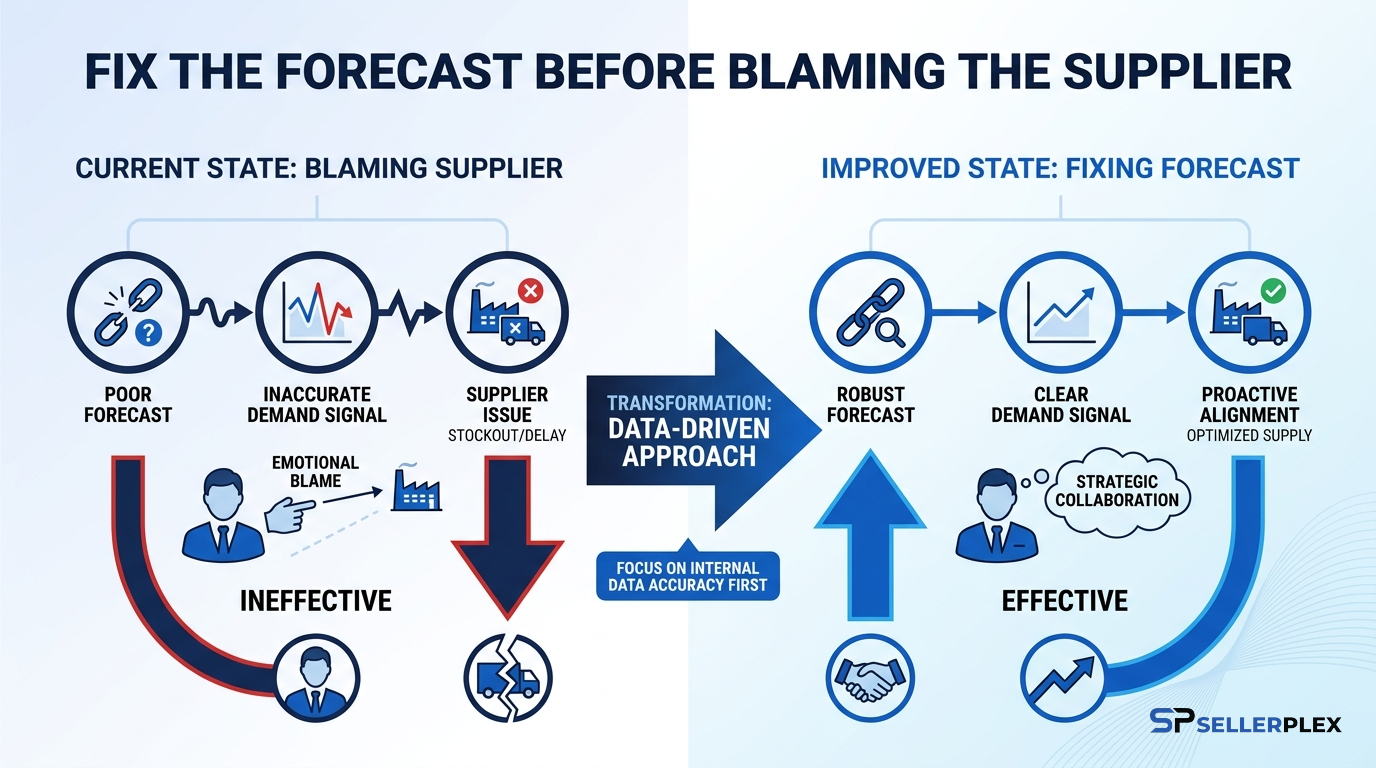
Some sourcing issues are supplier problems. Many are planning problems.
If your reorder point is based on a 35-day lead time but the real end-to-end lead time is 58 days, the supplier will look late even when production is reasonable. If your forecast ignores PPC scaling, seasonal lift, or a promotion, the purchase order will be too small before it is placed.
Amazon sellers need demand planning that connects marketplace signals to supply decisions. That includes:
- Sales velocity by SKU and variation
- Promotional calendar and expected lift
- PPC scaling plans and budget changes
- Seasonality by category
- Current FBA inventory and inbound status
- Supplier lead time by recent actuals, not old assumptions
- Cash available for reorder timing
SellerPlex covers these controls inside Amazon account management support when supply decisions affect marketplace performance. The account cannot scale cleanly if ads, inventory, and supplier planning are moving in separate lanes.
This is also where published operational guidance helps. If your FBA inventory flow is the constraint, our guide to building a faster, leaner Amazon FBA supply chain breaks down the operating decisions that keep replenishment from turning into constant firefighting.
Stop Supplier Issues From Draining Margin
Get a practical review of your sourcing, inventory, and FBA flow before the next reorder locks in avoidable cost.
Put supplier scorecards where decisions happen
A supplier scorecard should not be a quarterly slide. It should influence purchase order allocation.
Track the metrics that actually change sourcing decisions:
- On-time production completion
- Defect rate by order
- Inspection pass rate
- Responsiveness during issue resolution
- Quote accuracy against final invoice
- Lead time variance
- Packaging accuracy
- Willingness to support improved terms or split shipments
Scorecards are most useful when tied to volume. A supplier that repeatedly misses inspection standards should not keep receiving the same order share just because they are familiar. A supplier with stronger reliability may deserve more volume even if the quote is slightly higher.
Amazon brands often over-optimize for unit cost because it is easy to compare. Reliability is harder to price, but it is often more valuable. A supplier that protects launch timing, review quality, and stock availability can create more profit than the cheapest quote on the page.
Negotiate around total cost, not unit price
Better sourcing does not always mean cheaper sourcing. It means stronger economics.
A factory may refuse a lower unit cost but accept better payment terms, improved packaging, smaller MOQs, priority production slots, consolidated shipments, or stricter defect accountability. Each of those can improve cash flow or reduce risk.
A useful negotiation sequence:
- Confirm the current landed cost by SKU, including freight, duties, prep, and storage.
- Identify which cost driver is hurting margin most.
- Ask for supplier changes tied to that driver, not a generic discount.
- Offer volume commitments only when demand planning supports them.
- Put quality and timing commitments into the purchase order.
For categories where freight is a major variable, external benchmarks are useful. The Freightos Baltic Index can help teams understand broader container rate movement, while official U.S. Customs import guidance helps keep duty and documentation risk in view. You still need SKU-level landed cost analysis, but market context prevents bad assumptions.
The same logic applies to Amazon operational cost. Our article on reducing Amazon sourcing costs without weakening your supply chain goes deeper on cost reduction that does not create quality or stockout risk.
Qualify backup suppliers before you need them
Backup suppliers are not useful if they have never produced to spec.
At minimum, a real backup supplier should have completed sample approval, packaging review, compliance checks, cost validation, and a small production run. If the only backup is a promising quote, you still have single-supplier exposure.
The right approach depends on SKU economics. For a hero SKU with high revenue concentration, dual sourcing may be worth the extra operational complexity. For a slower SKU, the better answer may be stronger terms with the current supplier and deeper safety stock planning.
When dual sourcing makes sense
Dual sourcing is most useful when one of these conditions is true:
- The SKU drives a large share of revenue
- The supplier has repeated lead time misses
- Production depends on volatile raw materials
- The product has compliance or quality sensitivity
- Freight lanes or regional disruptions create repeated delays
Do not split volume blindly. Split with a reason. You may use 80 percent with the primary supplier and 20 percent with a qualified backup to keep production warm. You may shift seasonal volume based on capacity. You may reserve the backup for urgent replenishment. The operating model should match the risk.
Keep sourcing connected to Amazon content and ads
Sourcing decisions affect more than operations. They shape the commercial plan.
If a supplier changes packaging, the listing images and A+ Content may need updates. If product quality changes, review risk rises. If inventory becomes tight, PPC budgets may need to slow down before ads accelerate a stockout. If a bundle component is delayed, the content and promotion calendar may need to shift.
This is why Amazon sellers need cross-functional operating discipline. The supply chain manager, account manager, PPC manager, and content team should work from the same inventory truth. SellerPlex connects those functions across Amazon PPC management, Amazon listing content support, and supply chain execution, because the marketplace impact does not respect department lines.
For SKU-level decisions, profitability visibility matters too. A sourcing change that looks small in procurement can be material after Amazon fees, ads, refunds, and storage costs. Our guide to measuring true SKU-level profit before you scale explains how to keep those decisions grounded in actual economics.
A 30-day sourcing control plan
If sourcing issues are already showing up in your Amazon account, do not start with a broad transformation. Start with 30 days of control.
Week 1: Audit your top SKUs. Pull revenue share, current inventory, inbound shipments, supplier ownership, lead time actuals, landed cost, and defect history. Identify the SKUs where stockout, quality, or margin risk is highest.
Week 2: Rebuild reorder assumptions. Replace old lead time estimates with recent actuals. Add FBA receiving time. Align reorder points with current demand, planned promotions, and available cash.
Week 3: Review supplier performance. Score your suppliers against on-time delivery, defect rate, communication, and cost accuracy. Decide which suppliers need corrective action, reduced allocation, or backup qualification.
Week 4: Lock operating cadence. Create weekly reviews for Tier 1 suppliers, purchase order milestone tracking, pre-shipment inspection rules, and a shared inventory view for supply, PPC, and account management.
This plan will not solve every sourcing issue, but it will surface the problems that are currently hidden. That visibility is the first step toward margin protection.
Frequently Asked Questions
What are the most common sourcing issues in supply chain management for Amazon sellers?
The most common issues are supplier dependency, inaccurate lead times, rising landed costs, inconsistent quality, weak supplier communication, and poor alignment between reorder planning and Amazon demand.
How do sourcing issues cause Amazon stockouts?
Sourcing issues cause stockouts when supplier delays, production changes, freight problems, or inaccurate reorder assumptions leave too little inventory to cover real sales velocity and FBA receiving time.
Should Amazon sellers use multiple suppliers for every product?
No. Multiple suppliers make sense for high-revenue SKUs, risky categories, volatile materials, or suppliers with repeated performance issues. Low-volume SKUs may only need stronger terms and better planning.
How often should supplier performance be reviewed?
Tier 1 suppliers that support major revenue should be reviewed weekly. Mid-volume suppliers can be reviewed biweekly, while low-risk suppliers can be managed around production and shipment milestones.
What is the difference between unit cost and landed cost?
Unit cost is the supplier’s product price. Landed cost includes the full cost to make inventory sellable, including packaging, inspection, freight, duties, prep, warehousing, Amazon-related costs, and defects.
Where to start
The fastest way to reduce sourcing issues in supply chain management is to connect supplier decisions to margin, inventory, and marketplace execution. Start with your top revenue SKUs, calculate true landed cost, verify real lead times, and identify where one supplier can put sales at risk.
If your team is scaling faster than your sourcing controls, SellerPlex can help build the operating rhythm around forecasting, supplier coordination, FBA shipment planning, warehouse coordination, and cost control. See how our supply chain management team supports Amazon brands that need fewer stockouts, cleaner replenishment, and stronger margin protection.
Ready to Grow Your Amazon Business?
Book a free strategy session with our Amazon and e-commerce specialists. No obligations, just actionable insights.
Inventory planning, freight and 3PL coordination from factory to FBA, so stockouts stop costing you sales.