


Introduction
Amazon ecommerce trends are moving faster than most brands can operationalize. You are not just competing on price or ranking anymore. You are competing on inventory accuracy, ad efficiency, content quality, and your ability to react before margin slips.
Table of Contents
In 2026, the sellers winning on Amazon are usually the ones with tighter systems, clearer reporting, and faster execution. In this guide, you will see which amazon ecommerce trends matter most, how they affect your P&L, and what actions you can take now to stay competitive.
What Is Amazon Ecommerce Trends?
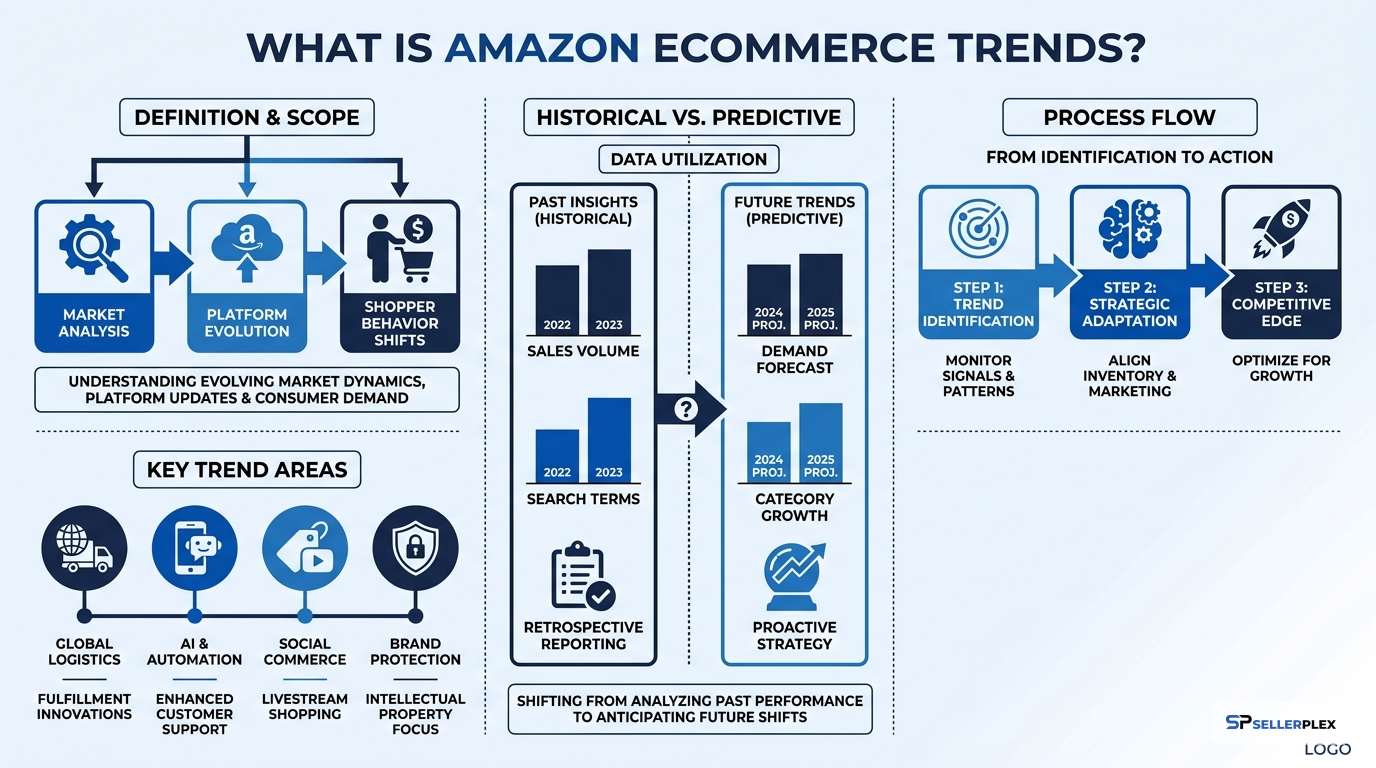
Amazon ecommerce trends are the platform, consumer, and operational shifts that change how you win sales on Amazon. They include changes in advertising costs, fulfillment expectations, search behavior, content standards, pricing pressure, and marketplace competition.
More specifically, amazon ecommerce trends show you where Amazon is rewarding sellers and where it is tightening the rules. For example, Amazon continues to push faster delivery, better product detail pages, and stronger retail readiness. At the same time, ad costs and competition remain intense, which means sloppy operations get exposed faster.
Because of that, tracking amazon ecommerce trends matters if you run a 7 or 8 figure brand. If you miss one major shift, you can lose share through higher TACoS, suppressed listings, stockouts, or weaker conversion rates. However, if you catch the trend early, you can build an edge through better execution, not guesswork.
How It Works
1. Amazon changes what it rewards
First, Amazon adjusts the marketplace through algorithm changes, policy updates, and customer experience priorities. According to Amazon Seller Central, the platform consistently emphasizes selection, price, and convenience. Those priorities shape visibility and conversion.
2. Shopper behavior changes demand patterns
Next, buyers respond to inflation, convenience, seasonality, and shifting category demand. In practice, that means your click-through rate, conversion rate, and average order value can move even when your product stays the same.
3. Competitors react at different speeds
Additionally, competitors adopt new tactics unevenly. Some improve listing content, some raise ad budgets, and others expand assortments. As a result, the brands that respond faster often gain ranking and market share before lagging sellers catch up.
4. Marketplace data reveals the trend
You can usually see amazon ecommerce trends in a few core places: search term reports, business reports, ad data, inventory health, and category benchmarks. For example, rising CPCs with flat conversion often signal a tougher paid environment. Meanwhile, lower sessions with stronger conversion can suggest better targeting or improved content.
5. Operations determine whether you benefit
Ultimately, trends only help if you turn them into action. That means aligning pricing, ads, content, and replenishment. If you need help connecting those levers, a structured Amazon account management service can help you move faster without adding chaos.
Key Benefits
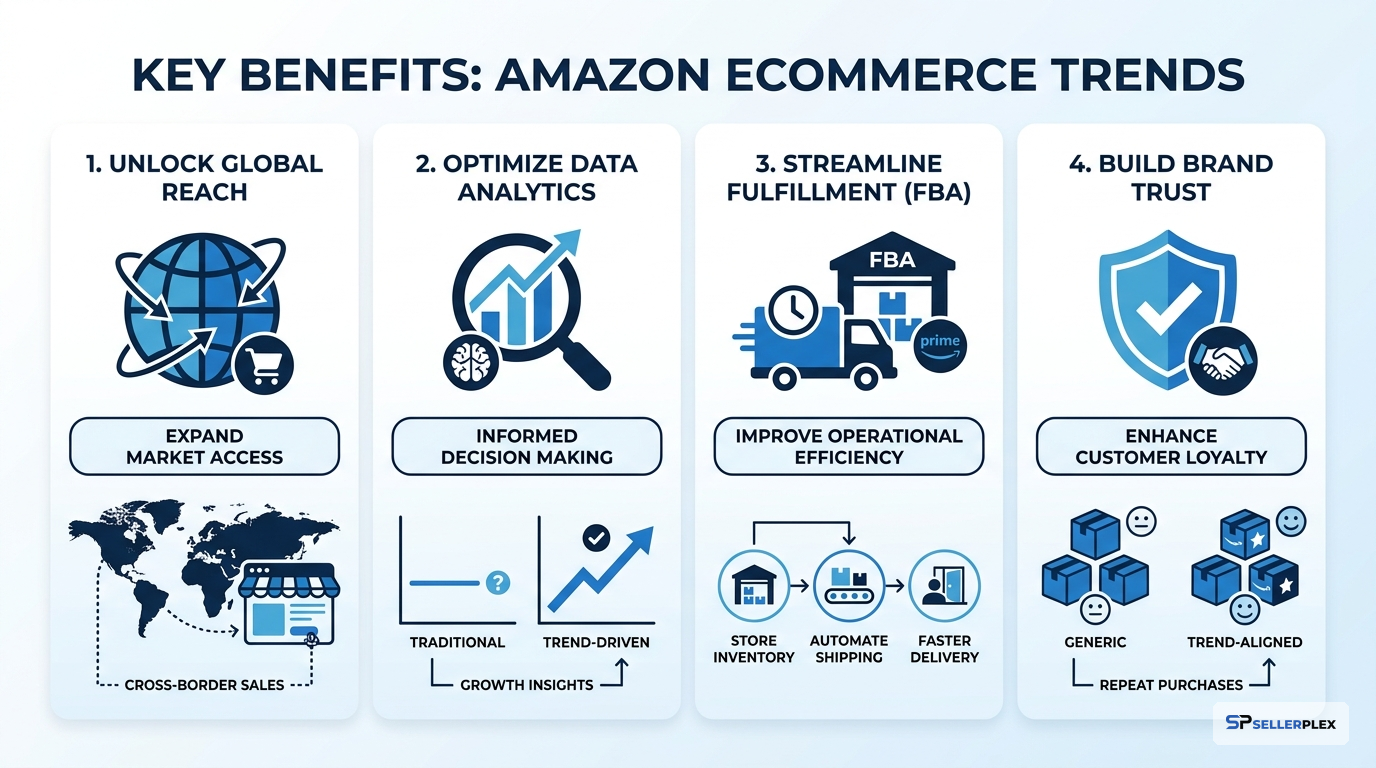
Tracking amazon ecommerce trends gives you practical advantages, not just industry knowledge.
Better budget allocation
- You can move spend toward channels, products, and campaigns that match current demand.
- Therefore, you avoid funding tactics that worked last year but now drain margin.
Faster response to rising ad costs
- Amazon CPCs remain volatile across categories.
- If you monitor the trend early, you can adjust bids, creative, and campaign structure before waste compounds. This is especially important if you are already reviewing Amazon PPC cost in 2026.
Stronger conversion rates
- Improved content, richer images, and clearer differentiation help you convert traffic more efficiently.
- In other words, you can grow sales without depending only on more spend.
Lower stockout risk
- Demand shifts often hit forecasting before they hit revenue reports.
- By watching trend signals, you can rebalance purchasing and protect organic rank.
More accurate strategic planning
- Amazon ecommerce trends help you decide when to expand catalog depth, enter new markets, or change pricing.
- Consequently, you make fewer reactive decisions under pressure.
Better cross-functional alignment
- Trends create shared priorities for marketing, operations, and finance.
- If your teams are misaligned, you lose time. If they work from the same marketplace signals, execution gets sharper.
More resilient growth
- Sellers that adapt to amazon ecommerce trends typically rely less on one SKU, one tactic, or one channel.
- That makes the business more stable when competition spikes.
Step-by-Step Guide
Step 1: Audit your current baseline
Start by pulling 90 days of data across sessions, conversion, TACoS, CPC, stockouts, and contribution margin. Without a baseline, you cannot tell which amazon ecommerce trends are helping or hurting your account.
Step 2: Identify the trend category
Next, define whether the signal is demand-driven, platform-driven, or operational. For example, a rising CPC trend is usually marketplace pressure. A drop in conversion after content changes is usually an execution issue.
Step 3: Map the trend to a business impact
Then, connect the trend to metrics that matter. Ask whether it affects revenue growth, gross margin, ad efficiency, or cash flow. This step matters because not every amazon ecommerce trends signal deserves immediate action.
Step 4: Prioritize the highest-leverage SKUs
Additionally, focus on the products that drive the largest share of revenue or profit. If 20% of your catalog drives 80% of your sales, start there. You will usually get faster returns than spreading effort evenly.
Step 5: Tighten listing quality
Update titles, images, A+ content, and backend search terms to match how shoppers search now. If you need a benchmark, review this guide to Amazon product listing optimization. Better content often helps you absorb marketplace volatility with stronger conversion.
Step 6: Rebuild campaign structure where needed
If amazon ecommerce trends show rising CPCs or weaker ROAS, simplify campaign architecture. Segment branded, non-branded, and product targeting. Moreover, isolate top ASINs so you can make cleaner bid decisions. For many brands, stronger Amazon PPC management is the fastest way to recover efficiency.
Step 7: Align replenishment with trend signals
Use sell-through, lead times, and seasonal shifts to revise purchase plans. According to Amazon’s FBA inventory guidance, stock health directly affects your ability to sustain growth. A trend is only useful if inventory can support it.
Step 8: Create a 30-day response plan
Finally, assign owners, deadlines, and KPIs. Your plan should include listing updates, ad tests, supply chain actions, and reporting checkpoints. If you want broader support, Amazon account management outsourcing can help you execute across functions.
Turn Trend Data Into Margin
See which marketplace shifts are hurting your performance and where you can recover profit fastest.
Best Tools and Resources
Amazon Seller Central
First, use Amazon Seller Central for business reports, search query insights, and inventory performance. It is the source of truth for many core trend signals.
Amazon Brand Analytics
If you are brand registered, Brand Analytics gives you valuable visibility into search terms and customer behavior. Therefore, it helps you spot amazon ecommerce trends before they show up in topline revenue.
Helium 10
Helium 10 is useful for keyword movement, competitor monitoring, and listing optimization workflows. It can support faster research when market conditions shift.
Jungle Scout
Jungle Scout helps with demand validation, market sizing, and opportunity scans. For example, it can help you gauge whether category growth is broad or SKU-specific.
SellerPlex operational support
Tools matter, but tools alone do not fix fragmented execution. If you need integrated help across PPC, content, and operations, SellerPlex offers Amazon content creation support and broader account execution.
Common Mistakes to Avoid
Treating every trend like an emergency
However, not every movement in the data is strategic. Some changes are short-lived. If you overreact to weekly noise, you create instability in ads, pricing, and replenishment.
Looking at ads without inventory context
A strong campaign does not matter if your lead times cannot support demand. Likewise, a weak campaign may actually be caused by low Buy Box share or suppressed listings. Always diagnose the full system.
Copying tactics from another category
What works in supplements may fail in home goods. Amazon ecommerce trends vary by category, price point, and review maturity. Therefore, avoid generic playbooks.
Ignoring contribution margin
Some brands chase revenue while margin erodes underneath. That is dangerous when fees, shipping costs, and CPCs are rising. Track profit after ad spend, not just top-line sales.
Delaying operational fixes
If you spot a trend but wait 60 days to respond, competitors get the advantage. In practice, slow action often costs more than imperfect action.
Advanced Tips and Strategies
Use trend clusters, not single metrics
First, evaluate amazon ecommerce trends through metric combinations. Rising clicks plus falling conversion suggests a different issue than falling clicks plus rising conversion. Clusters tell a clearer story.
Segment by lifecycle stage
Additionally, break analysis into launch, growth, and mature ASINs. A launch-stage product needs a different response than a bestseller defending rank. This prevents bad decisions caused by blended averages.
Build scenario plans for margin pressure
Create three operating plans: stable CPC, moderate inflation, and aggressive inflation. Then define what you will cut, defend, or expand in each case. As a result, you respond faster when market conditions shift.
Pair retail readiness with media strategy
Strong advertising only works when pricing, inventory, and content are already healthy. That is why the best operators connect media decisions with supply chain and listing execution. If your brand is scaling quickly, supply chain management support becomes a growth lever, not just an operations function.
Review trends at the SKU-family level
Finally, group parent-child variations, bundles, and closely related ASINs before making decisions. This helps you see whether a trend is product-specific or portfolio-wide.
Frequently Asked Questions
What are the most important amazon ecommerce trends in 2026?
The most important amazon ecommerce trends in 2026 include higher pressure on ad efficiency, stronger expectations for listing quality, tighter inventory discipline, and more competition across mature categories. You should also watch how customer acquisition costs and fulfillment costs change together because they often squeeze margin at the same time.
How often should you review amazon ecommerce trends?
You should review amazon ecommerce trends weekly at a high level and monthly in depth. Weekly reviews help you catch short-term issues in ads, conversion, and stock health. Monthly reviews are better for bigger decisions like budget allocation, assortment planning, and operational restructuring.
Do amazon ecommerce trends affect small and large sellers differently?
Yes, although the same marketplace shifts affect everyone, larger sellers usually feel them differently because they carry more SKUs, larger ad budgets, and more complex supply chains. That means trend detection matters even more once your brand is scaling past founder-led operations.
Which reports help you track amazon ecommerce trends?
The most useful reports usually include business reports, search query performance, advertising reports, inventory health, and contribution margin views. When you combine those, you can see whether the trend is driven by demand, competition, or execution gaps.
Are amazon ecommerce trends mostly about advertising?
No, advertising is only one part of the picture. Amazon ecommerce trends also include changes in shopper expectations, fulfillment standards, fee pressure, content requirements, and category competition. If you focus only on ads, you will miss the operational factors driving performance.
Can you respond to amazon ecommerce trends without adding headcount?
Yes, if you prioritize the highest-leverage actions first. Many brands can improve performance by tightening campaign structure, upgrading content, and improving forecasting before hiring internally. However, execution speed often becomes the limiting factor.
Conclusion
Amazon ecommerce trends are useful only when they change how you operate. If you track the right signals, prioritize the right SKUs, and connect ads with inventory and content, you can protect margin while still growing.
Next Steps
If your team needs help translating amazon ecommerce trends into a practical operating plan, SellerPlex can support the work across PPC, listings, and account management. Start with a closer look at your Amazon account management and identify where execution is costing you growth.
Ready to Grow Your Amazon Business?
Book a free strategy session with our Amazon and e-commerce specialists. No obligations, just actionable insights.
Related reading: Conversion Rate Optimization for Luxury Ecommerce, Without….