


TL;DR: No single tool wins. The strongest stack combines Amazon Brand Analytics for first-party search data, Helium 10 for keyword and competitive analysis, Jungle Scout for market estimates, and your own catalog and margin numbers. Use them to validate demand and model contribution margin against fees and ad spend before committing inventory dollars.
Introduction
If you are comparing the best product research tools, you are probably trying to answer a bigger question: which products can grow revenue without crushing your margin? That is not a software question alone. Instead, it is an operating decision that affects inventory, advertising, listing conversion, and cash flow.
Table of Contents
- Introduction
- What Are the Best Product Research Tools?
- How the Best Product Research Tools Work
- Key Benefits of Using the Best Product Research Tools
- Step-by-Step Guide to Using the Best Product Research Tools
- Best Tools and Resources to Support Product Research
- Common Mistakes to Avoid
- Advanced Tips and Strategies
- Frequently Asked Questions
- Conclusion
According to Amazon, data quality and listing relevance directly influence discoverability and conversion across the marketplace ecosystem. Meanwhile, many brands still rely on fragmented spreadsheets, gut feel, and delayed reports. In this guide, you will learn how the best product research tools fit into a practical workflow, what features matter most, which mistakes waste budget, and how to turn research into profitable execution.
What Are the Best Product Research Tools?
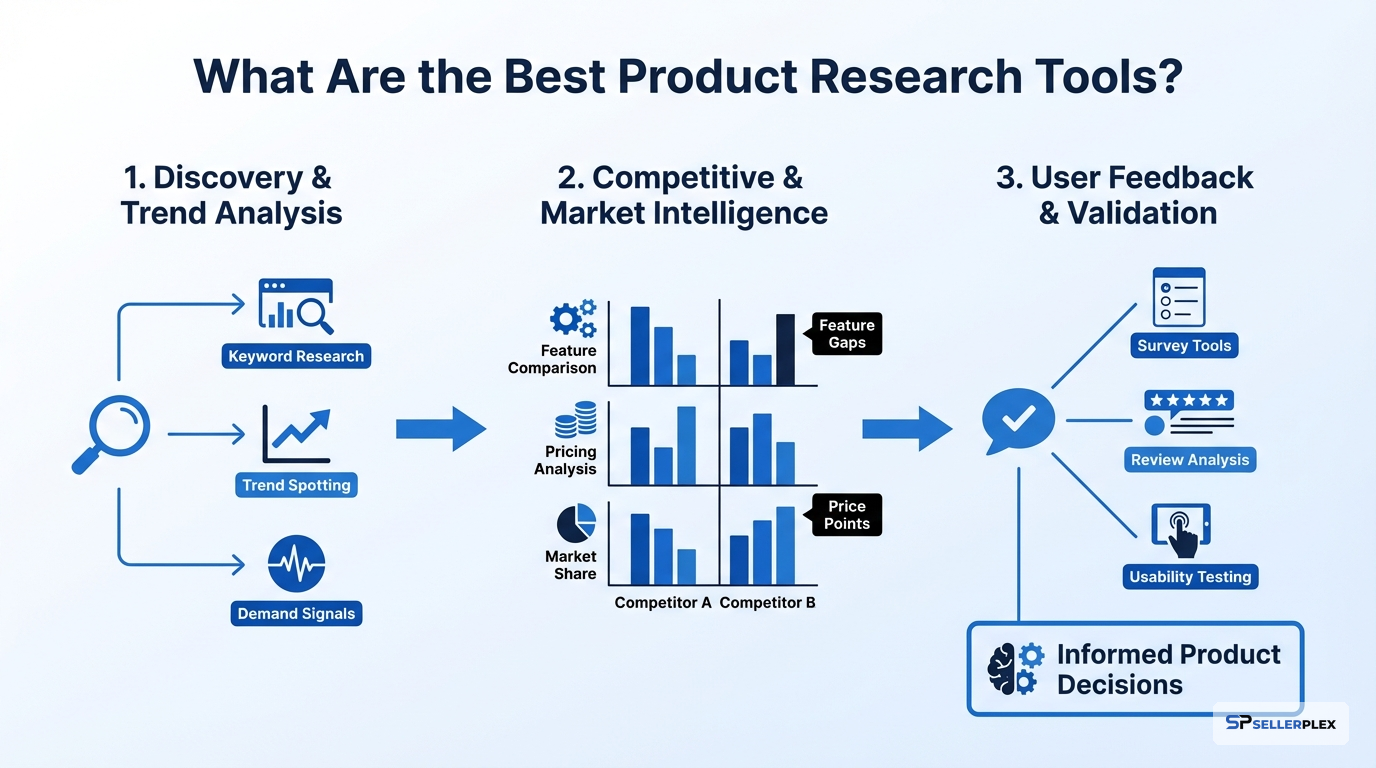
The best product research tools are platforms, databases, and validation resources that help you estimate demand, competition, pricing pressure, profitability, and customer intent before you launch or scale a product. For Amazon sellers, the best product research tools usually combine marketplace data, keyword intelligence, review analysis, and margin modeling.
However, the best product research tools are not always the tools with the longest feature list. The right stack is the one that helps you make faster decisions with fewer expensive mistakes. For example, a 7-figure brand may need demand validation, review mining, and supply chain forecasting far more than endless novelty-product alerts.
Because Amazon competition keeps rising, product selection errors get expensive fast. In addition, a weak decision can lead to excess stock, higher ad costs, and lower contribution margin. That is why strong brands pair research with broader operational systems such as Amazon account management, Amazon product listing optimization, and supply chain management support.
How the Best Product Research Tools Work
The best product research tools work by pulling signals from search demand, marketplace listings, pricing history, customer reviews, and competitor behavior. Then, they turn those signals into dashboards or reports you can act on.
1. They estimate demand
First, most tools look at keyword search volume, listing rank, category velocity, or trend data. That gives you a directional view of whether buyers actually want the product.
2. They surface competition patterns
Next, the best product research tools show how crowded the market is. For example, you can compare review counts, price concentration, listing quality, and brand dominance to see whether you can realistically win.
3. They connect research to unit economics
Additionally, good tools help you model fees, landed costs, and ad assumptions. This matters because a product with high demand can still fail if margin disappears after FBA fees and PPC.
4. They reveal customer needs
Review mining and content analysis show what buyers love, hate, and still need. As a result, you can improve positioning before you source inventory or rewrite a listing.
5. They support prioritization
Finally, you can score product ideas against clear criteria: demand, competition, margin, operational complexity, and fit with your catalog. Therefore, your team can stop chasing ideas that look exciting but do not scale.
In practice, this workflow gets stronger when research feeds execution. If a product opportunity looks solid, you still need conversion-ready content, tighter inventory planning, and disciplined ad launches. That is where services like Amazon PPC management and Amazon content creation become part of the growth system.
Key Benefits of Using the Best Product Research Tools
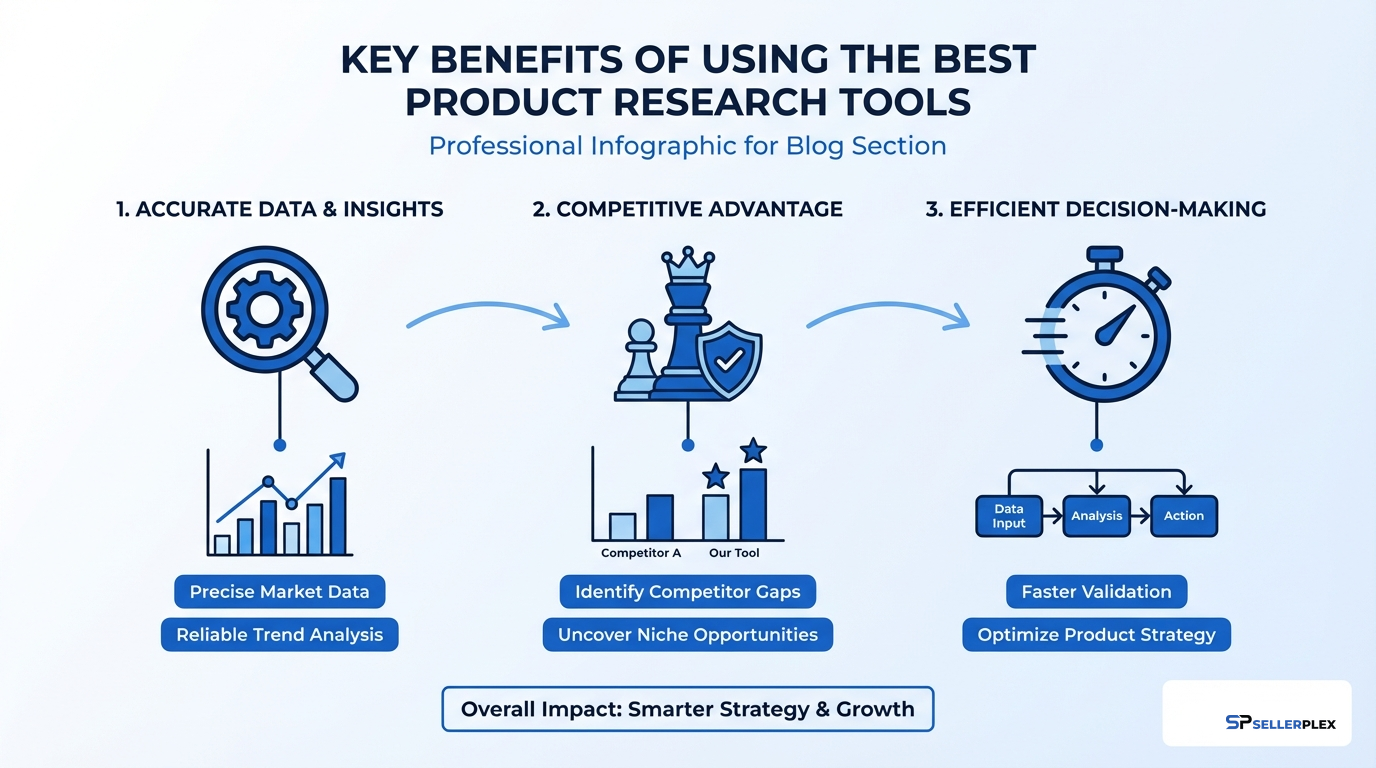
The best product research tools do more than save time. They reduce avoidable risk and help you allocate capital with more confidence.
Better demand validation
- You can spot whether interest is steady, seasonal, or fading.
- For example, trend data helps you avoid buying into a short-lived spike.
Faster competitive analysis
- Teams can review pricing bands, rating benchmarks, and listing saturation in minutes.
- Consequently, your team spends less time guessing where the market is already mature.
Stronger profit forecasting
- You can combine fees, freight, conversion assumptions, and ad cost scenarios.
- Therefore, product decisions become margin decisions, not just sales guesses.
Clearer content and positioning insights
- Review analysis exposes complaints, desired features, and language buyers already use.
- As a result, you can improve titles, images, and benefit-driven copy before launch.
More disciplined portfolio planning
- You can compare multiple opportunities using the same scorecard.
- In other words, the best product research tools help you prioritize what deserves working capital.
Better cross-team alignment
- Research data gives finance, operations, and marketing one source of truth.
- That matters because product bets affect reorder timing, advertising, and supply chain load simultaneously.
Lower cost of mistakes
- According to Jungle Scout’s seller trend reporting, product selection and profitability pressure remain core challenges for marketplace sellers.
- Therefore, better research reduces the odds of tying up cash in weak inventory decisions.
Step-by-Step Guide to Using the Best Product Research Tools
If you want the best product research tools to improve outcomes, build a repeatable workflow instead of chasing dashboards.
Step 1: Start with a narrow product hypothesis
Define the category, price band, customer use case, and margin target before you open any tool. Otherwise, you will drown in ideas that look interesting but do not fit your business model.
Step 2: Validate search and demand signals
Check keyword trends, category activity, and buyer interest. For example, compare monthly demand with seasonal swings so you do not confuse a temporary surge for durable demand.
Step 3: Audit the first page of results
Review top listings for image quality, review count, price clusters, and differentiation gaps. Additionally, note where incumbent brands are weak. Weak content often signals room for better execution.
Step 4: Model contribution margin
Estimate landed cost, referral fees, FBA fees, return rate, and ad spend. Then stress-test the numbers. Ask what happens if CPC rises 20% or if launch conversion lags your target.
Step 5: Mine reviews for unmet needs
Read negative reviews, Q&A, and competitor feedback themes. As a result, you can identify design improvements, messaging angles, and objection handling points.
Step 6: Score operational complexity
Assess supplier risk, packaging needs, replenishment cycles, and compliance requirements. However, do not ignore this step. Many promising products fail because they create inventory friction or quality-control headaches.
Step 7: Decide how you will win
Choose your edge before launch. That could be better bundling, clearer positioning, stronger listing conversion, or cleaner supply chain execution. If your only advantage is price, the product is weaker than it looks.
Validate Profit Before You Scale
Get a practical view of how product decisions affect ad spend, conversion, and margin.
Step 8: Turn insights into launch execution
Build the listing, ad plan, and inventory assumptions around the research findings. If reviews show confusion around sizing or usage, fix that in your images and copy before traffic hits the page. You can see how that execution layer matters in Amazon FBA optimization and Amazon PPC cost planning.
Best Tools and Resources to Support Product Research
There is no single winner for every team. Instead, the best product research tools usually combine a few specialized sources.
Amazon Brand Analytics
If you are brand registered, Amazon Brand Analytics gives you direct marketplace insight on search terms and shopper behavior. Therefore, it is one of the highest-value sources among the best product research tools because it gives you first-party Amazon data.
Helium 10
Helium 10 is useful for keyword discovery, listing analysis, trend checks, and competitive snapshots. Additionally, it helps teams move quickly when validating multiple opportunities.
Jungle Scout
Jungle Scout remains helpful for market estimates, opportunity scoring, and seller trend context. For many brands, it is a practical starting point when comparing the best product research tools for broader demand validation.
Internal catalog and margin data
Your own P&L, reorder performance, and ad history are often more valuable than external dashboards. In fact, the best product research tools become far more useful when paired with your actual contribution margin data.
Review mining workflows
A structured review-mining process, even in a spreadsheet, can outperform flashy dashboards when you need customer language and feature insights. Therefore, teams that combine tool output with disciplined analysis usually make better decisions.
Common Mistakes to Avoid
Even with the best product research tools, poor process can still produce bad product bets.
Mistake 1: Chasing demand without checking margin
High search volume looks attractive. However, if freight, returns, and PPC erase profit, you have not found a winner. Always test contribution margin before you commit.
Mistake 2: Trusting estimates as certainty
Most tools rely on modeled or sampled data. Therefore, treat forecasts as directional signals, not guaranteed outcomes. You still need operational judgment.
Mistake 3: Ignoring listing quality on page one
Some teams see crowded results and quit too early. In contrast, weak images, poor copy, and unresolved review themes may reveal a real opening for a better operator.
Mistake 4: Skipping review analysis
If you only look at volume and price, you miss buyer frustration. As a result, your product and content strategy become generic instead of differentiated.
Mistake 5: Overlooking supply chain realities
A product may look great in a dashboard and still create stockouts, inspection issues, or cash conversion pressure. That is why research should connect to Amazon account management outsourcing and supply chain planning.
Advanced Tips and Strategies
Once you know the basics, the best product research tools become more powerful when you layer them into broader growth systems.
Build a weighted scorecard
Create one score for demand, one for competition, one for margin, and one for complexity. Then assign weights based on your strategy. For example, a cash-constrained brand may weight margin and replenishment risk more heavily than top-line demand.
Compare demand against conversion potential
Do not stop at keyword volume. Instead, review whether the current first page deserves its traffic. If listings are weak, you may have more upside than the raw market estimate suggests.
Use review themes to shape your listing
Mine complaint language, then reflect those points in your images and bullets. Consequently, your product page answers buyer objections before they reduce conversion. This pairs well with Amazon product listing optimization.
Forecast ad pressure before launch
Estimate the traffic cost required to gain visibility. In other words, product research should include paid acquisition realism. If the niche will require aggressive spend, your launch plan must reflect that from day one.
Recheck opportunities every 30 to 60 days
Markets move. Therefore, revisit your top product ideas on a fixed cadence. Pricing compression, review growth, or inventory shifts can change the decision faster than many teams expect.
Frequently Asked Questions
What are the best product research tools for Amazon sellers?
The best product research tools for Amazon sellers usually combine marketplace data, keyword research, review analysis, and profitability modeling. Amazon Brand Analytics, Helium 10, Jungle Scout, and your own margin data are often the most practical mix because they help you validate demand and execution risk together.
How many product research tools do you actually need?
Most brands do not need a huge stack. In practice, 2 or 3 strong sources are enough if they cover demand, competition, and unit economics. Adding more tools does not help if your team lacks a clear decision framework.
Are product research tools accurate?
They are useful, but they are not perfectly accurate. Most third-party platforms estimate sales and demand using modeled data. Therefore, you should use them for directional insight, then validate with first-party signals, supplier input, and financial assumptions.
Can the best product research tools help reduce launch risk?
Yes, because the best product research tools can show whether a market is overcrowded, margin is too thin, or customer dissatisfaction creates an opening. However, they only reduce risk when your team turns the data into better sourcing, listing, and advertising decisions.
What should you look for when comparing the best product research tools?
Focus on search demand visibility, competitor benchmarks, review analysis, trend tracking, and profit modeling. Additionally, check whether the workflow is fast enough for your team to use consistently. A powerful platform that nobody uses is not the right tool.
Are free product research tools enough?
Free tools can help with early discovery, especially if you use Amazon search suggestions and internal catalog data. However, growing brands usually outgrow free workflows because they need deeper keyword intelligence, competitive snapshots, and stronger forecasting.
Conclusion
The best product research tools do not create profit by themselves. Instead, they help you choose better products, avoid weak bets, and move faster with more confidence. If you want stronger outcomes, connect research to listing conversion, paid acquisition, inventory planning, and account operations.
Next Steps
If your team needs help turning product insights into profitable execution, review SellerPlex’s Amazon content creation services, Amazon PPC management, and Amazon account management. The right research stack matters. However, execution is what turns data into revenue.
Ready to Grow Your Amazon Business?
Book a free strategy session with our Amazon and e-commerce specialists. No obligations, just actionable insights.
Related reading: PPC Strategy Optimization for Amazon Brands That Need Profit,….
Day-to-day Seller Central operations handled for you: catalog health, cases, compliance and buyer messages.
Want more of this in your Google results? Add SellerPlex as a preferred source.