


If your Amazon business is growing faster than your internal team can manage, account management outsourcing can become a lever instead of a liability. This article is a complete guide to what outsourced Amazon account management looks like, how it works, what it costs, and when it improves margin instead of creating more complexity.
Table of Contents
- Introduction
- What Is Amazon Account Management Outsourcing?
- How Amazon Account Management Outsourcing Works
- Key Benefits of Outsourcing Amazon Account Management
- Step-by-Step Guide to Choosing the Right Partner
- Best Tools and Resources for Outsourced Amazon Management
- Common Mistakes to Avoid
- Advanced Tips and Strategies
- Frequently Asked Questions
- Conclusion
Moreover, Amazon keeps getting harder to run well. Marketplace Pulse has reported that Amazon hosts millions of sellers globally, while advertising, catalog control, and supply chain pressure continue to rise. As a result, you need tighter execution across listings, PPC, inventory, and account health. In this guide, you will learn how to evaluate outsourcing, what mistakes to avoid, and how to decide whether a partner or in-house team gives you the stronger return.
Introduction
Amazon account management outsourcing becomes relevant when your team is doing more work but getting less control. If weekly performance depends on chasing flat files, resolving support cases, and patching catalog issues, you need a clearer operating model. This article is a complete guide to deciding when outsourcing makes sense, how to evaluate providers, and how to protect margin while you scale.
Additionally, the Amazon environment rewards operational consistency. A missed inventory handoff can hurt rank, ad efficiency, and conversion at once. Therefore, this complete guide focuses on practical decisions: what outsourced account management includes, what good partners actually do, and how you should measure success.
What Is Amazon Account Management Outsourcing?
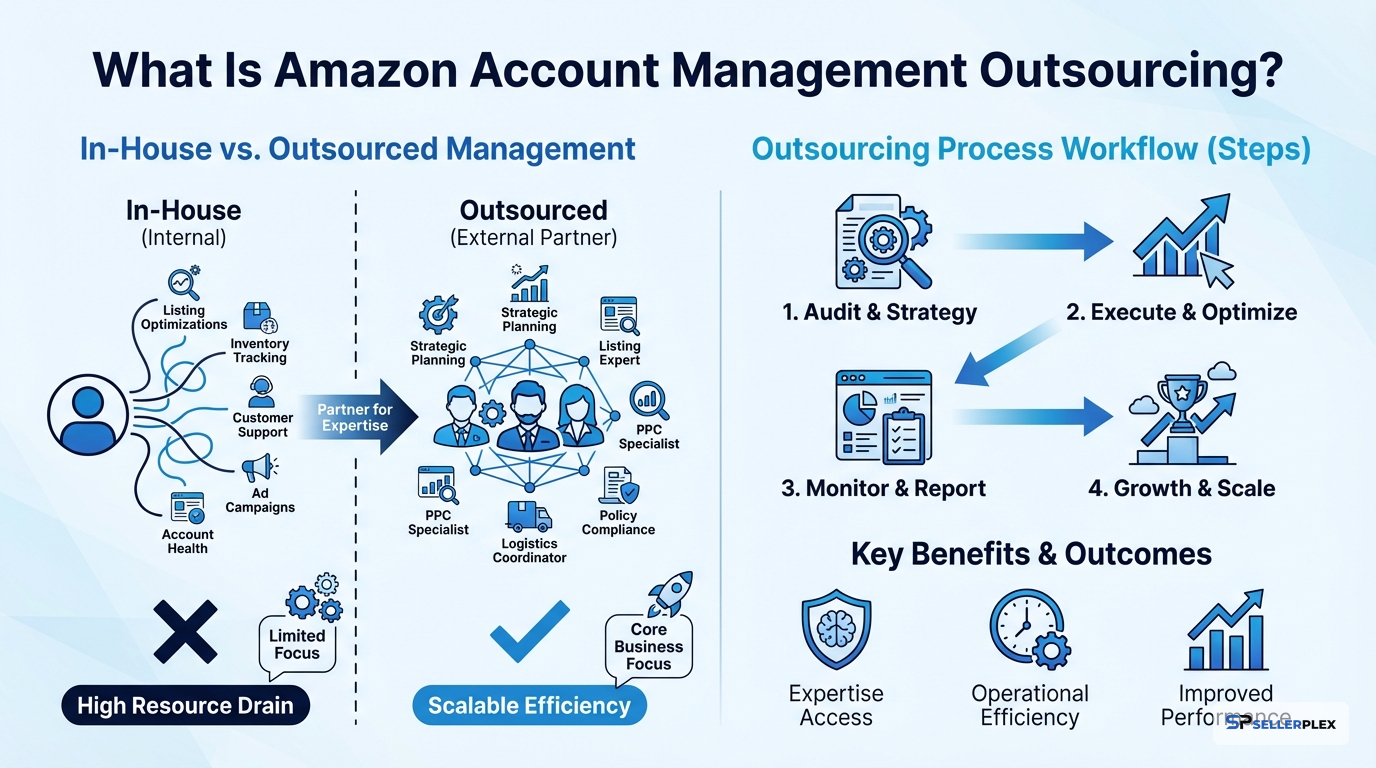
Amazon account management outsourcing means hiring a specialist team to run key parts of your marketplace operation. Typically, that includes catalog updates, case management, listing optimization, reporting, advertising coordination, inventory planning support, and account health monitoring. In other words, you shift execution from a fragmented internal process to an external operating partner.
However, outsourcing is not the same as handing off one tactical task. A real partner works across systems. For example, a title change that improves ranking may also affect conversion, ad efficiency, and browse path relevance. That is why many brands pair outsourced management with services like Amazon account management, Amazon PPC management, and Amazon content creation.
Today, the trend is toward specialization. Jungle Scout’s seller research has shown that brands increasingly rely on software and outside expertise as competition intensifies. Therefore, if your team is spending too much time on reactive fixes, outsourcing can create leverage by turning scattered execution into a documented operating rhythm.
How Amazon Account Management Outsourcing Works
Outsourcing usually follows a structured handoff. First, the partner audits your account, catalog, ad performance, inventory flow, and account health. Next, they prioritize the highest-impact problems. Then, they take ownership of recurring workflows and reporting.
1. Audit the current account state
A strong partner starts with data. They review suppressed listings, stranded inventory, session-to-conversion rates, TACoS, Buy Box status, and support case history. Therefore, you get a baseline before any changes happen.
2. Define roles and decision rights
Next, you clarify who owns what. For example, your team may approve pricing strategy, while the partner owns listing updates, case follow-up, and weekly reporting. This step matters because unclear ownership slows execution.
3. Build a recurring operating cadence
After that, the team moves into weekly and monthly rhythms. That often includes KPI reviews, catalog maintenance, PPC coordination, and inventory exception tracking. As a result, issues get caught before they turn into revenue leaks.
4. Connect cross-functional workstreams
Amazon performance is rarely isolated. A stockout hurts rank, ad efficiency, and organic sales at the same time. Consequently, outsourced management works best when it links content, advertising, and supply chain execution instead of treating them as separate channels.
5. Report on outcomes, not activity
Finally, you should expect clear reporting. Good partners track contribution to revenue, conversion rate, ad efficiency, and issue resolution time. In contrast, weak partners report tasks completed without showing business impact.
Key Benefits of Outsourcing Amazon Account Management
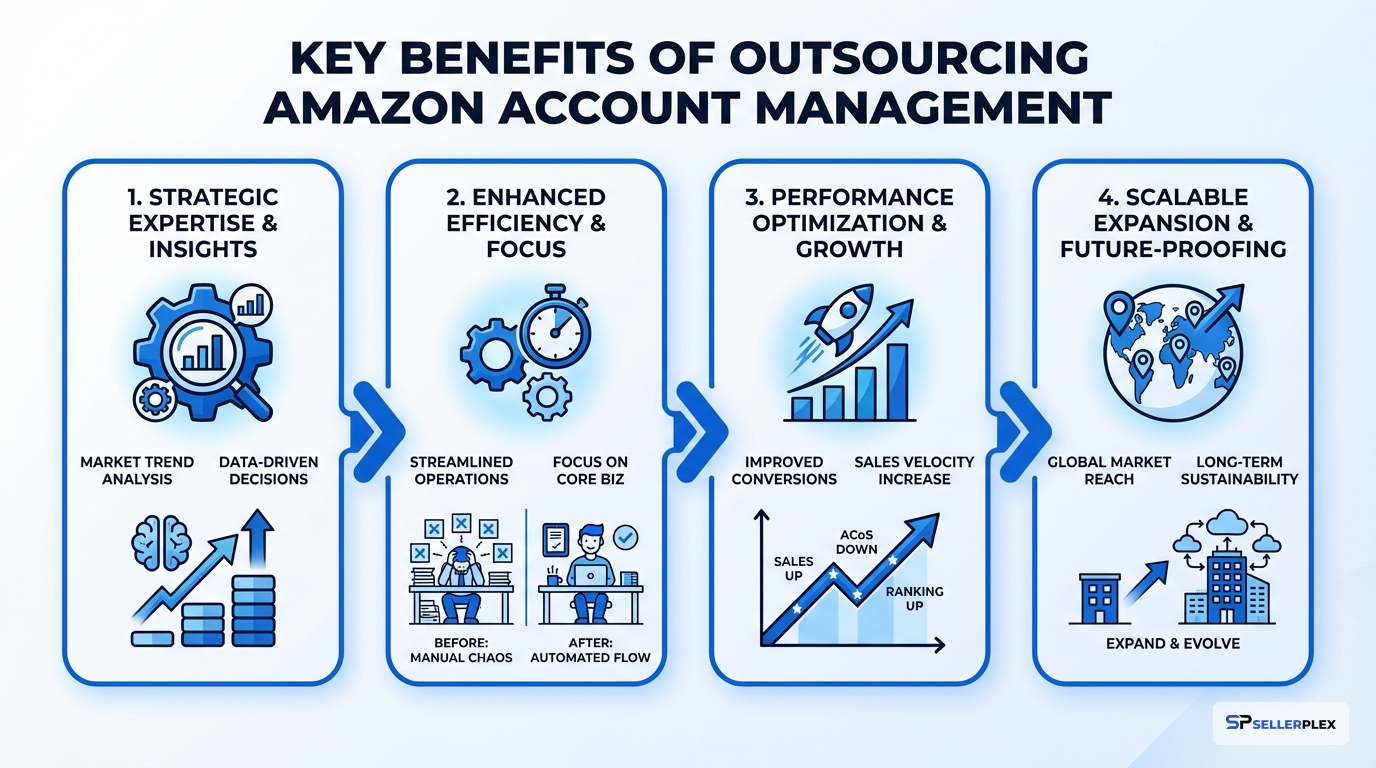
When done well, outsourcing gives you faster execution and stronger control. More importantly, it can protect margin.
1. Faster issue resolution
- Amazon cases often stall when they lack follow-up. An experienced team knows how to escalate, document, and push issues through faster.
2. Better operational visibility
- Additionally, outsourced teams build dashboards and weekly reporting. You see account health, inventory risks, and performance movement sooner.
3. Stronger conversion through cleaner catalog execution
- Listing quality affects ranking and revenue. For example, optimized content and image updates can raise conversion more efficiently than spending more on ads. See SellerPlex’s guide to Amazon product listing optimization.
4. Lower founder and operator load
- If senior leaders still handle flat files, support cases, and catalog clean-up, that is expensive labor in the wrong place. Therefore, outsourcing often frees leadership to focus on product, cash flow, and growth.
5. Better coordination with advertising
- PPC rarely performs well when catalog quality is weak. Consequently, outsourcing paired with Amazon PPC 2026: The Complete Guide to Scaling Profitably can improve paid efficiency and organic lift together.
6. Fewer avoidable inventory disruptions
- Inventory issues damage rank and conversion. Teams that connect operational workflows with supply chain management can reduce stockout risk and protect revenue continuity.
7. More predictable scaling
- Ultimately, standardized processes matter once you pass founder-led operations. A trained external team can often scale across SKUs and markets faster than a new internal hire ramp.
Step-by-Step Guide to Choosing the Right Partner
The right outsourcing partner should improve execution without adding management drag. Use this process to evaluate fit.
Step 1: Define your primary bottleneck
First, identify where revenue is leaking. Is it catalog inconsistency, PPC inefficiency, inventory instability, or slow case resolution? If you cannot name the bottleneck, you will buy vague help.
Step 2: Map the workflows you want off your plate
Next, list the exact tasks you want a partner to own. For example, that may include listing updates, reimbursements, flat file uploads, account health checks, and weekly KPI reporting. This step prevents scope creep later.
Step 3: Ask for operating specifics
Then, ask how the partner runs the account. Request examples of dashboards, meeting cadence, escalation paths, and KPI ownership. In contrast, avoid firms that only talk in broad growth language.
Step 4: Test cross-functional depth
Because Amazon systems are connected, your partner should understand how content, ads, and inventory affect each other. For example, a good operator will connect a drop in conversion to content quality, stock position, reviews, or ad traffic mix.
Step 5: Review communication expectations
Additionally, confirm response times, reporting format, and decision escalation rules. You should know what happens when a listing is suppressed on a Friday afternoon or inventory slips below reorder threshold.
Step 6: Validate channel expertise with evidence
Ask for concrete examples. What happened to conversion rate, issue resolution speed, or ad efficiency after takeover? Although partners may not share client names, they should share anonymized outcomes and clear before-and-after logic.
Step 7: Start with a 90-day scorecard
Finally, define success for the first 90 days. Use metrics such as suppression rate, case resolution time, conversion rate, TACoS trend, and inventory in-stock percentage.
Additionally, treat your scorecard as part of the contract. A complete guide to vendor evaluation should always connect service scope to revenue protection, margin stability, and owner time saved.
Remove Amazon Operating Bottlenecks
Get a senior team to tighten execution across catalog, ads, and account health before small issues turn into margin loss.
Best Tools and Resources for Outsourced Amazon Management
The best outsourced teams combine process with the right tool stack. However, tools should support decisions, not replace them.
Amazon Seller Central
Use Amazon Seller Central help and policy docs for category rules, case references, and operational guidance. This is your source of record.
Helium 10
Helium 10 helps with keyword tracking, listing diagnostics, and market visibility. Therefore, it is useful when outsourced teams need fast research across large catalogs.
Jungle Scout
Jungle Scout offers market data and seller benchmarks. It is especially helpful when you want context on category competition and seller behavior.
Internal reporting and SOPs
Finally, documented SOPs, KPI dashboards, and issue trackers matter as much as third-party software. If the partner cannot show process maturity, the tools will not save execution.
Common Mistakes to Avoid
Brands often outsource because the internal team is overloaded. Nevertheless, a bad handoff can make performance worse.
Mistake 1: Outsourcing without clear KPIs
If success is undefined, every discussion becomes subjective. Therefore, agree on conversion, account health, in-stock rate, and case turnaround targets early.
Mistake 2: Choosing on price alone
Cheap support often becomes expensive rework. For example, one wrong catalog change can suppress a hero ASIN or damage variation structure.
Mistake 3: Separating account management from ads and content
When teams work in silos, you lose speed and context. As a result, conversion issues stay unresolved while ad spend rises.
Mistake 4: Keeping approvals too slow
Some brands outsource execution but force every small change through a long chain. Consequently, urgent fixes stall and the partner becomes a messenger instead of an operator.
Mistake 5: Ignoring onboarding quality
A weak onboarding phase creates missing access, incomplete SOPs, and scattered expectations. In practice, that delays value for weeks.
Advanced Tips and Strategies
Once the basics are in place, you can make outsourcing more profitable by tightening how your team and partner work together.
Create a revenue-impact priority model
First, rank tasks by financial consequence. Suppressed top sellers, stockout risks, and conversion drops should outrank cosmetic fixes. Therefore, the outsourced team focuses on what moves revenue fastest.
Use one scorecard across departments
Additionally, align content, PPC, and operations around a shared dashboard. Metrics like conversion rate, TACoS, contribution margin, and in-stock percentage prevent teams from optimizing in isolation.
Build escalation playbooks for common failures
For example, document what happens when ASINs are suppressed, parentage breaks, or inventory lands late. This reduces reaction time and creates consistency.
Audit meeting time, not just output
If your internal team spends 5 hours each week managing the partner, the model may be inefficient. In contrast, a strong engagement reduces management overhead while improving execution quality.
Review outsource-versus-hire economics quarterly
Finally, compare partner cost against fully loaded in-house cost, ramp time, and error rate. For many brands, outsourcing wins during complexity spikes or multi-SKU expansion. Yet once you reach enough stable scale, a hybrid model may outperform.
Moreover, a complete guide to scaling Amazon operations should compare outsourcing against hiring, agency coordination, and the cost of keeping senior leadership stuck in execution.
Frequently Asked Questions
What does Amazon account management outsourcing usually include?
It usually includes listing updates, support case management, account health monitoring, performance reporting, operational troubleshooting, and coordination with advertising or content teams. However, scope varies by partner, so you should define ownership clearly before starting.
When should you outsource Amazon account management?
You should consider it when growth creates execution gaps your internal team cannot cover. For example, if suppressions linger, reporting is inconsistent, or founders still handle day-to-day account tasks, outsourcing can create leverage.
Is outsourcing cheaper than hiring in-house?
Often, yes, especially when you need senior capability across multiple functions. In addition, outsourcing can reduce ramp time and rework. That said, the right comparison is not monthly fee versus salary alone. You also need to compare training time, management load, and business impact.
How do you measure whether an outsourced partner is working?
Track outcome metrics, not just completed tasks. Start with conversion rate, account health status, case resolution time, in-stock rate, and advertising efficiency where relevant. Therefore, you can tie the engagement to revenue protection or growth.
Can outsourced account management improve PPC performance?
Yes, because PPC performance depends on catalog quality, inventory availability, and conversion health. If those operational inputs improve, advertising usually becomes more efficient as well.
What is the biggest risk when outsourcing Amazon management?
The biggest risk is hiring a team that executes tasks without understanding business priorities. As a result, you get activity but not leverage. Strong partners connect each action to revenue, margin, or operational resilience.
Conclusion
If your Amazon operation feels reactive, outsourcing can be a practical way to restore control. More importantly, this complete guide shows that the best outcomes come from tighter ownership, clearer reporting, and stronger coordination across catalog, ads, and inventory.
Start by auditing your current bottlenecks, defining a 90-day scorecard, and deciding which workflows truly need senior ownership. Then, compare partners based on operating depth instead of promises.
Next Steps
If you want help tightening execution across your marketplace operations, review SellerPlex’s Amazon account management services and assess where your current process is leaking revenue. In addition, use this complete guide as your checklist when you evaluate whether outsourcing will lower operational drag and improve profitability.
Ready to Grow Your Amazon Business?
Book a free strategy session with our Amazon and e-commerce specialists. No obligations, just actionable insights.