


Introduction
Amazon gives you scale, but it does not give you customer ownership. That is exactly why dtc email marketing for amazon sellers matters more in 2026 than it did even 2 years ago. According to Shopify, email marketing can deliver one of the highest ROI levels across owned channels because it drives repeat purchases without adding marketplace ad costs.
Table of Contents
- Introduction
- What Is DTC Email Marketing for Amazon Sellers?
- How DTC Email Marketing for Amazon Sellers Works
- Key Benefits of DTC Email Marketing for Amazon Sellers
- Step-by-Step Guide to DTC Email Marketing for Amazon Sellers
- Best Tools and Resources for DTC Email Marketing for Amazon Sellers
- Common Mistakes to Avoid
- Advanced Tips and Strategies
- Frequently Asked Questions
- Conclusion
If you sell on Amazon and also run a DTC store, you can use email to recover margin, improve repeat rate, and build a first-party audience you actually control. In this guide, you will learn how dtc email marketing for amazon sellers works, where it fits in your growth mix, which tools matter, and how to avoid the compliance and execution mistakes that quietly kill performance.
What Is DTC Email Marketing for Amazon Sellers?
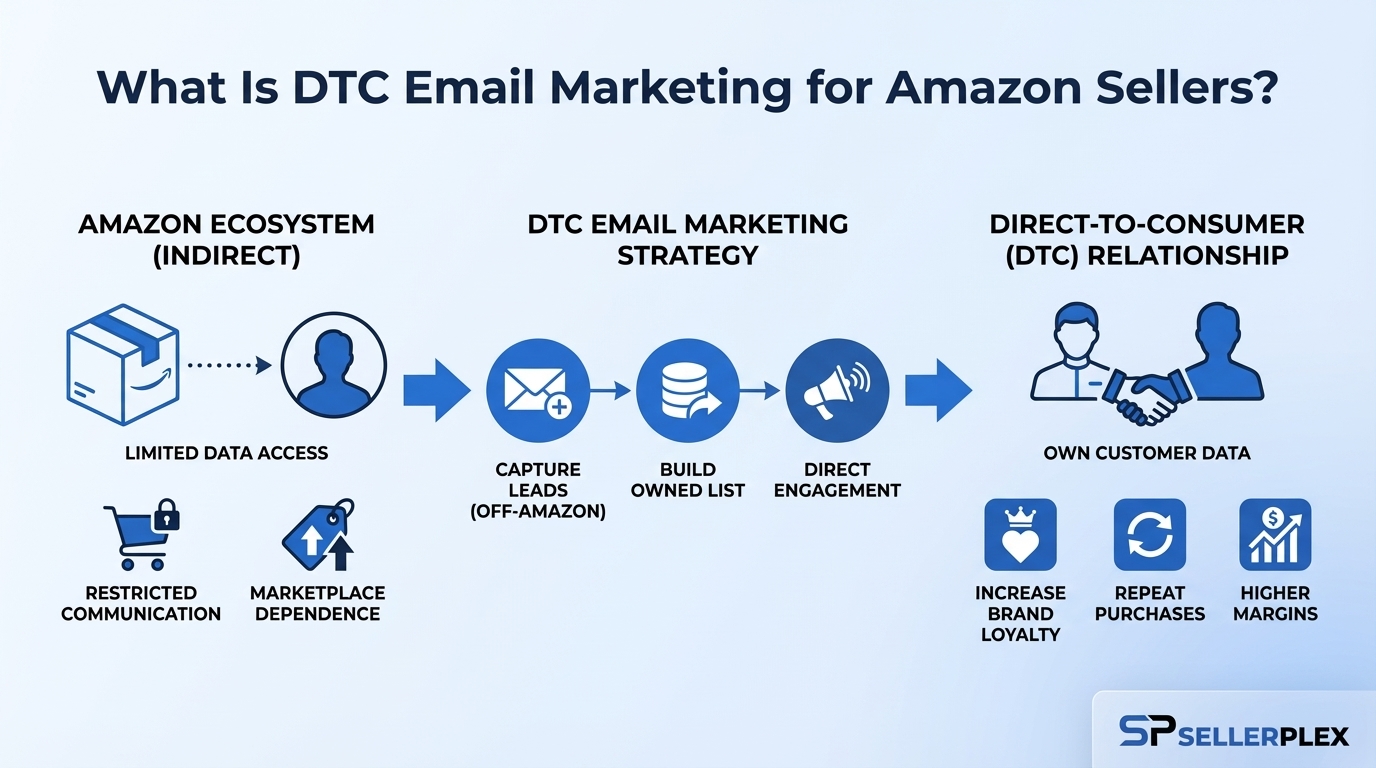
DTC email marketing for amazon sellers is the practice of using email to build relationships with customers outside Amazon’s marketplace environment. In practical terms, you use your brand site, packaging inserts, post-purchase flows, paid traffic, and retention campaigns to collect opt-ins and drive repeat demand through owned channels.
However, this is not about emailing Amazon customers directly from marketplace order data. Amazon’s buyer-seller messaging rules are strict, and you should respect them. Instead, dtc email marketing for amazon sellers focuses on turning marketplace awareness into compliant first-party relationships through your own storefront, landing pages, and brand ecosystem.
That matters because acquisition costs keep rising. In addition, at the same time, sellers need more control over contribution margin, customer lifetime value, and launch velocity. As a result, brands that pair Amazon with owned retention systems often create a more durable growth engine than brands that rely on marketplace traffic alone. For broader operational alignment, your retention strategy should connect with Amazon account management services and channel-level planning.
How DTC Email Marketing for Amazon Sellers Works
At a high level, dtc email marketing for amazon sellers turns anonymous marketplace demand into measurable owned revenue. Therefore, the goal is not just to send newsletters. The goal is to create a system that captures interest, segments customers, and sends the right message at the right time.
1. Attract traffic to a controlled touchpoint
You drive shoppers to a DTC site, product quiz, landing page, or gated offer using channels such as social ads, content, Amazon Brand Store traffic, creator partnerships, and packaging-driven QR codes.
2. Capture permission-based email opt-ins
Next, you collect consent through forms, welcome offers, back-in-stock alerts, educational content, or loyalty benefits. This step is critical because dtc email marketing for amazon sellers only works if the audience is truly opted in.
3. Segment contacts by intent and behavior
For example, you can separate new prospects, first-time buyers, repeat customers, high-AOV buyers, and churn-risk subscribers. Once segmentation improves, revenue per send usually improves as well.
4. Trigger lifecycle automations
Additionally, you set up welcome flows, abandoned cart emails, post-purchase education, replenishment reminders, and win-back campaigns. According to Klaviyo benchmark reporting, automated lifecycle flows often outperform one-off campaigns because they are tied to real customer intent.
5. Measure retention and incrementality
Finally, you review open rates, click rates, conversion rate, revenue per recipient, unsubscribe rate, and repeat purchase trends. If email is not improving retention economics, then your dtc email marketing for amazon sellers program needs better segmentation, offers, or creative.
If your listing conversion is also weak, email alone will not fix the business. Furthermore, in that case, pairing retention work with Amazon product listing optimization and Amazon FBA optimization usually creates a stronger result.
Key Benefits of DTC Email Marketing for Amazon Sellers
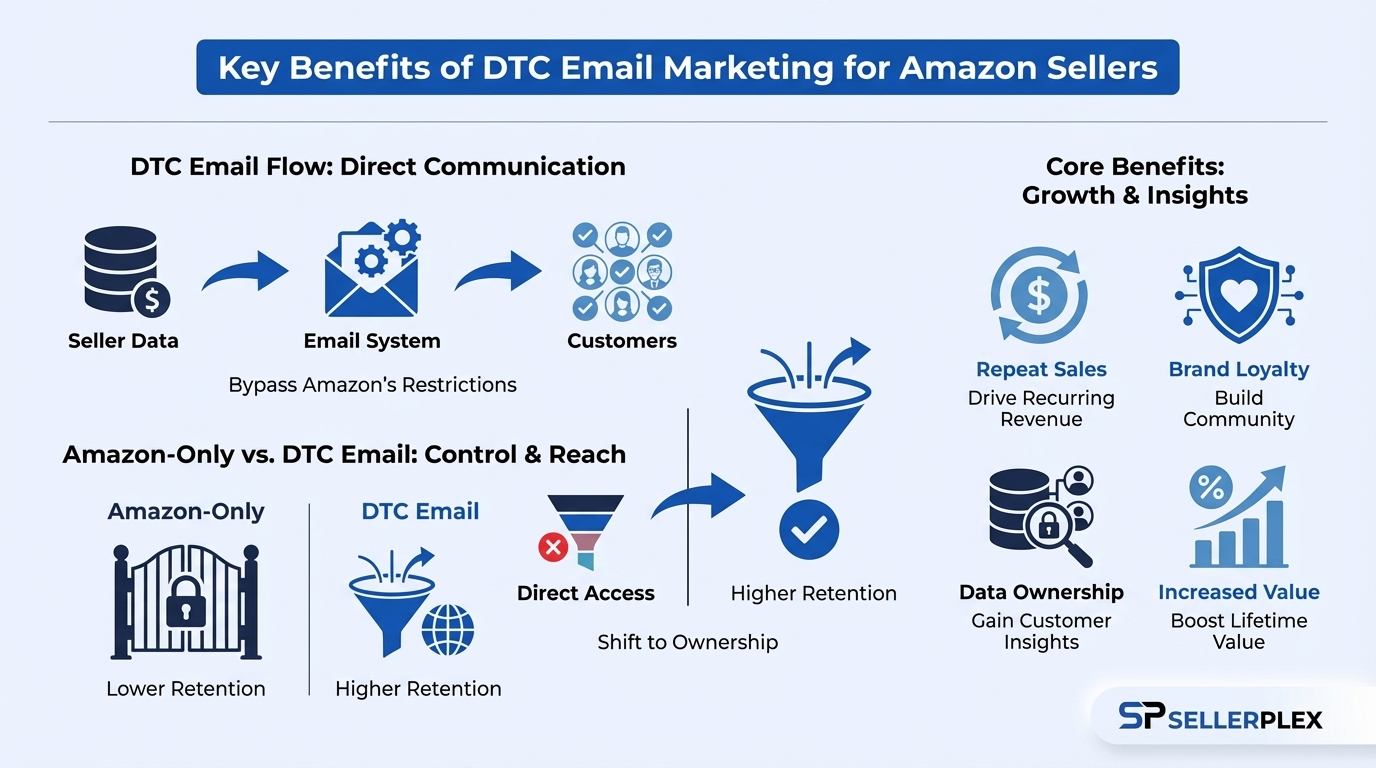
When you execute dtc email marketing for amazon sellers well, you are not just adding another channel. Instead, you are improving how your whole revenue system behaves.
Why the upside is meaningful
- Higher repeat purchase rate: Email gives you a low-cost path to bring customers back without paying Amazon CPC again.
- Better margin control: Because owned retention reduces dependence on paid reacquisition, it can improve contribution margin over time.
- First-party data ownership: You learn what customers buy, when they reorder, and which offers move them.
- Stronger launch support: When you release a new SKU, your email list can create day-1 demand and improve forecast confidence.
- Improved audience segmentation: You can tailor offers by product category, purchase cadence, and lifecycle stage.
- More resilient channel mix: If Amazon ad costs rise, dtc email marketing for amazon sellers helps offset some pressure by increasing retention efficiency.
- Cross-sell potential: You can introduce bundles, complementary products, and subscriptions more effectively than on Amazon alone.
Data supports the case. For example, the Data & Marketing Association has long reported strong email ROI relative to many paid channels. Likewise, Amazon’s Customer Engagement tool documentation shows that Amazon itself recognizes the value of direct brand-to-customer communication within approved environments.
Step-by-Step Guide to DTC Email Marketing for Amazon Sellers
If you want dtc email marketing for amazon sellers to produce measurable revenue, build the system in this order.
Step 1: Define the retention goal first
First, choose the business target before you choose the platform. You might target higher repeat purchase rate, faster second-order conversion, lower CAC payback period, or better launch support. Without a clear goal, most email programs drift into generic campaign sends.
Step 2: Build a compliant opt-in engine
Next, create at least 2 to 3 paths for email capture on your DTC site. For example, use a welcome offer, a bundle guide, or an educational lead magnet tied to the product category. If you need better conversion inputs, align this with Amazon content creation support so your messaging matches shopper intent.
Step 3: Set up your core automations
Then launch the non-negotiables: welcome series, abandoned cart, browse abandonment if available, post-purchase education, replenishment, and win-back. These flows are the foundation of dtc email marketing for amazon sellers because they monetize intent faster than broad newsletters.
Step 4: Segment by product and lifecycle stage
Additionally, separate subscribers by source, product interest, order count, and expected reorder cadence. A skincare brand, for example, should not email a 30-day replenishment reminder to a subscriber who only downloaded a buying guide yesterday.
Step 5: Build campaign calendars around real buying triggers
Now map promotions to seasonality, replenishment windows, launches, and category demand spikes. Therefore, your email calendar should reflect inventory realities, not just marketing ideas. This matters even more if your team is also managing supply chain planning for Amazon sellers.
Step 6: Create clear offer architecture
For example, decide when you will use discounts, bundles, loyalty messaging, educational content, or social proof. Dtc email marketing for amazon sellers works best when offers are structured, not random. If every send is a discount, you will train the list to wait.
Step 7: Measure incrementality, not vanity metrics
Finally, review revenue per recipient, repeat order rate, gross margin after discounts, and list growth quality. Open rate still matters, but it is not the business outcome. As a result, strong teams judge dtc email marketing for amazon sellers by retained revenue and profit contribution.
Turn More Buyers Into Repeat Customers
See where your retention funnel leaks revenue and how to fix it with stronger content and lifecycle messaging.
Best Tools and Resources for DTC Email Marketing for Amazon Sellers
The right stack depends on volume, complexity, and internal bandwidth. These tools consistently show up in high-performing dtc email marketing for amazon sellers programs.
Klaviyo
Klaviyo is one of the strongest choices for lifecycle automation, segmentation, and ecommerce reporting. It is especially useful if you want advanced flow logic and product-level targeting.
Shopify Email and Shopify data layer
If your DTC site runs on Shopify, the Shopify ecosystem gives you clean ecommerce event data and native customer profiles. That makes automation setup easier.
Helium 10
Helium 10 is not an email platform, yet it is valuable for demand research and product insights. You can use that data to shape messaging themes, launch timing, and category-specific retention hooks.
Amazon Customer Engagement and Brand Analytics
Amazon’s own Customer Engagement features and Brand Analytics reports can inform your creative and audience priorities. Although they are not replacements for DTC ownership, they improve message relevance.
Common Mistakes to Avoid
Many brands try dtc email marketing for amazon sellers but underperform because the program is disconnected from operations.
Treating email like a batch-and-blast channel
If every send goes to everyone, engagement drops and unsubscribe rates climb. Instead, segment aggressively and match message to intent.
Ignoring compliance boundaries
You should never misuse Amazon buyer data for external marketing. Besides the policy risk, it creates trust problems that are hard to reverse.
Sending offers that operations cannot support
However strong the email creative is, stockouts and long lead times destroy retention trust. Therefore, align campaigns with inventory and reorder timelines.
Over-discounting the list
Too many sellers use discounts as the only lever. As a result, subscribers learn to delay purchases, and margin suffers.
Measuring clicks instead of profit contribution
Clicks can look healthy while the business outcome is weak. For that reason, track repurchase, gross margin, and time to second order.
Advanced Tips and Strategies
Once the basics are stable, you can make dtc email marketing for amazon sellers meaningfully more profitable.
Use category-specific replenishment windows
Different products reorder on different timelines. Therefore, your reminders should reflect actual usage cycles rather than fixed calendar intervals.
Build post-purchase education flows
For example, supplements, beauty, and consumables often benefit from usage guidance, FAQs, and routine-building content. Better education usually improves repeat rate and reduces support friction.
Combine email with Amazon and DTC creative learnings
If a message angle converts in PDP content or Amazon ads, test it in retention flows too. Likewise, lessons from Amazon DSP advertising can help shape audience-level messaging on owned channels.
Create VIP and churn-risk segments
Additionally, build flows for high-LTV buyers and a separate win-back path for subscribers showing declining engagement. One-size-fits-all retention rarely maximizes value.
Run holdout tests when possible
Finally, if you want to prove incrementality, use holdout groups for major lifecycle changes. That gives you clearer evidence that dtc email marketing for amazon sellers is driving behavior rather than just claiming attribution.
Frequently Asked Questions
Is dtc email marketing for amazon sellers allowed?
Yes, dtc email marketing for amazon sellers is allowed when you collect consent through your own DTC channels and market to first-party subscribers. You should not use Amazon order data to build off-platform email lists outside Amazon policy.
Why does dtc email marketing for amazon sellers matter if Amazon already brings traffic?
Amazon brings demand, but it does not give you full customer ownership. Dtc email marketing for amazon sellers matters because it helps you build repeat revenue, launch new products faster, and reduce dependence on paid reacquisition.
What is the best platform for dtc email marketing for amazon sellers?
For many mid-market brands, Klaviyo is a strong fit because it combines segmentation, automation, and ecommerce reporting. However, the best choice depends on your store platform, catalog complexity, and team resources.
How quickly can dtc email marketing for amazon sellers show results?
If your list quality is solid and your automations are set up correctly, you can often see early results within 30 to 60 days. Welcome flows, abandoned cart, and replenishment campaigns usually produce the fastest signal.
How large does my list need to be before dtc email marketing for amazon sellers works?
You do not need a massive list to start. Even a smaller list can perform well if it is permission-based, segmented, and tied to strong product-market fit.
Can dtc email marketing for amazon sellers improve profitability, not just revenue?
Yes, it can improve profitability when it lifts repeat purchase rate without relying on constant discounts or additional marketplace ad spend. The key is measuring contribution margin, not just attributed sales.
Conclusion
In short, dtc email marketing for amazon sellers works best when your retention engine is built on consent, segmentation, and margin-aware measurement.
Next Steps
Your Action Plan
The strongest dtc email marketing for amazon sellers programs do 3 things well: they collect real first-party consent, automate around customer behavior, and measure retention against margin. Therefore, your next move should be operational, not theoretical.
Audit your current capture paths, lifecycle flows, segmentation logic, and reporting model. Additionally, then decide where revenue is leaking first. If you want expert support aligning content, retention, and channel operations, review SellerPlex’s Amazon content creation services and build a lifecycle engine that turns one-time buyers into repeat customers.
Ready to Grow Your Amazon Business?
Book a free strategy session with our Amazon and e-commerce specialists. No obligations, just actionable insights.
Related reading: Amazon Seller Email Marketing That Builds Repeat Revenue.
Day-to-day Seller Central operations handled for you: catalog health, cases, compliance and buyer messages.