


If you are evaluating the 2 types of amazon seller accounts, the choice affects more than your monthly fee. It shapes how you manage margins, unlock selling tools, and scale your catalog over time. Amazon gives you two core paths inside Seller Central: Individual and Professional. However, many brands choose too quickly, then pay for the mistake through lost automation, higher fees, or operational drag.
Table of Contents
- What Are the 2 Types of Amazon Seller Accounts?
- How the 2 Types of Amazon Seller Accounts Work
- Key Benefits of Choosing the Right Account Type
- Step-by-Step Guide to Choosing Your Amazon Seller Account
- Best Tools and Resources for Amazon Seller Accounts
- Common Mistakes to Avoid
- Advanced Tips and Strategies
- Frequently Asked Questions
- Next Steps
For example, Amazon charges Individual sellers $0.99 per item sold, while Professional sellers pay a monthly subscription fee instead, according to Amazon Seller Central. Therefore, your break-even point can arrive faster than you expect. In this guide, you will learn how the 2 types of amazon seller accounts work, when each one makes sense, and how to pick the right account for your stage of growth.
What Are the 2 Types of Amazon Seller Accounts?
When people search for the 2 types of amazon seller accounts, they are usually comparing the two plans Amazon offers inside Seller Central: Individual and Professional. In other words, you are not choosing between two marketplaces. You are choosing between two selling models with different fee structures, feature access, and growth ceilings.
Individual Seller Account
The Individual plan is built for low-volume sellers. You do not pay a monthly subscription, but you pay a per-item fee on each sale. As a result, this option can work if you are testing a product, clearing limited inventory, or selling fewer than roughly 40 units a month.
Professional Seller Account
The Professional plan charges a monthly subscription, but it removes the per-item fee and unlocks more tools. For example, you gain access to bulk listings, advanced reports, advertising features, and eligibility for top-level merchandising tools. If you expect to scale, the Professional option usually becomes the practical choice.
Because fees and tool access directly affect profitability, the 2 types of amazon seller accounts matter most for brands that want to protect margin while building operational leverage.
How the 2 Types of Amazon Seller Accounts Work
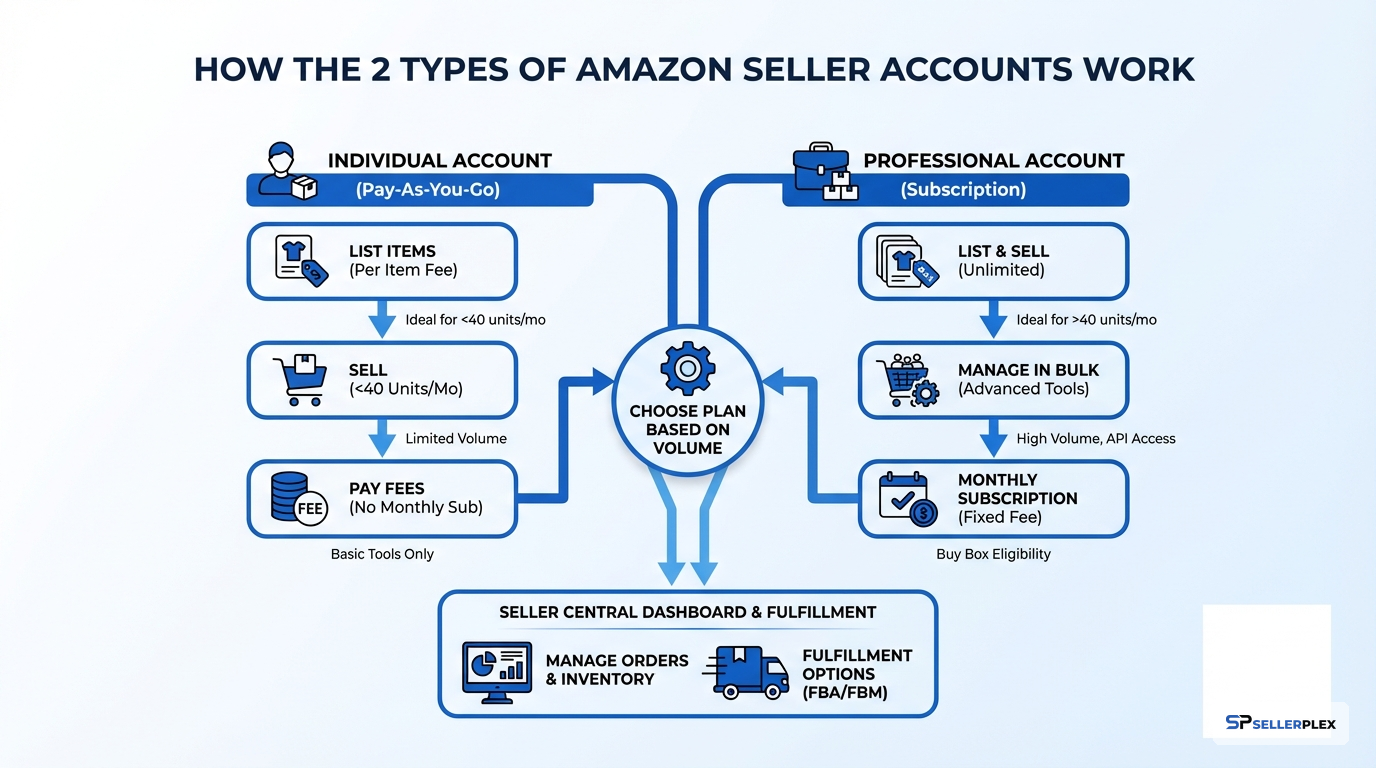
To understand the 2 types of amazon seller accounts, you need to look at both cost and capability. The core mechanics are simple, but the downstream impact is not.
1. You choose a plan inside Seller Central
First, you open a Seller Central account and select either Individual or Professional. Amazon then applies the corresponding subscription logic to your account.
2. Amazon charges plan-specific fees
With an Individual account, you pay $0.99 per unit sold, plus referral and other applicable fees. With a Professional account, you pay a fixed monthly subscription instead of the per-unit charge, plus the same underlying selling fees. Therefore, volume determines which option is cheaper.
3. Your tool access changes by plan
Professional sellers can usually access advertising, promotions, bulk uploads, and deeper reporting. By contrast, Individual sellers operate with a more limited toolkit. That difference matters if you want to move quickly across many SKUs.
4. Your operating model follows your account type
A simple account may work at launch. However, once catalog size, support volume, or compliance risk increases, the wrong plan creates friction. For example, if you need tighter oversight on listing health, support cases, or account performance, you may also need stronger Amazon account management processes.
5. You can upgrade as your business grows
Finally, Amazon allows sellers to change plans. That flexibility helps, but waiting too long can slow expansion. If you already see traction, it is better to choose the structure that supports scale rather than react after problems appear.
Key Benefits of Choosing the Right Account Type
Choosing correctly between the 2 types of amazon seller accounts gives you operational and financial advantages. More importantly, it helps you avoid unnecessary cost.
Lower total selling costs
- If you sell low volume, the Individual plan can reduce fixed overhead.
- If you sell more than roughly 40 units monthly, the Professional plan often lowers effective per-unit cost.
- According to Amazon’s pricing model, the break-even point arrives quickly once volume builds.
Better access to growth tools
- Professional sellers can unlock advertising and promotional features.
- Additionally, they can use bulk listing tools that save time across larger catalogs.
- That efficiency compounds as SKU count rises.
Stronger reporting and decision-making
- Better data helps you manage inventory, conversion rates, and margin.
- Therefore, a Professional setup supports smarter decisions when your account grows more complex.
- If you are also improving listings, pairing account structure with Amazon content creation services can improve conversion quality.
Easier operational scaling
- The right account reduces manual work.
- For example, brands that plan to expand across marketplaces, add SKUs, or invest in ads usually need the Professional path.
- As a result, your team avoids reworking processes later.
Fewer bottlenecks in daily management
- Poor account setup creates friction around catalog updates, reporting, and support workflows.
- By contrast, the right plan gives you cleaner processes from the start.
- This becomes more important when inventory and fulfillment complexity increase alongside supply chain management.
More room to protect account health
- Growth increases compliance exposure.
- Therefore, brands with larger catalogs benefit from a more structured operating model and proactive monitoring.
- SellerPlex’s own account management work focuses on case handling, listing health, policy adherence, and reimbursement recovery.
Step-by-Step Guide to Choosing Your Amazon Seller Account
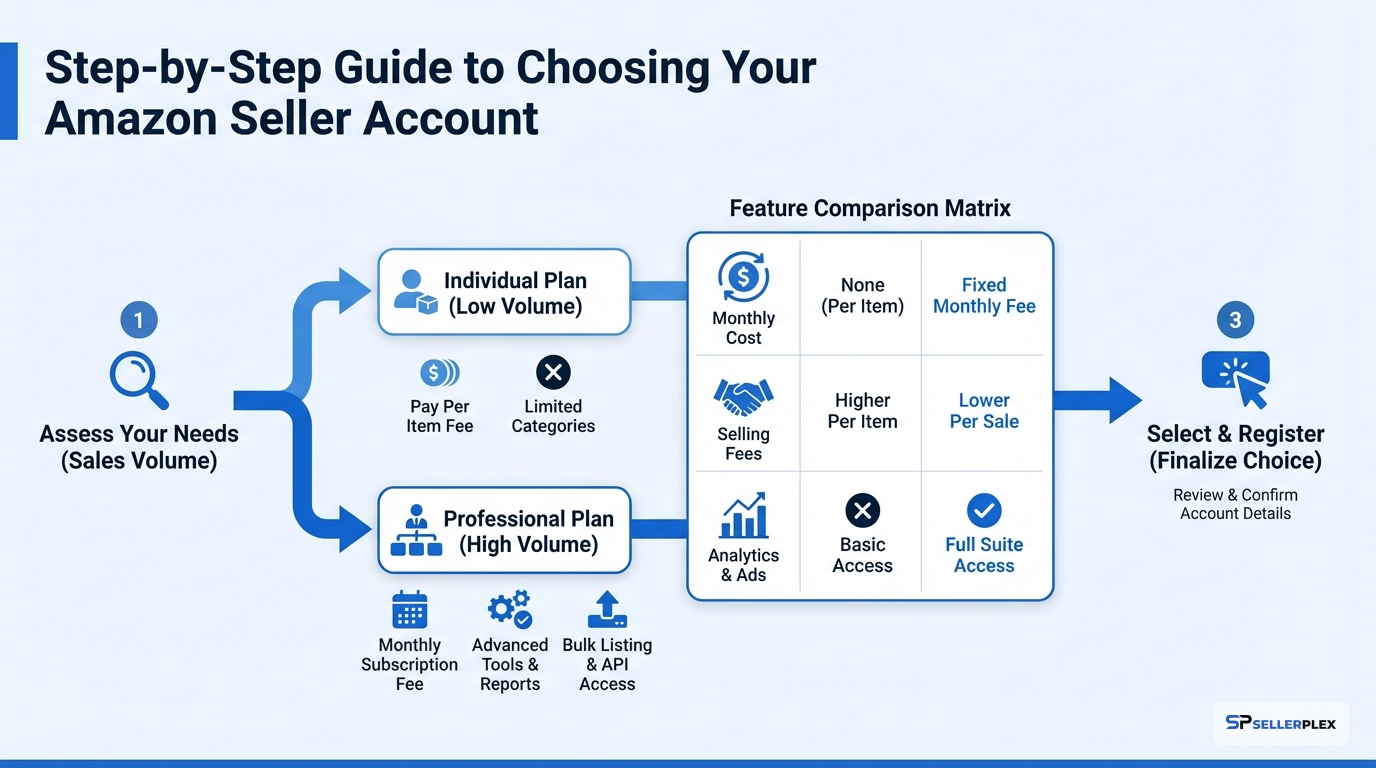
The best way to evaluate the 2 types of amazon seller accounts is to tie the decision to volume, workflow, and growth plans rather than opinion.
Step 1: Estimate your monthly sales volume
Start with a realistic sales forecast. If you expect fewer than 40 units monthly, the Individual plan may be cost-efficient. However, if demand could rise quickly, the Professional plan often becomes the smarter choice before you hit that threshold.
Step 2: Map your catalog complexity
Next, look at your SKU count, variation structure, and listing update frequency. A single-product brand can survive with simpler tooling for a while. By contrast, multi-SKU brands need more control, faster edits, and cleaner operational workflows.
Step 3: Decide whether you will run ads
If your launch plan includes sponsored ads, you should verify that your account type supports the tools you need. In many cases, brands investing in growth also need structured Amazon PPC management. Therefore, the Professional account usually aligns better with an acquisition-driven strategy.
Step 4: Review your operational bandwidth
Ask who will handle customer messages, returns, performance notifications, and seller support cases. If the answer is “whoever has time,” that is a risk. As volume grows, these tasks can damage account health if they stay unmanaged.
Step 5: Compare total cost, not just subscription cost
Do not focus only on the monthly fee. Instead, calculate referral fees, per-item charges, labor time, and missed revenue from limited tools. In many cases, the cheapest-looking option becomes more expensive in practice.
Step 6: Factor in your 12-month growth plan
If you plan to add products, enter new marketplaces, or improve your listing and ad engine, choose the structure that supports that roadmap. Waiting until your operations are stressed usually means fixing problems under pressure.
Step 7: Build an account-health process early
Finally, document how you will monitor listing suppressions, policy alerts, buyer messages, and reimbursement issues. This is where many sellers underinvest. Yet operational discipline matters as much as product demand when you scale.
Choose the Right Account Structure
Get a clear account review and operating plan before small setup mistakes turn into bigger Amazon problems.
Best Tools and Resources for Amazon Seller Accounts
The 2 types of amazon seller accounts become easier to evaluate when you use reliable resources instead of forum opinions.
Amazon Seller Central Pricing
Start with Amazon Seller Central pricing. It gives you the clearest breakdown of subscription structure, per-item charges, and fee considerations.
Amazon Seller University
Additionally, Amazon Seller University explains setup, workflows, and account fundamentals. It is useful if you want Amazon’s own guidance before you commit.
Jungle Scout Revenue and Opportunity Data
Jungle Scout can help you pressure-test whether your expected volume supports a Professional plan. For example, stronger product demand can move you past the Individual break-even point fast.
Helium 10 Market Intelligence
Likewise, Helium 10 helps you validate demand, competitor saturation, and listing opportunities. That context matters when you are deciding how aggressively to scale.
SellerPlex Operating Playbooks
Finally, practical guides like Amazon Account Management Service: The 2026 Guide to Scaling Without the Chaos help you connect account type to actual day-to-day operations, not just fees.
Common Mistakes to Avoid
Many sellers understand the 2 types of amazon seller accounts at a surface level but still make costly mistakes during setup.
Choosing based only on the monthly fee
This is the most common error. Sellers see “no subscription” and assume Individual is safer. However, they ignore per-unit charges, missing features, and time costs.
Staying on Individual too long
A plan that works for validation often fails during growth. As a result, sellers delay upgrades until manual work piles up and reporting becomes weak.
Confusing account management with advertising
Some brands assume the right account type alone will solve growth. It will not. Account management covers operational health, while advertising drives acquisition. Those are different systems with different owners.
Ignoring operational risk
Policy notices, listing suppressions, stranded inventory, and customer issues all create drag. Therefore, failing to assign ownership early can turn a healthy account into a reactive one.
Using generic advice instead of business-specific math
Every seller has different volume, margin, and complexity. In other words, copying a blanket recommendation from a YouTube video is a poor decision framework. Use your own numbers.
Advanced Tips and Strategies
Once you understand the 2 types of amazon seller accounts, you can make a more strategic decision that supports long-term growth.
Model your break-even by SKU, not just by account
Do not stop at total unit volume. Instead, review which SKUs will drive the most monthly sales. A few fast-moving products can justify a Professional account even if the rest of the catalog is still early.
Align account type with your operating stack
If you plan to scale content, ads, and support at the same time, your account setup should reduce friction across all three. For example, brands improving listings through Amazon product listing optimization often also need stronger reporting and account oversight.
Treat account health as a revenue lever
Most sellers think of account health as a compliance issue. However, it is also a growth issue. Suppressed listings, unresolved cases, or delayed support responses can slow revenue and hurt conversion quality.
Upgrade before expansion events
If Prime Day, Q4, or a large catalog launch is approaching, make the switch early. Therefore, your team can stabilize workflows before demand spikes.
Pair growth planning with managed operations
The highest-performing brands do not treat Seller Central as a side task. Instead, they build operational ownership around customer service, listing health, support cases, policy response, and reporting. That is exactly where managed Amazon account management outsourcing can remove chaos.
Frequently Asked Questions
What are the 2 types of amazon seller accounts?
The 2 types of amazon seller accounts are Individual and Professional. The Individual plan charges a per-item fee without a monthly subscription, while the Professional plan charges a monthly fee and unlocks more selling features.
Which Amazon seller account is better for beginners?
For very low-volume sellers, the Individual account can work as a low-risk starting point. However, if you expect to scale quickly, add multiple SKUs, or run ads, the Professional account is usually the better long-term choice.
When should you switch from Individual to Professional?
You should review a switch once you approach 40 units sold per month or need advanced tools. Additionally, if manual work, limited reporting, or growth bottlenecks are slowing you down, upgrading earlier often makes sense.
Does the Professional plan reduce all Amazon fees?
No. The Professional plan removes the $0.99 per-item fee charged on the Individual plan, but referral fees and other category-specific charges still apply. Therefore, you need to compare total selling cost, not just subscription structure.
Can you run ads with any Amazon seller account?
Amazon’s advertising and advanced selling tools are generally tied to a more robust seller setup. In practice, brands planning a serious paid acquisition strategy usually choose the Professional plan because it aligns better with scaling activity.
Is Vendor Central one of the 2 types of amazon seller accounts?
No. When most sellers discuss the 2 types of amazon seller accounts, they mean the two Seller Central plans: Individual and Professional. Vendor relationships operate differently and are not the same decision.
How does account management fit into this decision?
Account management matters after you choose the plan because day-to-day execution still determines account health. You may pick the right account type and still underperform if buyer messages, policy alerts, listing issues, and support cases go unmanaged.
Next Steps
The 2 types of amazon seller accounts look simple on paper, but the right choice depends on your sales volume, operating complexity, and growth plan. If you are testing demand with low unit volume, the Individual plan can work. However, if you want scale, better tools, and cleaner operations, the Professional plan usually wins.
More importantly, account type is only the starting point. You still need disciplined oversight on customer service, policy compliance, listing health, and seller support workflows. If you want expert help building that operating layer, explore SellerPlex’s Amazon account management service and turn your Seller Central account into a system that scales.
Ready to Grow Your Amazon Business?
Book a free strategy session with our Amazon and e-commerce specialists. No obligations, just actionable insights.
Related reading: Best Analytics Tools for Ecommerce.
Day-to-day Seller Central operations handled for you: catalog health, cases, compliance and buyer messages.