
Small businesses that run Amazon PPC outperform those that don’t — by a wide margin. Sellers who advertise on Amazon see an average 30-50% lift in organic ranking within 60 days, simply because ad-driven sales velocity signals Amazon’s algorithm that a product is worth promoting. The problem isn’t whether amazon ppc for small business works. The problem is that most small sellers launch campaigns the wrong way, burn through budget, and conclude that PPC “isn’t for them.”
Table of Contents
- What Is Amazon PPC for Small Business?
- How Amazon PPC Works
- Key Benefits for Small Sellers
- Step-by-Step: Launching Your First Small Business PPC Campaign
- Best Tools for Small Business Amazon PPC
- Common Mistakes Small Sellers Make with PPC
- Advanced Strategies to Stretch Your Budget
- Frequently Asked Questions
- Take Control of Your Amazon PPC Costs
This guide gives you the framework that 100+ SellerPlex-managed brands use to build profitable amazon ppc for small business campaigns — even with daily budgets under $30.
What Is Amazon PPC for Small Business?
Amazon PPC (Pay-Per-Click) is Amazon’s self-serve advertising platform that lets sellers pay to place their products in front of high-intent shoppers. Unlike traditional advertising where you pay for impressions, with amazon ppc for small business you only pay when someone actually clicks your ad.
For small businesses specifically, this is a significant advantage: you set your own budget, down to $1/day if needed, and you can pause campaigns instantly. There’s no minimum spend requirement and no agency contract required.
The three main ad formats:
- Sponsored Products — Ads that appear in search results and on product pages. The foundation of any amazon ppc for small business strategy. Average CPC: $0.75–$1.35.
- Sponsored Brands — Banner ads featuring your brand logo and up to 3 products. Better for brand awareness. Average CPC: $1.15–$2.50.
- Sponsored Display — Retargeting ads that follow shoppers on and off Amazon. Lowest CPC at $0.35–$0.85, ideal for recovering lost sales.
For small businesses with limited budgets, Sponsored Products should be your starting point. They deliver the most direct sales impact at the lowest cost.
How Amazon PPC Works
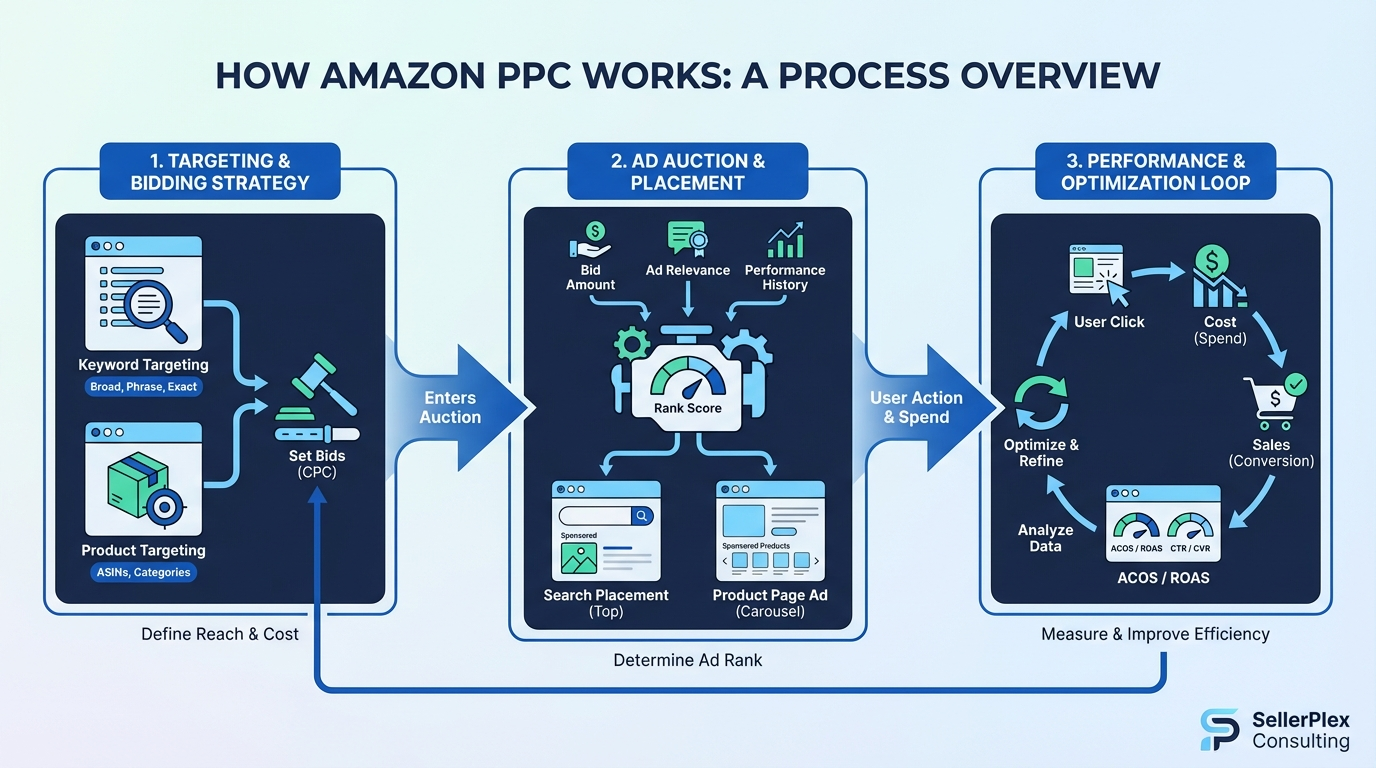
First and foremost, understanding the auction mechanics is critical for any amazon ppc for small business strategy. Amazon runs a second-price auction: you bid the maximum you’re willing to pay per click, but you only pay $0.01 more than the next highest bidder. This means your actual cost is always lower than your maximum bid.
Here’s the step-by-step flow:
- A shopper enters a search term (e.g., “bamboo cutting board”)
- Amazon runs an instant auction among all sellers bidding on that keyword
- Your ad quality score + bid determines placement — Amazon rewards ads with strong click-through and conversion history
- If the shopper clicks your ad — you’re charged at the second-price rate
- Once the shopper lands on your listing — conversion depends on your listing quality, reviews, and price
- Amazon reports results in your Seller Central dashboard within 24-48 hours
Additionally, one thing small businesses often miss: your listing quality directly affects your CPC. A well-optimized listing with strong reviews wins ad auctions at lower bids than a poorly optimized competitor. Before scaling PPC spend, invest in Amazon content creation — it reduces your long-term advertising cost.
Key Benefits for Small Sellers
Overall, Amazon PPC for small business delivers advantages that level the playing field against larger competitors:
- Immediate visibility — New products typically take 3-6 months to rank organically. PPC gives you front-page placement from day one.
- Controlled spend — Set daily budget caps down to $5/day. Never spend more than you authorize.
- Data-driven insights — Search term reports reveal exactly what customers type before buying. This data is invaluable for listing optimization.
- Organic rank boost — Ad-driven sales velocity improves your organic ranking, creating a compounding effect over time.
- Precise targeting — Target specific keywords, competitor ASINs, or customer interest categories.
- Scalable model — Start small, prove profitability, then scale spend on winning campaigns.
- No minimum commitment — Pause or cancel campaigns at any time without penalties.
The Amazon PPC cost for small businesses is often lower than many expect. With careful keyword selection and negative keyword management, $15-20/day can generate 2-4 incremental sales daily for a $25-40 product.
Step-by-Step: Launching Your First Small Business PPC Campaign
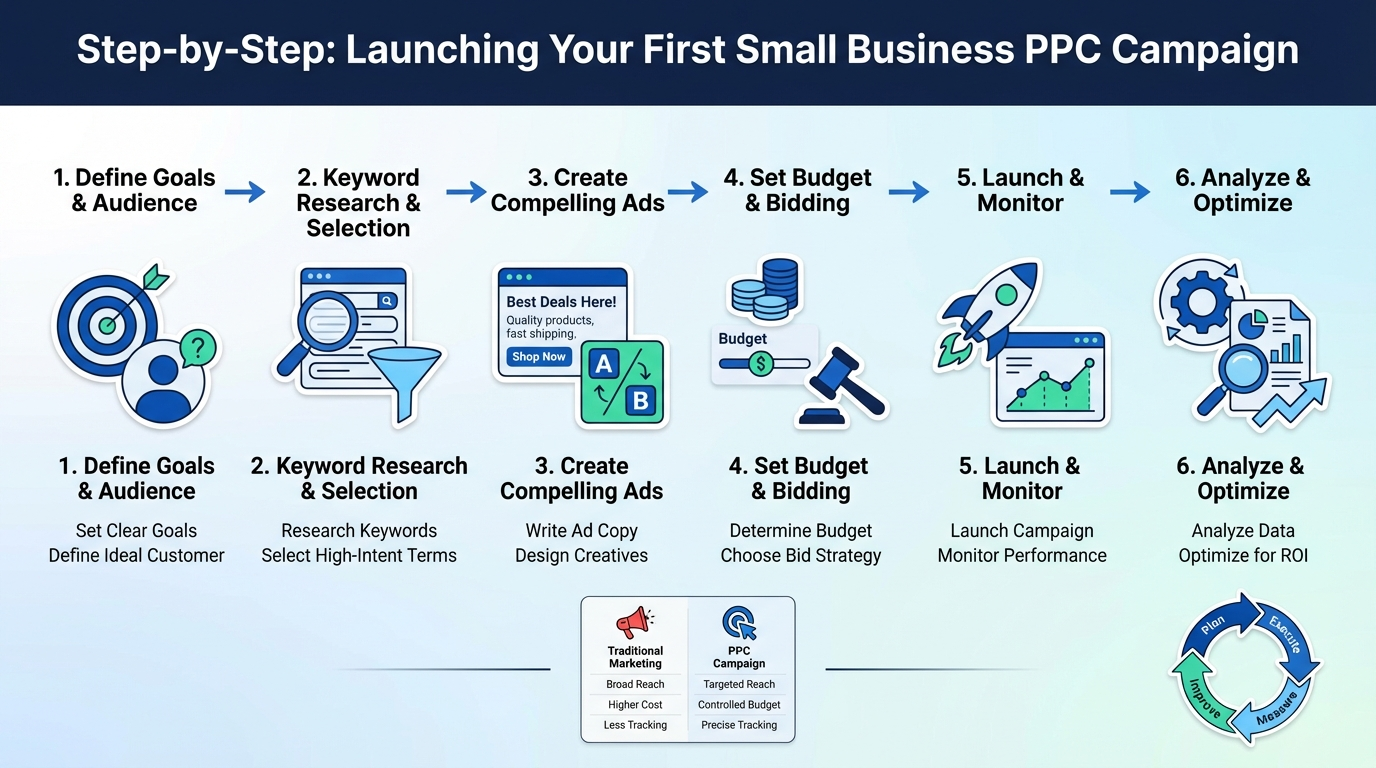
Follow this sequence exactly. In fact, most small business PPC failures come from skipping steps 1-3.
Step 1: Optimize Your Listing First
Before spending a dollar on ads, ensure your listing has: 7+ high-quality images, 200+ reviews averaging 4.0+, keyword-rich title and bullets, and A+ Content if brand registered. Specifically, ads amplify what’s already there — a weak listing wastes budget. See our complete guide to Amazon FBA optimization for the full listing checklist.
Step 2: Calculate Your Target ACoS
ACoS (Advertising Cost of Sale) = ad spend ÷ ad revenue × 100. Your target ACoS should be 5-10% below your profit margin. For example, if your margin is 30%, target 20-25% ACoS.
Step 3: Set a Realistic Launch Budget
Minimum effective budget: $15-20/day per campaign for at least 14 days. Otherwise, you won’t gather enough data to optimize. Budget for a 2-week “discovery phase” before expecting profitability.
Step 4: Start with Automatic Targeting
Create one Sponsored Products campaign with automatic targeting. Set your bid 20-30% above suggested bids and let Amazon discover which keywords and ASINs your product converts on. Run this for 2 full weeks without touching it.
Step 5: Mine Your Search Term Report
After 14 days, download the Search Term Report from Seller Central. Identify: (a) keywords with 3+ clicks and 0 sales — add these as negatives immediately. (b) keywords with sales at your target ACoS — these are your winners.
Step 6: Build Manual Campaigns from Your Winners
Next, create a manual exact-match campaign targeting your 5-10 highest-converting keywords from Step 5. Set bids based on your target CPC formula: (Average order value × Target ACoS × Conversion rate).
Step 7: Add Negative Keywords Aggressively
The single biggest waste in amazon ppc for small business is irrelevant clicks. Therefore, add negatives weekly. Common categories: competitor brand names (unless you’re targeting them intentionally), keywords with “free,” “DIY,” or “how to make.”
Step 8: Review and Adjust Weekly
Check ACoS by keyword every 7 days. Reduce bids by 20% on keywords over target ACoS. Conversely, increase bids by 10-15% on keywords performing below target ACoS with room to scale.
Small Business PPC Audit — Find Your Wasted Ad Spend
We’ll analyze your campaigns, identify underperforming keywords, and show you exactly where your budget is leaking.
Best Tools for Small Business Amazon PPC
You don’t need expensive software to run profitable amazon ppc for small business campaigns. These tools give you the most value at the lowest cost:
- Amazon Seller Central (free) — Your primary dashboard. The Search Term Report and Campaign Manager are all you need for a basic optimization workflow. Don’t pay for tools before you’ve exhausted what Seller Central provides free.
- Helium 10 (from $39/month) — Keyword research and competitor analysis. The Cerebro reverse-ASIN tool reveals which keywords your competitors are ranking for organically and via ads.
- Jungle Scout (from $49/month) — Market research and demand validation. Useful for confirming keyword search volume before committing budget.
- Scale Insights (from $78/month) — PPC automation for small businesses ready to scale. Rule-based bid adjustments reduce manual optimization time by 80%.
- SellerPlex Amazon PPC Management — For small businesses that want expert management without large agency fees. Our team manages campaigns end-to-end with performance-based pricing.
Common Mistakes Small Sellers Make with PPC
Mistake 1: Launching PPC Before the Listing Is Ready
Ads drive traffic to your listing. However, if your listing has fewer than 50 reviews, poor images, or low conversion rate, every click is wasted spend. Fix the listing first.
Mistake 2: Setting Budgets Too Low to Generate Data
For example, a $5/day budget at $1.00 CPC gives you 5 clicks — statistically meaningless. You need 50-100 clicks per keyword to determine if it’s profitable. Underfunding your launch phase is the #1 reason small businesses conclude “PPC doesn’t work.”
Mistake 3: Ignoring the Search Term Report
The search term report is the most valuable document in Amazon advertising. Sellers who check it weekly consistently outperform those who don’t. As a result, block one hour every Friday to review it.
Mistake 4: Optimizing Only for ACoS, Not Total Profitability
A keyword with 40% ACoS might be destroying your margins. Yet if it’s also driving significant organic rank improvement, it may be worth running at a loss short-term. Consider the full picture, not just the ACoS metric.
Mistake 5: Stopping Campaigns When They Start Working
This is counterintuitive, but common. In fact, a campaign achieving 20% ACoS is profitable — increasing its budget will generate more profitable sales. Sellers who cap winning campaigns at $10/day leave significant revenue on the table.
Advanced Strategies to Stretch Your Budget
Once your foundational campaigns are profitable, these techniques extend the impact of every dollar:
Dayparting for Budget Efficiency
Pull your hourly performance data from Amazon’s Campaign Manager. If 70% of your conversions happen between 6 PM and 11 PM, then concentrate your budget in that window. For small businesses with limited daily budgets, this can double effective reach without increasing spend.
Competitor ASIN Targeting
Create a Sponsored Products campaign targeting your top 10 competitors’ ASINs directly. Shoppers viewing competitors are already in buy mode — conversion rates from ASIN targeting are often 2-3x higher than keyword targeting. CPCs are typically lower too.
Branded Keyword Campaigns
Always bid on your own brand name. Specifically, CPCs for branded keywords average $0.10-0.30 — the cheapest clicks you’ll ever buy. If you don’t bid on your brand, competitors will steal your traffic for pennies.
Bid-by-Placement Optimization
In your Sponsored Products campaign settings, set a placement bid adjustment of +50-100% for “Top of Search.” Top-of-search converts 2-3x higher than other placements. Small businesses that optimize placements consistently achieve lower effective ACoS than those who don’t.
Portfolio Budget Caps
Use Amazon’s portfolio feature to group your campaigns and set a portfolio-level daily budget cap. As a result, no single campaign can consume your entire daily budget, and spend is distributed evenly across your product catalog.
Frequently Asked Questions
How much should a small business spend on Amazon PPC?
Start with a minimum of $15-20 per day per campaign for at least 14 days. This gives you enough data to optimize effectively. Many profitable small business accounts operate on $30-50/day total. Scaling beyond this should only happen after your initial campaigns prove profitable — meaning ACoS is consistently below your target margin.
Is Amazon PPC worth it for a small business with a low-margin product?
Yes, but the strategy changes significantly. Low-margin products (under 20% margin) require tight keyword targeting, aggressive negative keyword lists, and exact-match campaigns only. In particular, focus on keywords with proven conversion data rather than broad discovery. Additionally, consider using PPC primarily to boost organic ranking, then reducing spend once you achieve page-one organic position.
Can I run Amazon PPC without a big budget?
Absolutely. $15/day is enough to run a productive discovery campaign. Specifically, the key is launching with automatic targeting, monitoring the search term report weekly, and moving budget aggressively toward keywords that convert at your target ACoS. In fact, many successful small businesses started with $300-400/month in ad spend.
How long does it take for Amazon PPC to show results?
Expect 2-4 weeks to gather enough data for meaningful optimization. Subsequently, most campaigns stabilize in performance between days 30-60. The first 14 days are a “discovery phase” — data collection, not profit generation. By week 8, sellers who optimize weekly typically see ACoS 20-35% lower than their launch ACoS.
What is a good ACoS for amazon ppc for small business?
A good ACoS equals your profit margin minus 5-10%. If your margin is 30%, target 20-25% ACoS. During product launches, 35-50% ACoS is acceptable because you’re investing in organic ranking and review velocity. For established products on mature listings, 15-20% ACoS is achievable with disciplined optimization.
Should I use automatic or manual campaigns for small business Amazon PPC?
Both — but in sequence. Start with automatic targeting for 14 days to discover converting search terms. Then build manual exact-match campaigns from your winners. Keep the automatic campaign running at a lower bid as a continuous keyword discovery engine. This two-campaign structure is standard practice for profitable amazon ppc for small business accounts.
Take Control of Your Amazon PPC Costs
Amazon PPC for small business isn’t about having the biggest budget — it’s about having the smartest system. Ultimately, the brands that win on Amazon in 2026 are those that treat advertising as a data-driven operation: launch small, learn fast, optimize weekly, and scale only what’s proven.
Your action plan:
- Optimize your listing before spending on ads
- Set a 14-day discovery budget of $15-20/day with automatic targeting
- Mine the search term report after 2 weeks
- Build manual exact-match campaigns from your winners
- Add negative keywords every week without exception
- Scale budget only on campaigns hitting your target ACoS
Related: Amazon PPC Cost in 2026: What You’ll Actually Pay (With Real Data)
Ready to Grow Your Amazon Business?
Book a free strategy session with our Amazon and e-commerce specialists. No obligations, just actionable insights.

SellerPlex Editorial Team
Amazon & E-commerce Experts
The SellerPlex Editorial Team brings together Amazon operators, PPC strategists, and supply chain specialists with hands-on experience scaling 100+ FBA brands. Every article is grounded in real campaign data, operational experience, and a commitment to practical, ROI-driven advice.